
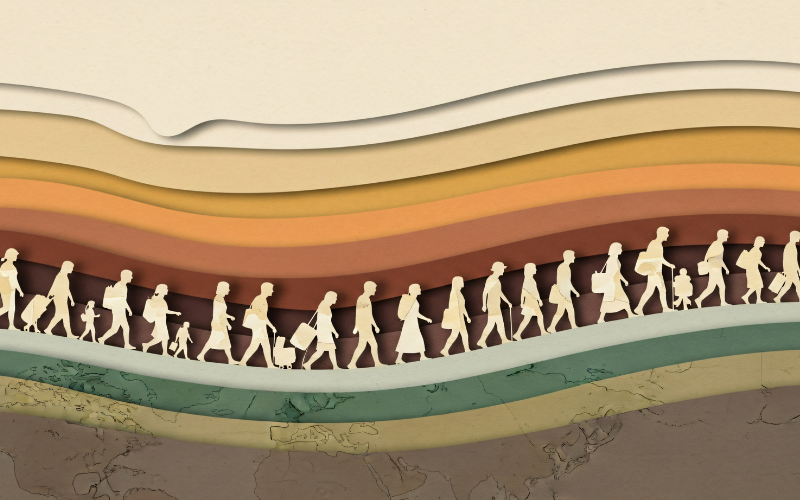
The Political Nervous System: EMDR, Migration, and Mental Health in a Time of Fear
Guest Blog Post by Liliana Baylon, LMFT-S
 In therapy rooms across the country, immigrant clients describe an invisible pressure from policies and rhetoric that keep their nervous systems on alert. Recent scholarship underscores that migration-related stressors are no longer confined to pre- or per-migration trauma: post-migration political conditions matter. For example, major immigration-policy shifts and enforcement rhetoric correlate with greater anxiety and depression among immigrant populations. In one cross-sectional U.S. study (n ≈ 796), individuals surveyed about experiences under the current USA administration reported higher levels of policy-related stress, discrimination, and worse mental-health symptoms (depression, anxiety) compared to those surveyed under the past administration; resilience functioned as a buffer (Lehman Held et al., 2025).
Separately, a 2025 brief from Physicians for Human Rights (April 2025) described how fear of deportation, family separation, and restricted access to services act as chronic stressors with downstream effects such as post traumatic stress disorder (PTSD), depression, and behavioral changes (e.g., avoiding medical care). Moreover, enforcement‐driven changes in behavior (for instance, preventing public programs due to fear of immigration consequences) were strongly correlated with worse mental-health outcomes among Latino adolescents (Garcini et al., 2021). These findings suggest that the political context is a social determinant of mental health.
As EMDR therapists working with migrants and newcomers, you are positioned to consider these broader systemic forces alongside individual trauma. Political climates that heighten fear and uncertainty through policies such as asylum bans, public charge rules, and deportation threats activate chronic survival responses in migrant nervous systems. These sustained states of hyperarousal, vigilance, or emotional numbing reflect a body shaped by ongoing threat rather than discrete trauma. Attuning to this interplay between policy context and neurobiology helps EMDR clinicians understand the body‘s story beneath the presenting symptoms.
Implications for clinical practice: Trauma, migration, and EMDR
Our clients from immigrant and newcomer backgrounds often present with complex layers of distress: pre-migration trauma (e.g., violence, persecution), traumatic journey, resettlement hardship, and now post-migration political stress and discrimination.
The growing body of evidence offers key guidance for clinicians.
In practice, political stress often re-emerges during Phase 1 (History Taking). Clients may initially minimize systemic fear or discrimination, describing them as “just how things are.” Naming these experiences as trauma-relevant broadens the target map and helps clients contextualize chronic threat responses before reprocessing begins. For instance, a client who avoids driving to work after local raids may identify this as “just anxiety.” Framing this as a trauma-linked survival response invites new compassion and integration in EMDR processing.
Across recent trials and reviews, EMDR has consistently demonstrated efficacy for forcibly displaced populations. A 2025 meta-analysis validated decreases in PTSD and associated symptoms (Antuña-Camblor & Hernandez, 2025). In contrast, a randomized experiment demonstrated that EMDR outcomes were comparable to stabilization treatment in refugees with PTSD (Van Heemstra et al., 2024). A narrative review confirmed that trauma-focused therapies, such as EMDR, yield favorable outcomes, but cultural adaptation is crucial (Velu et al., 2025).
What EMDR therapists can do when working with migrants
Drawing on the literature and clinical experience, here are practical strategies you can implement when working with migrants and newcomers in the U.S. context:
Start by asking about your client’s migration journey, resettlement conditions, and current fears, especially those linked to enforcement, discrimination, or access to care. These contextual factors are known to affect mental health outcomes.
Intersectional factors such as race, language proficiency, gender identity, socioeconomic status, and documentation shape how these political stressors are experienced. Recognizing this complexity helps you avoid overgeneralization and tailor interventions to each client’s lived context.
Expand the trauma inquiry beyond classic “event“ trauma to chronic threat: for example, a family member under threat of detention, anti-immigrant hostility, or insecure status. Acknowledging this systemic layer validates the client’s lived reality.
Use culturally responsive EMDR protocols:
- Ensure language and cultural interpretation as needed.
- Modify bilateral stimulation pacing to match client resources and safety.
- Prioritize stabilization and resource-building early if the client is in an unstable post-migration phase (housing, legal status, family separation).
- When conducting EMDR processing, pay attention to images, beliefs, and emotions tied to displacement and policy-driven fear.
Research indicates that resilience mitigates internalizing symptoms in environments characterized by policy-related stress. Enhance and solidify strengths: community connectedness, bilingualism, and family migration narratives. For instance, encourage the client to recognize migrating “insights” or cultural heritage, then integrate these into EMDR resource installation (Lehman Held et al., 2025).
Because post-migration stressors include access to care, legal insecurity, and discrimination, you can act as a bridge by collaborating with legal advocates, community organizations, and systems that support migrants. As clinicians, we cannot treat policy determinants alone, but we can recognize them and coordinate care.
Ethically, EMDR clinicians are called to recognize how systemic conditions influence trauma presentation, access to care, and treatment outcomes. This awareness extends beyond the therapy room, advocating for trauma-informed community systems and equitable access, which is part of ethical attunement. Awareness of these power dynamics aligns with EMDRIA’s value of client safety, advocacy, and social responsibility.
Migrants may face repeated challenges (e.g., new policy announcements and family separations). Be alerted to triggers that may require a revisit to stabilization or the identification of novel targets. EMDR sessions may need to alternate between past-trauma processing and present-threat coping.
As EMDR therapists, you are in prime positions to help other therapists adopt a migration and cultural humility lens. Encourage peer reflection on bias, systemic barriers, and ethical dimensions of working with migrants and newcomers.
Reflective questions for your practice
- How is the current U.S. immigration environment entering your client’s inner world?
- In what ways do your EMDR sessions attend not only to intrapsychic trauma but also to systemic fear, discrimination, and belonging?
- How can you configure EMDR phases (history, resource installation, processing, and re-evaluation) to account for lived uncertainty (e.g., legal status) in your migrant clients?
- What partnerships (legal, social, and language access) might enhance your therapeutic offering to newcomer clients?
Liliana Baylon, MBA, LMFT-S, RPT-S, EMDRIA Approved Consultant™, is a bilingual/bicultural therapist and global migration expert specializing in culturally responsive trauma care. She provides EMDR consultation, supervision, and training with a focus on the intersection of migration, attachment, and nervous system regulation.
References
Antuña-Camblor, C., & Hernández, V. T. (2025). EMDR interventions in refugees and asylum seekers: A systematic review and meta-analysis. Clinical Psychology & Psychotherapy, 32(1): e70039. https://doi.org/10.1002/cpp.70039
Garcini, L. M., Daly, R., Chen, N., Mehl, J., Pham, T., Phan, T., Hansen, B., & Kothare, A. (2021). Undocumented immigrants and mental health: A systematic review of recent methodology and findings in the United States. Journal of Migration and Health, 4, 100058. https://doi.org/10.1016/j.jmh.2021.100058
Lehman Held, M., Zuch, M. T., & Galvez, E. (2025). Policy-related stress and mental health among immigrants in the United States. Journal of International Migration & Integration, 26, 1547–1566. https://doi.org/10.1007/s12134-025-01233-5
Physicians for Human Rights. (2025, April). Consequences of fear: How the Trump administration’s immigration policies and rhetoric block access to health care. Physicians for Human Rights. https://phr.org/our-work/resources/consequences-of-fear/
Turrini, G., Purgato, M., Acarturk, C., Priebe, S., & Crabtree, A. (2025). Comparative efficacy and acceptability of psychosocial interventions for refugees and asylum-seekers: A network meta‐analysis. The Lancet Public Health, 48, 101152. https://doi.org/10.1016/j.lanepe.2024.101152
Van Heemstra, H., van der Aa, N., Mooren, T., Medema, D., Vink, G., & Knipscheer, J. (2024). Coping styles in refugees with PTSD: Results from a randomized trial comparing EMDR therapy and stabilization. PLOS ONE, 19(9), e0310093. https://doi.org/10.1371/journal.pone.0310093
Velu, M. E., Kuiper, R. M., Schok, M., Sleijpen, M., de Roos, C., & Mooren, T. (2025). Effectiveness of trauma-focused treatments for refugee children: A systematic review and meta-analyses. European Journal of Psychotraumatology, 16(1),2494362. Open access: https://doi.org/10.1080/20008066.2025.2494362
Back to Focal Point Blog Homepage
Additional Resources
If you are a therapist interested in the EMDR training:
- Learn more about EMDR therapy at the EMDRIA Library
- Learn more about EMDR Training
- Search for an EMDR Training Provider
- Check out our EMDR Training FAQ
If you are EMDR trained:
- Check out the EMDRIA Let’s Talk EMDR Podcast
- Check out the EMDRIA Focal Point Blog
- Learn more about EMDRIA membership
- Search for EMDR Continuing Education opportunities
If you are an EMDRIA™ Member:
- Learn more about EMDR Consultation
- Find clinical practice articles in the EMDRIA Go With That Magazine®
- Search for articles in Journal of EMDR Practice and Research in the EMDRIA Library
Related Articles