
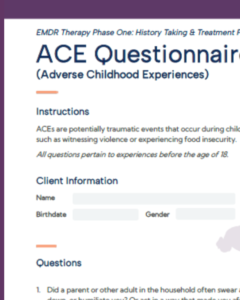
ACE Questionnaire (Adverse Childhood Experiences) (Phase 1 Toolkit)
ACEs are potentially traumatic events that occur during childhood (0-17 years), such as witnessing violence or experiencing food insecurity.
Read More
Impact of Event Scale – Revised (IES-R) for DSM-IV (U.S. Department of Veterans Affairs)
Impact of Event Scale – Revised (IES-R), a self-report measure used to assess distress caused by traumatic events.
Read More
International Trauma Questionnaire (ITQ) (International Trauma Consortium)
A self-report tool for assessing ICD-11 PTSD and Complex PTSD, along with translations and scoring guidelines.
Read More
Multidimensional Inventory of Dissociation – 60-item version (MID-60) (NovoPsych)
Clinically supported, 60-item version of the Multidimensional Inventory of Dissociation for use in assessing dissociative symptoms in adults.
Read More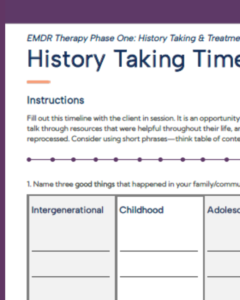
History Taking Timeline (Phase 1 Toolkit)
A visual timeline for organizing client history.
Read More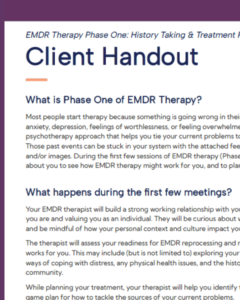
Client Handout (Phase 1 Toolkit)
An introductory handout on Phase One of EMDR therapy to share with your clients.
Read More
Issue-Driven Treatment Planning Video (Phase 1 Toolkit)
This video offers guidance and an example of issue-driven treatment planning during Phase One of EMDR therapy.
Read More
Getting Started with Phase One Video (Phase 1 Toolkit)
This quick video introduction offers guidance for orienting yourself to Phase One of EMDR therapy and structuring early client sessions.
Read More
Increasing access for Deaf clients to EMDR through an adapted EMDR-ASL protocol (National University, 2025)
A program is presented that adapts EMDR standard protocol in ASL to increase understanding and access to trauma-informed care for Deaf clients.
Read More
Lost in translation: A phenomenological exploration of a humanistic psychotherapist’s experience of integrating EMDR therapy into their practice (Inside Out: The Irish Journal for Humanistic and Integrative Psychotherapy)
This qualitative research study using Interpretative Phenomenological Analysis (IPA) was conducted to address a gap in the research on the experiences of humanistic therapists who use and integrate EMDR into their practice.
Read More
Applying eye movement desensitization and reprocessing in counseling with survivors of intimate partner violence (Journal of Mental Health Counseling)
The article aims to articulate how EMDR can be effective for intimate partner violence (IPV) survivors, providing a synthesis of the literature and a case study with a female in an outpatient setting.
Read More
Healing the Unseen: EMDR Therapy for Invisible Grief
In this powerful episode, we delve into how Eye Movement Desensitization and Reprocessing (EMDR) therapy can aid in processing invisible grief—the quiet, unspoken losses…
Read More