

Child Dissociative Checklist (CDC) (Springer, 2014)
The child dissociative checklist (CDC) is a tool that compiles observations by an adult observer regarding a child’s behaviors.
Read More
The EMDR Revolution: Change Your Life One Memory At A Time (The Client’s Guide) (Morgan James, 2014)
In The EMDR Revolution you will discover information you need when feeling distressed or inhibited, as a way to select the appropriate help.
Read More
Implementing EMDR early mental health interventions for man-made and natural disasters: Models, scripted protocols and summary sheets (Springer, 2014)
The authors combine lessons learned, personal accounts, and best practices of how to integrate mental health care into disaster response.
Read More
Attachment-focused EMDR: Healing relational trauma (W. W. Norton, 2013)
Integrating the latest in attachment theory and research into the use of EMDR.
Read More
Treating traumatic stress injuries in military personnel: An EMDR practitioner’s guide (Routledge, 2013)
A practical guide for treating the spectrum of traumatic stress injuries with EMDR.
Read More
Redefining trauma and its hidden connections: Identifying and reprocessing the experiential contributors to a wide variety of disorders (Norton, 2013)
Francine Shapiro offers a psychotherapy model to heal trauma, through Adaptive Information Processing, EMDR therapy & therapeutic presence.
Read More
Eye movement desensitization and reprocessing (Guilford, 2013)
Wesselmann/Shapiro describe how eye movement desensitization and reprocessing (EMDR) therapy can help complex trauma in children & adolescents.
Read More
EMDR therapy and adjunct approaches with children: Complex trauma, attachment, and dissociation (Springer, 2012)
First book to provide a wide range of step-by-step strategies for clinicians using EMDR therapy and adjunct approaches with children.
Read More
EMDR and dissociation: the progressive approach (Amazon Imprint, 2012)
This book describes how to apply EMDR in severe cases: dissociative disorders, personality disorders and complex traumatization.
Read More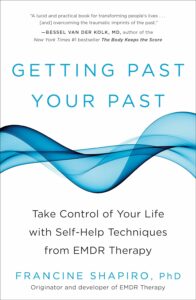
Getting past your past: Take control of your life with self-help techniques from EMDR therapy (Rodale, 2012)
Overcome trauma with self-help techniques that empower readers to take control of their life, based on EMDR therapy.
Read More
Eye movement desensitization and reprocessing (EMDR) psychotherapy with children who have experienced sexual abuse and trauma (Wiley, 2011)
EMDR psychotherapy can be used with children who experienced sexual trauma. Learn more in this comprehensive guide to treatment of child sexual abuse.
Read More
Eye movement desensitisation and reprocessing (EMDR): Mental health-substance use (Radcliffe, 2011)
This chapter explores using EMDR for mental health-substance use in an edited volume on the theory/application of a variety of techniques.
Read More