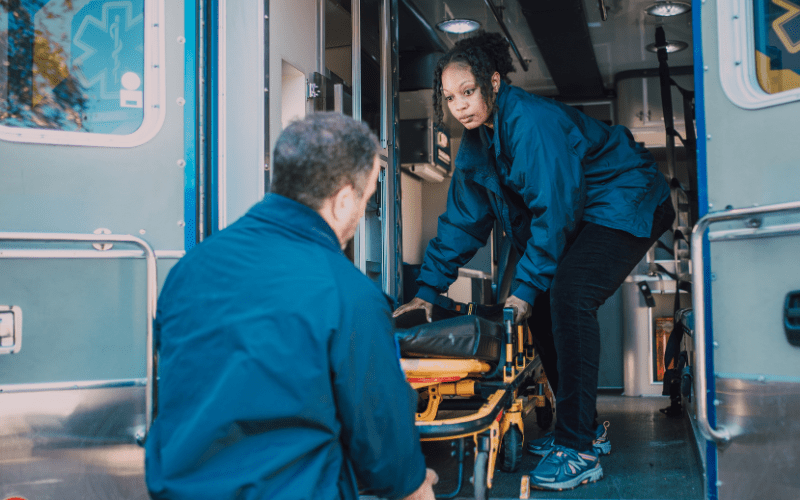
First Responders Day(opens in new tab) is an opportunity not only to thank first responders for what they do, but also better understand what their work asks of them. The skills that help them manage crisis, danger, loss, and unpredictability are often essential for the job. Yet those same adaptations can create challenges when they enter the therapy room. In this blog post, EMDRIA member Christina Allen helps us see the task is not to dismantle those adaptations, but to understand them well enough to help first responders find greater flexibility, healing, and choice.
The Balancing Act: Honoring Defensive Adaptations That Interfere with Trauma Recovery Among First Responders
Guest Blog Post by Christina Allen, LCPC(opens in new tab)
 They call. They come for the initial session, maybe two.
And then they drop off your caseload – sometimes without notice.
I often hear from colleagues, “First responders are a challenging population to work with.”
Before we make that assumption, I think we need to get curious about why EMDR therapists arrive at that conclusion in the first place.
What makes it challenging for the first responder community to engage in therapy? What makes it difficult for some first responders to lean into the work? And what might EMDR therapists be missing about how to engage them in a way that feels meaningful enough to stay?
Maybe it is not whether first responders are challenging as clients. Maybe EMDR therapists need to flex the way we work with first responders.
First responders routinely function in environments that most people are not designed to navigate. They witness injury, violence, death, human suffering, and unpredictable threat—and then are expected to return to family and their personal life, while having to do it all again on the next shift. To do that, many develop sophisticated strategies that allow them to function effectively under extraordinary conditions.
And those adaptations can be incredibly helpful—until they aren’t.
What works on the job does not always work at home. What protects someone during a critical incident may make it harder to connect with others when the call is over. What allows someone to keep moving through one traumatic experience after another may create a very different set of challenges when they finally sit face-to-face with themselves in our office.
If you are a therapist who works with first responders, you have probably seen this tension firsthand—particularly when the work involves EMDR therapy. A client may show up motivated for services but struggling to access emotion. They may intellectualize, minimize, disconnect from their body, go blank, or simply say, “I don’t know.” Sometimes, they just…stop coming.
In my experience, some of these challenges have less to do with a lack of desire to heal and more to do with the sophisticated adaptations these individuals have developed—and reinforced—through years of occupational exposure to high-stress situations.
But what do we do when the very adaptations that helped someone thrive on the job begin to interfere with their ability to heal from occupational trauma?
As an EMDR therapist who specializes in working with the first responder community, I have witnessed how occupationally-reinforced adaptations can function as both powerful survival strategies and barriers to healing. These adaptations often extend far beyond the job itself, shaping identity, relationships, emotional expression, and nervous system functioning long after a traumatic call is over. In the therapy room, they can easily be experienced or interpreted as “resistant” or “avoidant” when, in fact, the adaptations may be evidence of a system that has become highly skilled at doing what it intended to do: protect the person enough to move from one call to the next.
Overdeveloped defensive adaptations
I think we can all agree that adaptations to trauma can be highly effective in one context and become less effective in another.
Compartmentalization may allow a paramedic to treat a critically injured patient without becoming overwhelmed. Emotional suppression may allow a police officer to remain composed while managing a volatile scene. Narrowing attention to the task at hand may help a firefighter move toward danger while others are moving away from it.
These responses make sense. In many ways, they are necessary skills in high-stakes situations. The challenge comes when the nervous system continues operating according to the demands of the occupational environment long after the person is off the clock.
Over time, these adaptations can become overused, rigid, or automatic. What once allowed someone to function under high stress may make it difficult to recognize what they feel, tolerate affect, access vulnerable material, or allow others close enough to provide support. EMDR therapists may be tempted to see these responses primarily as barriers to the therapeutic work. However, I believe we need to become curious about what the adaptation is still trying to accomplish—both in and out of the therapy office.
How do we honor what protects the client while helping create enough flexibility for healing to occur?
EMDR therapists know that adaptations are an important part of Adaptive Information Processing (AIP) case conceptualization: understanding how survival strategies developed, what function they serve, and where they may no longer fit the context in which the client is living. With first responders, however, it is beneficial to hold that conceptualization with particular nuance because many of these strategies may still have ongoing utility in the occupational setting.
With that in mind, it may be helpful to consider the following:
- A first responder client who struggles to access emotion may be in default mode, not resisting the work.
- First responders who intellectualize may be relying on a well-practiced way of staying regulated, not avoiding feeling.
- When a first responder says, “I don’t know what I feel,” there may be more happening beneath the surface than an inability to connect with their experience. Their nervous system may simply have become highly skilled at keeping certain experiences at a distance—and that skill may still serve an important function when they return to their shift.
We need to be cautious not to pathologize the adaptation. We want to understand its function, then look for where it has become overused, rigid, or automatic—and work toward flexibility rather than eradication.
Occupational adaptations in default mode
During an EMDR group intensive I conducted with first responders, I observed well-established adaptations including hypervigilance, emotional suppression, compartmentalization, and a strong orientation toward control across participants struggling with PTSD symptoms. While these responses could be viewed as challenges, I began to think about them differently—not as barriers to the work, but as capacities shaped by years of navigating high-stress situations.
One participant described feeling most comfortable in “survival mode,” recognizing that he did not quite feel like himself outside of it. Another carried a deeply ingrained sense of responsibility for others that shaped how he moved through nearly every situation, including the intensive experience. Unsurprisingly, neither participant was willing to change those characteristics.
What could easily be labeled as rigidity, over-functioning, or emotional avoidance may also represent qualities that have helped these individuals function effectively in their occupational roles—qualities woven into the culture, identity, and significance of what it means to be a first responder. EMDR therapists can recognize the function of these adaptations by seeing them not simply as obstacles to the work, but as part of the story of how these individuals learned to survive, serve, and keep going. Understanding how those adaptations showed up in the therapeutic space allowed me to honor what they had protected while creating room for something new to emerge. It set the foundation for deeper therapeutic work—not by asking them to leave those characteristics at the door, but by helping them discover that they could carry those strengths with greater flexibility.
Importantly, the adaptations did not disappear. Nor should we expect them to. What began to change was the space around them.
One participant experienced significant distress in his body while processing traumatic material. Rather than shutting down or disengaging, after a momentary pause, he was able to return to the task and continue participating. That represented a meaningful shift in his ability to hold both engagement in the work and uncomfortable emotions.
Another participant, who had historically struggled to engage in weekly therapy, continued to notice a strong pull to disengage during the EMDR group intensive. The difference was that he became increasingly able to recognize what was happening, name the experience, and remain engaged rather than automatically shutting down when difficult material surfaced. The goal was to increase awareness of the automatic response and build the capacity to choose something different.
When working with first responders, EMDR therapists might consider that the intention is not to take away the ability to compartmentalize when the job still requires it. The focus is not to eliminate vigilance from someone who may still need to walk into unpredictable and dangerous situations, nor is it to ask a client to become emotionally open and vulnerable at all times. In my experience, the therapeutic work is about helping clients recognize when an adaptation is serving them—and when it may be safe enough to set it down. The goal is not to take the adaptation away, but to create enough flexibility for the client to choose when it is needed and when it is not.
The work of EMDR therapists requires a delicate balance: honoring the protective functions of these adaptations while creating space for something different to emerge. Part of that process involves creating enough relational safety for these clients to feel understood within the context of their occupational identity and culture. When that happens, the nervous system may begin to discover that there can be more than one way to respond, especially with regard to the material their system has worked very hard to contain.
We don’t want to dismantle the adaptation, but work towards creating enough flexibility that a first responder client has a choice about when they need it—and when they don’t—and to strengthen the capacity to move between the two.
That, to me, is the balancing act.
Christina Allen, LCPC, is an EMDRIA Certified Therapist™, Approved Consultant™ and host of The EMDR Consultation Corner podcast. With 15+ years of experience, she specializes in complex trauma, PTSD, and first responder mental health, integrating EMDR and somatic approaches. She founded TRN-MD to expand timely, specialized trauma care across Maryland.
References
Bryant, R. A. (2021). Psychological models of PTSD. In M. J. Friedman, P. P. Schnurr, & T. M. Keane (Eds.), Handbook of PTSD: Science and practice (3rd ed., pp. 96-110). Guilford Press.
Ceschi, G., Meylan, S., Rowe, C., & Boudoukha, A. H. (2022). Psychological profile, emotion regulation, and aggression in police applicants: A Swiss cross-sectional study. Journal of Police and Criminal Psychology, 37(1), 962-971. https://doi.org/10.1007/s11896-022-09548-0(opens in new tab)
Horan, K. A., Marks, M., Ruiz, J., Bowers, C., & Cunningham, A. (2021). Here for my peer: The future of first responder mental health. International Journal of Environmental Research and Public Health, 18, 11097. https://doi.org/10.3390/ijerph182111097(opens in new tab)
Mahat-Shamir, M., Zaks Zitronblat, L., Dar, R., & Leichtentritt, R. D. (2025). Parts that hold one together: Compartmentalization as resilience in body handling. Death Studies, 1–11. https://doi.org/10.1080/07481187.2025.2559733(opens in new tab)
Shapiro, E. (2024). EMDR group traumatic episode protocol. In R. M. Robinson, S. K. (Eds.), EMDR group therapy: Emerging principles and protocols to treat trauma and beyond (1st ed., pp.65-80). Springer Publishing Company. http://doi.org/10.1891/9780826152954
Torricelli, L., Gasparini, I., Díaz Crescitelli, M. E., Filiberti, S., Remondini, L., Ghirotto, L., Rabitti, E., Rubini, G., Zini, E., & Di Leo, S. (2025). Frontliners narratives: qualitative insights into EMDR group therapy during COVID-19. European Journal of Psychotraumatology, 16: 2571253. https://doi.org/10.1080/20008066.2025.2571253
Back to Focal Point Blog Homepage(opens in new tab)
Additional Resources
If you are a therapist interested in the EMDR training:
- Learn more about EMDR therapy at the EMDRIA Library(opens in new tab)
- Learn more about EMDR Training(opens in new tab)
- Search for an EMDR Training Provider(opens in new tab)
- Check out our EMDR Training FAQ(opens in new tab)
If you are EMDR trained:
- Check out the EMDRIA Let’s Talk EMDR Podcast(opens in new tab)
- Check out the EMDRIA Focal Point Blog(opens in new tab)
- Learn more about EMDRIA membership(opens in new tab)
- Search for EMDR Continuing Education opportunities(opens in new tab)
If you are an EMDRIA™ Member:
- Learn more about EMDR Consultation(opens in new tab)
- Find clinical practice articles in the EMDRIA Go With That Magazine®(opens in new tab)
- Search for articles in Journal of EMDR Practice and Research in the EMDRIA Library(opens in new tab)
Related Articles