
About JEMDR®
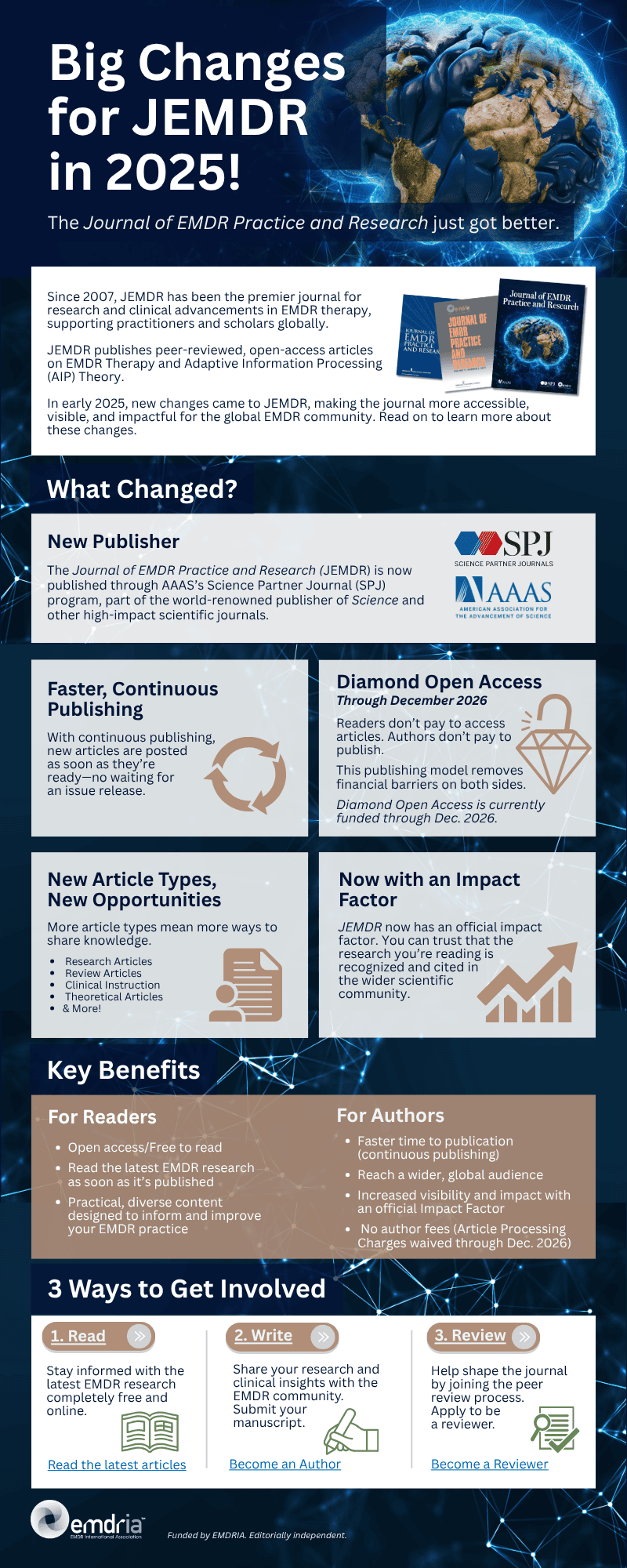
The Journal of EMDR Practice and Research® (JEMDR) is a peer-reviewed publication devoted to integrative, state-of-the-art papers about EMDR therapy. It is a broadly conceived interdisciplinary journal that stimulates and communicates research and theory about EMDR therapy and its application to clinical practice. The journal publishes experimental studies; theoretical, review, and methodological articles; case studies; brief reports; and book reviews.
Established in July 2007 by EMDRIA™, the journal is published by The American Association for the Advancement of Science (AAAS). Beginning January 1, 2025, JEMDR® will be published by the Science Partner Journals (SPJ) program of AAAS, the world’s oldest and largest general science organization, serving 10 million people around the globe. AAAS publishes the renowned journal Science, among others.
- ISSN (print): 1933-3196
- ISSN (online): 1933-320X
JEMDR® is co-edited by Jenny Rydberg, a former special editor with JEMDR®, book editor, and associate editor of the European Journal of Trauma and Dissociation, and Derek Farrell, Ph.D., MBE, a principal lecturer in psychology at the University of Worcester, UK, where he directs a master’s program in EMDR therapy.
Read the Latest Articles
Stay informed with the latest research completely free and online.
Learn More
Help shape the journal by submitting your manuscript or joining the peer review process.
Recent Articles
A mixed-methods service evaluation for group traumatic episode protocol (G-TEP) for clients with heterogeneous trauma histories in an NHS outpatient psychological therapist service (Journal of EMDR Practice and Research)
This service evaluation investigated the feasibility of group EMDR-based intervention G-TEP for clients with varied trauma histories (not from a shared traumatic event), reporting good clinical outcomes.
The use of a pressure vest to reduce anxiety and dissociation during eye movement desensitization and reprocessing – a single-case experimental design study (Journal of EMDR Practice and Research)
This study investigated the hypothesis that the use of a pressure vest would decrease anxiety and dissociation during EMDR.
See other resource types in the EMDRIA™ Library.
JEMDR® Issues
2025
Published on a continuous/rolling basis.
2026 Articles
2025
Published on a continuous/rolling basis.
2025 Articles