Skip to content
EMDR International Association
  • About EMDR Therapy
    • What is EMDR Therapy?

      AIP Model

      AIP Model

      Experiencing EMDR Therapy

      Experiencing EMDR Therapy

      EMDR in Treatment Guidelines

      EMDR in Treatment Guidelines

      Recent Research

      Recent Research

      Using EMDR with ...

      Addiction

      Addiction

      Anxiety

      Anxiety

      Childhood Trauma

      Childhood Trauma

      Depression

      Depression

      PTSD

      PTSD

      Find an EMDR Therapist®
  • About EMDR Therapy
    • What is EMDR therapy?
      • Adaptive Information Processing (AIP) Model
      • EMDR Therapy & Addiction
      • EMDR Therapy & Anxiety
      • EMDR Therapy & Childhood Trauma
      • EMDR Therapy & Depression
      • EMDR Therapy & PTSD
    • Experiencing EMDR Therapy
    • EMDR Therapy in Treatment Guidelines
    • Recent Research on EMDR Therapy
    • Find an EMDR Therapist®
  • Training & Events
    • EMDR Basic Training

      Eligibility Requirements

      Eligibility Requirements

      5 Steps to EMDR Training

      5 Steps to EMDR Training

      EMDR Basic Training FAQs

      EMDR Basic Training FAQs

      Training vs Certification

      Training vs Certification

      Find EMDR Basic Training

      Find EMDR Basic Training

      EMDR Education Calendar

      Consultant / Trainer Events

      EMDRIA OnDemand Education

      EMDRIA Conference
      EMDRIA Virtual Summit
  • Training & Events
    • EMDR Education Calendar
    • EMDR Basic Training
      • 5 Steps to Take an EMDRIAâ„¢ Approved EMDR Basic Training
      • Eligibility Requirements for EMDR Basic Training
      • EMDR Basic Training FAQs
      • Training vs Certification
      • Find an EMDR Basic Training
    • Continuing Education
      • OnDemand Education
    • EMDRIA Conference
    • EMDRIA Summit
      • Summit Speaker Resources
    • EMDRIAâ„¢ Digital Badges
    • EMDRIA Certified Therapistâ„¢ Application
      • How to Market Yourself as an EMDRIA Certified Therapistâ„¢
      • EMDRIA Certified Therapistâ„¢ FAQs
      • Membership vs Certification
      • EMDRIA Certified Therapistâ„¢ Renewal
    • EMDRIA Approved Consultantâ„¢ Application
      • Updating EMDRIA Approved Consultantâ„¢ Standards
      • CIT Declaration Form
      • EMDRIA Approved Consultant in Trainingâ„¢ FAQs
      • Consultation Packet
      • EMDRIA Approved Consultantâ„¢ Renewal
      • Consultant Day Events
    • EMDRIA Credit Provider & Program Applications
    • EMDRIA Approved Trainerâ„¢ Application
    • EMDR Basic Training Policies & Requirements
    • Standards for EMDR Basic Training
    • Trainer Day Events
  • Credentialing
    • EMDRIA Certified Therapistâ„¢

      Membership vs Certification

      Membership vs Certification

      Certification FAQs

      Certification FAQs

      Certified Therapist Renewal

      Certified Therapist Renewal

      EMDRIA Approved Consultantâ„¢

      Updating Consultant Standards

      Updating Consultant Standards

      CIT Declaration Form

      CIT Declaration Form

      Consultant-in-Training FAQs

      Consultant-in-Training FAQs

      Approved Consultant Renewal

      Approved Consultant Renewal

      EMDRIA Approved Trainerâ„¢

      EMDR Basic Training Standards

      EMDR Basic Training Standards

      Training Policies & Requirements

      Training Policies & Requirements

      EMDRIA Credit Providers

      Program Application & Guidelines

      Program Application & Guidelines

      EMDRIA Credit FAQs

      EMDRIA Credit FAQs

      EMDRIA Digital Badges

      Consultant / Trainer Events

      EMDRIA Certified
      Therapistâ„¢ Application
      EMDRIA Approved
      Consultantâ„¢ Application
      EMDRIA Approved
      Trainerâ„¢ Application
  • Publications & Resources
    • Journal of EMDR Practice & Research®

      Go With That Magazine®

      Focal Point Blog

      Let's Talk EMDR Podcast

      EMDRIA Library

      Glossary of EMDR Terms

      Glossary of EMDR Terms

      Online EMDR Therapy Resources

      Online EMDR Therapy Resources

      Antiracism Resources

      Antiracism Resources

      Toolkits & Practice Resources

      Toolkits & Practice Resources

      Español: Recursos en Español

      Español: Recursos en Español

      Seach EMDRIA Library
      Subscribe to Blog
  • Publications & Resources
    • EMDRIA Library
    • Glossary of EMDR Terms
    • Antiracism Resources
    • Online EMDR Therapy Resources
    • Focal Point Blog
      • Subscribe to Focal Point Blog
    • Go With That Magazine®
    • Journal of EMDR Practice & Research®
    • Let’s Talk EMDR Podcast
    • Toolkits & Practice Resources
      • 8 Phases Toolkit
      • Building Your EMDR Practice Toolkit
      • Client Brochures
      • Addictions Toolkit
      • Depression Toolkit
      • EMDRIA Children’s Toolkit
      • Chronic Pain Toolkit
      • Military Toolkit
      • EMDR Consultation Toolkit
    • Kits y Recursos Prácticos
      • Folletos de Terapia EMDR
      • Kit de las 8 Fases
      • Kit de la Depresión
      • Kit del Dolor Crónico
      • Kit de los Niños y Niñas
  • Membership
    • Join EMDRIA

      Benefits of Membership

      Benefits of Membership

      Membership vs Certification

      Membership vs Certification

      Agency Group Membership

      Agency Group Membership

      International Affiliates

      International Affiliates

      Members Only

      Account Overview

      Account Overview

      Directory Profile Information

      Directory Profile Information

      Renew Membership

      Renew Membership

      Retired Membership

      Retired Membership

      Member Hub
      EMDRIA Online Community
  • Membership
    • Join EMDRIAâ„¢
      • Retired Membership
      • Agency Group Membership
      • International Affiliate Organizations
    • Member Hub
    • Renew EMDRIAâ„¢ Membership
    • Membership Benefits
    • EMDRIAâ„¢ Member Account Overview
    • Directory Profile Information
    • Membership vs Certification
  • About EMDRIAâ„¢
    • About Us

      EMDRIA 30th Anniversary

      EMDRIA 30th Anniversary

      Policies & Code of Conduct

      Policies & Code of Conduct

      EMDRIA Awards & Winners

      EMDRIA Awards & Winners

      EMDRIA FAQs

      EMDRIA FAQs

      Meet the Board of Directors

      Board News and Updates

      Board News and Updates

      Call for BoD Nominations

      Call for BoD Nominations

      Contact Media Relations

      Contact EMDRIA

      EMDRIA Foundation
  • About EMDRIAâ„¢
    • EMDRIA’s 30th Anniversary
    • EMDRIAâ„¢ FAQs
    • Contact EMDRIAâ„¢
    • Contact Media Relations
    • Meet the Board of Directors
      • Call for Board of Directors Nominations
    • Board News and Updates
      • Annual Membership Meeting
    • EMDR International Associationâ„¢ Policies
    • EMDRIAâ„¢ Awards & Winners
    • EMDRIA Foundation
FacebookTwitterLinkedinInstagramWordpress
  • Join EMDRIAâ„¢
  • Contact
  • Find an EMDR Therapist®
EMDR International Association
Log In
  • About EMDR Therapy
    • What is EMDR Therapy?

      AIP Model

      AIP Model

      Experiencing EMDR Therapy

      Experiencing EMDR Therapy

      EMDR in Treatment Guidelines

      EMDR in Treatment Guidelines

      Recent Research

      Recent Research

      Using EMDR with ...

      Addiction

      Addiction

      Anxiety

      Anxiety

      Childhood Trauma

      Childhood Trauma

      Depression

      Depression

      PTSD

      PTSD

      Find an EMDR Therapist®
  • About EMDR Therapy
    • What is EMDR therapy?
      • Adaptive Information Processing (AIP) Model
      • EMDR Therapy & Addiction
      • EMDR Therapy & Anxiety
      • EMDR Therapy & Childhood Trauma
      • EMDR Therapy & Depression
      • EMDR Therapy & PTSD
    • Experiencing EMDR Therapy
    • EMDR Therapy in Treatment Guidelines
    • Recent Research on EMDR Therapy
    • Find an EMDR Therapist®
  • Training & Events
    • EMDR Basic Training

      Eligibility Requirements

      Eligibility Requirements

      5 Steps to EMDR Training

      5 Steps to EMDR Training

      EMDR Basic Training FAQs

      EMDR Basic Training FAQs

      Training vs Certification

      Training vs Certification

      Find EMDR Basic Training

      Find EMDR Basic Training

      EMDR Education Calendar

      Consultant / Trainer Events

      EMDRIA OnDemand Education

      EMDRIA Conference
      EMDRIA Virtual Summit
  • Training & Events
    • EMDR Education Calendar
    • EMDR Basic Training
      • 5 Steps to Take an EMDRIAâ„¢ Approved EMDR Basic Training
      • Eligibility Requirements for EMDR Basic Training
      • EMDR Basic Training FAQs
      • Training vs Certification
      • Find an EMDR Basic Training
    • Continuing Education
      • OnDemand Education
    • EMDRIA Conference
    • EMDRIA Summit
      • Summit Speaker Resources
    • EMDRIAâ„¢ Digital Badges
    • EMDRIA Certified Therapistâ„¢ Application
      • How to Market Yourself as an EMDRIA Certified Therapistâ„¢
      • EMDRIA Certified Therapistâ„¢ FAQs
      • Membership vs Certification
      • EMDRIA Certified Therapistâ„¢ Renewal
    • EMDRIA Approved Consultantâ„¢ Application
      • Updating EMDRIA Approved Consultantâ„¢ Standards
      • CIT Declaration Form
      • EMDRIA Approved Consultant in Trainingâ„¢ FAQs
      • Consultation Packet
      • EMDRIA Approved Consultantâ„¢ Renewal
      • Consultant Day Events
    • EMDRIA Credit Provider & Program Applications
    • EMDRIA Approved Trainerâ„¢ Application
    • EMDR Basic Training Policies & Requirements
    • Standards for EMDR Basic Training
    • Trainer Day Events
  • Credentialing
    • EMDRIA Certified Therapistâ„¢

      Membership vs Certification

      Membership vs Certification

      Certification FAQs

      Certification FAQs

      Certified Therapist Renewal

      Certified Therapist Renewal

      EMDRIA Approved Consultantâ„¢

      Updating Consultant Standards

      Updating Consultant Standards

      CIT Declaration Form

      CIT Declaration Form

      Consultant-in-Training FAQs

      Consultant-in-Training FAQs

      Approved Consultant Renewal

      Approved Consultant Renewal

      EMDRIA Approved Trainerâ„¢

      EMDR Basic Training Standards

      EMDR Basic Training Standards

      Training Policies & Requirements

      Training Policies & Requirements

      EMDRIA Credit Providers

      Program Application & Guidelines

      Program Application & Guidelines

      EMDRIA Credit FAQs

      EMDRIA Credit FAQs

      EMDRIA Digital Badges

      Consultant / Trainer Events

      EMDRIA Certified
      Therapistâ„¢ Application
      EMDRIA Approved
      Consultantâ„¢ Application
      EMDRIA Approved
      Trainerâ„¢ Application
  • Publications & Resources
    • Journal of EMDR Practice & Research®

      Go With That Magazine®

      Focal Point Blog

      Let's Talk EMDR Podcast

      EMDRIA Library

      Glossary of EMDR Terms

      Glossary of EMDR Terms

      Online EMDR Therapy Resources

      Online EMDR Therapy Resources

      Antiracism Resources

      Antiracism Resources

      Toolkits & Practice Resources

      Toolkits & Practice Resources

      Español: Recursos en Español

      Español: Recursos en Español

      Seach EMDRIA Library
      Subscribe to Blog
  • Publications & Resources
    • EMDRIA Library
    • Glossary of EMDR Terms
    • Antiracism Resources
    • Online EMDR Therapy Resources
    • Focal Point Blog
      • Subscribe to Focal Point Blog
    • Go With That Magazine®
    • Journal of EMDR Practice & Research®
    • Let’s Talk EMDR Podcast
    • Toolkits & Practice Resources
      • 8 Phases Toolkit
      • Building Your EMDR Practice Toolkit
      • Client Brochures
      • Addictions Toolkit
      • Depression Toolkit
      • EMDRIA Children’s Toolkit
      • Chronic Pain Toolkit
      • Military Toolkit
      • EMDR Consultation Toolkit
    • Kits y Recursos Prácticos
      • Folletos de Terapia EMDR
      • Kit de las 8 Fases
      • Kit de la Depresión
      • Kit del Dolor Crónico
      • Kit de los Niños y Niñas
  • Membership
    • Join EMDRIA

      Benefits of Membership

      Benefits of Membership

      Membership vs Certification

      Membership vs Certification

      Agency Group Membership

      Agency Group Membership

      International Affiliates

      International Affiliates

      Members Only

      Account Overview

      Account Overview

      Directory Profile Information

      Directory Profile Information

      Renew Membership

      Renew Membership

      Retired Membership

      Retired Membership

      Member Hub
      EMDRIA Online Community
  • Membership
    • Join EMDRIAâ„¢
      • Retired Membership
      • Agency Group Membership
      • International Affiliate Organizations
    • Member Hub
    • Renew EMDRIAâ„¢ Membership
    • Membership Benefits
    • EMDRIAâ„¢ Member Account Overview
    • Directory Profile Information
    • Membership vs Certification
  • About EMDRIAâ„¢
    • About Us

      EMDRIA 30th Anniversary

      EMDRIA 30th Anniversary

      Policies & Code of Conduct

      Policies & Code of Conduct

      EMDRIA Awards & Winners

      EMDRIA Awards & Winners

      EMDRIA FAQs

      EMDRIA FAQs

      Meet the Board of Directors

      Board News and Updates

      Board News and Updates

      Call for BoD Nominations

      Call for BoD Nominations

      Contact Media Relations

      Contact EMDRIA

      EMDRIA Foundation
  • About EMDRIAâ„¢
    • EMDRIA’s 30th Anniversary
    • EMDRIAâ„¢ FAQs
    • Contact EMDRIAâ„¢
    • Contact Media Relations
    • Meet the Board of Directors
      • Call for Board of Directors Nominations
    • Board News and Updates
      • Annual Membership Meeting
    • EMDR International Associationâ„¢ Policies
    • EMDRIAâ„¢ Awards & Winners
    • EMDRIA Foundation

Efficacy and mechanisms of action of EMDR as a treatment for PTSD (Murdoch University)

Thesis-FeaturedImage

Home / Resources / PTSD / Efficacy and mechanisms of action of EMDR as a treatment for PTSD (Murdoch University)

Efficacy and mechanisms of action of EMDR as a treatment for PTSD

Successful treatment approaches were reviewed which indicated two major contenders for the most efficacious treatment for PTSD: CBT and EMDR, followed by a discussion of the underlying processes of EMDR.


Article Abstract

“The first aim of this thesis was to describe the characteristics of Posttraumatic Stress Disorder (PTSD) and to elucidate its place as a symptom disorder that sometimes develops when people are exposed to a traumatic event. The current major theoretical approaches to account for why some people who are exposed to trauma develop PTSD and the mechanisms by which this occurs were described. Three classes of theories were reviewed: conditioning/learning approach; information processing theories with a particular focus on the meaning of the trauma event; and biological models with an emphasis on recent neurocircuitry and neurochemistry models.

Successful treatment approaches were then reviewed which indicated two major contenders for the most efficacious treatment for PTSD: traditional cognitive behaviour therapies (CBT) using either stress inoculation or prolonged exposure; and eye movement desensitisation and processing (EMDR). Prior to the first study (Lee, Gavriel, Drummond, Richards, and Greenwald, 2002), a review of the literature indicated equivalent effects for EMDR and CBT. There had been very few direct comparison studies and each had serious methodological flaws, particularly with respect to random assignment and treatment fidelity. Therefore, the first study ensured adequate attention to these areas and involved a direct comparison between the two procedures using a sample of 24 participants diagnosed with PTSD. EMDR and stress inoculation training with prolonged exposure were found to lead to similar symptom improvement at the end of treatment, apart from a slight advantage for EMDR on intrusion symptoms. Both treatments led to significantly greater symptom reduction than a wait list control condition. At follow-up, EMDR led to greater gains on both self-report and observer rated measures of PTSD and self-report measures of depression. Overall, the findings were similar to those described in previously published studies, with a suggestion that EMDR was slightly more efficient than the standard CBT approach.

Given that the evidence suggested that EMDR was a more efficient treatment, it became critical to understand the underlying processes. A process study was undertaken that examined the responses of people with PTSD receiving EMDR treatment (Lee, Taylor, and Drummond, 2006). Guided by process studies of other treatments and theories that might account for why EMDR is effective, participants’ responses were examined to see which models better accounted for symptom improvement. The main analysis tested whether or not the responses were consistent with processes that occurred during traditional CBT treatment, which prior research had identified as reliving, or whether they were more consistent with Shapiro’s proposal that enhanced information processing occurs because there is a dual focus of attention (that is, the person simultaneously focuses on an external stimulus and on the traumatic memory) (Shapiro, 1995). The responses made by 44 participants were coded by an independent rater according to whether they were primarily reliving, distancing, affect or material other than the primary trauma. The coding system was found to have satisfactory inter-rater reliability. Greatest improvement occurred when the participant processed in a more detached or distant manner, whereas reliving responses were not associated with improvement. Cross-lagged panel correlations suggested that processing in a more detached manner was a consequence of the EMDR procedure rather than a measure that co-varied with improvement. The findings underscored a difference in the processes that underlie EMDR and traditional CBT.

The major question left unanswered from this second study was what causes this distancing process? Competing views were that it was facilitated by eye movement; alternatively, the therapist’s instructions to participants might have precipitated this distancing phenomenon. The third study tested these ideas by randomly assigning 48 participants to either an eye movement or a no eye movement condition under two types of therapist instructions (reliving or distancing). Participants recalled personal distressing memories, and measures of distress and vividness were taken after treatment and at follow up. Only the eye movements made a significant difference to people’s level of distress.

This conclusion appeared at odds with some of the previous literature that had tested the effects of eye movement on levels of distress. A meta-analysis of some of this research had suggested that there was no significant advantage of including eye movement in EMDR treatment unless the person had been diagnosed with PTSD. However, a close examination of this meta-analysis indicated some major methodological flaws in the computation; therefore, this was recalculated. The conclusion from this fourth study was consistent with study three in that EMDR with eye movement was found to lead to significantly greater improvement that EMDR without eye movement.

The results of these four studies were then discussed in terms of their implications for the theoretical models presented in Chapter 1. Aspects of learning theory that might account for EMDR efficiency were discussed as well as the failure of this model to account for treatment gains following EMDR. Information processing models were seen to better account for some of the phenomena observed in EMDR and for the findings from the four studies. Some suggestions of how eye movements might facilitate improved information processing were presented.

Finally, the relative merits of EMDR and CBT treatments were discussed and suggestions made for when to combine approaches. The conclusions highlight the point that EMDR appears to be the most promising treatment for PTSD.”

—Description from publisher

Article Access

Open Access

Lee, C., & Drummond, P. (2006). Efficacy and mechanisms of action of EMDR as a treatment for PTSD. Murdoch University, Western Australia [Thesis]. https://researchportal.murdoch.edu.au/esploro/outputs/991005544779907891

View the Resource
Basic Info Collapse

Date
May 1, 2006

Creator(s)
Christopher Lee

Contributor(s)
Peter Drummond

Topics
PTSD

Practice & Methods
Efficacy, Mechanisms of Action

More Info Collapse

Extent
16 pages

Publisher
Murdoch University

APA Citation
Lee, C., & Drummond, P. (2006). Efficacy and mechanisms of action of EMDR as a treatment for PTSD. Murdoch University, Western Australia [Thesis]. https://researchportal.murdoch.edu.au/esploro/outputs/991005544779907891

Audience
EMDR Therapists, Other Mental Health Professionals

Language
English

Content Type
Thesis/Dissertation

Access Type
External Resource, Open Access
Related Resources

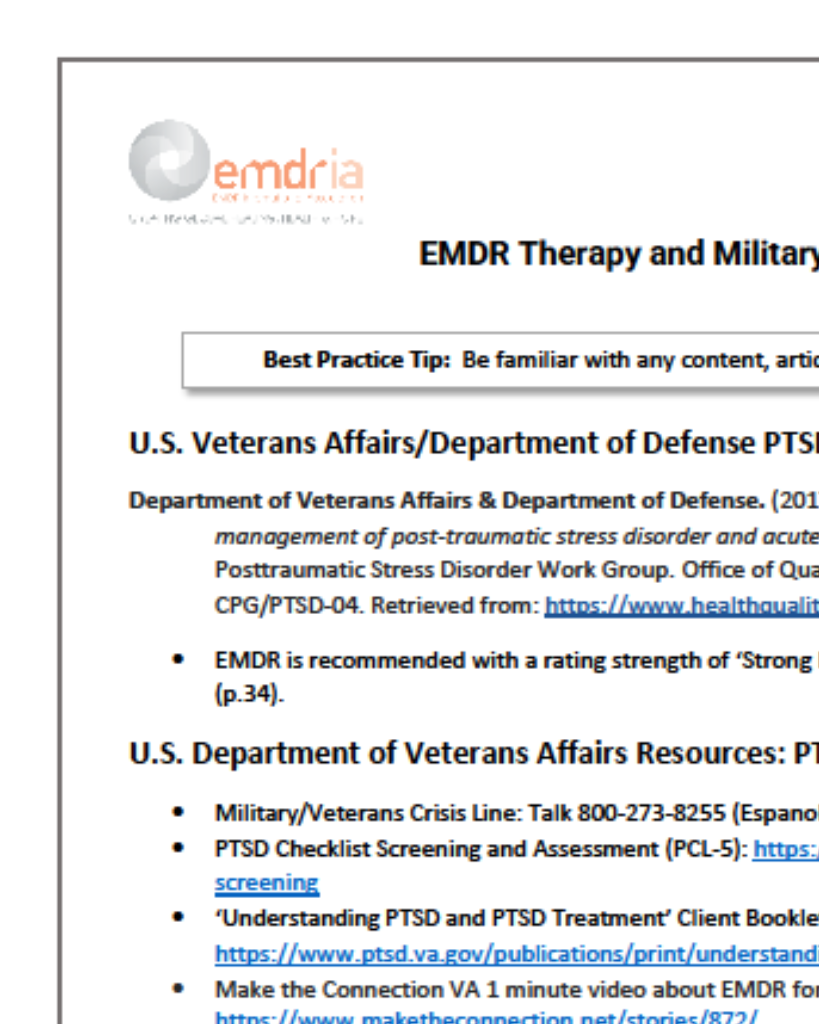
EMDR Therapy and Military Resource List

Read More

Guidelines for Virtual EMDR Therapy: A Report of the Virtual Training and Therapy Task Group

Read More

Core Competencies for EMDRIA Approved Consultantsâ„¢

Read More

Find an EMDR Therapist®

EMDRIAâ„¢ has more than 18,000 members trained to provide EMDR Therapy. Find a therapist near you.

Find an EMDR Therapist®
sun-flare-min
logo-emdria-grayscale-min

7000 N Mo Pac Expy
Ste 200
Austin, TX 78731-3013

Email info@emdria.org

Phone 512-451-5200

EMDRIA Facebook EMDRIA Twitter EMDRIA LinkedIn EMDRIA YouTube EMDRIA Online Community
  • About EMDR Therapy
  • EMDR Training and Education
  • EMDRIAâ„¢ Membership
  • Publications & Resources
  • EMDRIA Online Community
  • EMDRIA Foundation
  • Privacy Policy
  • Copyright Policy
  • Accessibility Statement
  • Sitemap
gold-circle-2022

© 1995-2026 EMDR International Association™. All rights reserved.

Website by Yoko Co

  • This field is for validation purposes and should be left unchanged.
  • This field is hidden when viewing the form
  • This field is hidden when viewing the form
  • This field is hidden when viewing the form
  • This field is hidden when viewing the form
  • This field is hidden when viewing the form
  • Please be aware that email is not a secure means of communication and spam filters may prevent your email from reaching the therapist. We recommend you follow up with a phone call. Sending an email using this page does not guarantee that the recipient will receive, read, or respond to your email.

    If this is an emergency do not use this form. Call 911 or your nearest hospital.

We use cookies to ensure the best website experience. See our privacy policy to learn more.