Skip to content
EMDR International Association
  • About EMDR Therapy
    • What is EMDR Therapy?

      AIP Model

      AIP Model

      Experiencing EMDR Therapy

      Experiencing EMDR Therapy

      EMDR in Treatment Guidelines

      EMDR in Treatment Guidelines

      Recent Research

      Recent Research

      Using EMDR with ...

      Addiction

      Addiction

      Anxiety

      Anxiety

      Childhood Trauma

      Childhood Trauma

      Depression

      Depression

      PTSD

      PTSD

      Find an EMDR Therapist®
  • About EMDR Therapy
    • What is EMDR therapy?
      • Adaptive Information Processing (AIP) Model
      • EMDR Therapy & Addiction
      • EMDR Therapy & Anxiety
      • EMDR Therapy & Childhood Trauma
      • EMDR Therapy & Depression
      • EMDR Therapy & PTSD
    • Experiencing EMDR Therapy
    • EMDR Therapy in Treatment Guidelines
    • Recent Research on EMDR Therapy
    • Find an EMDR Therapist®
  • Training & Events
    • EMDR Basic Training

      Eligibility Requirements

      Eligibility Requirements

      5 Steps to EMDR Training

      5 Steps to EMDR Training

      EMDR Basic Training FAQs

      EMDR Basic Training FAQs

      Training vs Certification

      Training vs Certification

      Find EMDR Basic Training

      Find EMDR Basic Training

      EMDR Education Calendar

      Consultant / Trainer Events

      EMDRIA OnDemand Education

      EMDRIA Conference
      EMDRIA Virtual Summit
  • Training & Events
    • EMDR Education Calendar
    • EMDR Basic Training
      • 5 Steps to Take an EMDRIA™ Approved EMDR Basic Training
      • Eligibility Requirements for EMDR Basic Training
      • EMDR Basic Training FAQs
      • Training vs Certification
      • Find an EMDR Basic Training
    • Continuing Education
      • OnDemand Education
    • EMDRIA Conference
    • EMDRIA Summit
      • Summit Speaker Resources
    • EMDRIA™ Digital Badges
    • EMDRIA Certified Therapist™ Application
      • How to Market Yourself as an EMDRIA Certified Therapist™
      • EMDRIA Certified Therapist™ FAQs
      • Membership vs Certification
      • EMDRIA Certified Therapist™ Renewal
    • EMDRIA Approved Consultant™ Application
      • Updating EMDRIA Approved Consultant™ Standards
      • CIT Declaration Form
      • EMDRIA Approved Consultant in Training™ FAQs
      • Consultation Packet
      • EMDRIA Approved Consultant™ Renewal
      • Consultant Day Events
    • EMDRIA Credit Provider & Program Applications
    • EMDRIA Approved Trainer™ Application
    • EMDR Basic Training Policies & Requirements
    • Standards for EMDR Basic Training
    • Trainer Day Events
  • Credentialing
    • EMDRIA Certified Therapist™

      Membership vs Certification

      Membership vs Certification

      Certification FAQs

      Certification FAQs

      Certified Therapist Renewal

      Certified Therapist Renewal

      EMDRIA Approved Consultant™

      Updating Consultant Standards

      Updating Consultant Standards

      CIT Declaration Form

      CIT Declaration Form

      Consultant-in-Training FAQs

      Consultant-in-Training FAQs

      Approved Consultant Renewal

      Approved Consultant Renewal

      EMDRIA Approved Trainer™

      EMDR Basic Training Standards

      EMDR Basic Training Standards

      Training Policies & Requirements

      Training Policies & Requirements

      EMDRIA Credit Providers

      Program Application & Guidelines

      Program Application & Guidelines

      EMDRIA Credit FAQs

      EMDRIA Credit FAQs

      EMDRIA Digital Badges

      Consultant / Trainer Events

      EMDRIA Certified
      Therapist™ Application
      EMDRIA Approved
      Consultant™ Application
      EMDRIA Approved
      Trainer™ Application
  • Publications & Resources
    • Journal of EMDR Practice & Research®

      Go With That Magazine®

      Focal Point Blog

      Let's Talk EMDR Podcast

      EMDRIA Library

      Glossary of EMDR Terms

      Glossary of EMDR Terms

      Online EMDR Therapy Resources

      Online EMDR Therapy Resources

      Antiracism Resources

      Antiracism Resources

      Toolkits & Practice Resources

      Toolkits & Practice Resources

      Español: Recursos en Español

      Español: Recursos en Español

      Seach EMDRIA Library
      Subscribe to Blog
  • Publications & Resources
    • EMDRIA Library
    • Glossary of EMDR Terms
    • Antiracism Resources
    • Online EMDR Therapy Resources
    • Focal Point Blog
      • Subscribe to Focal Point Blog
    • Go With That Magazine®
    • Journal of EMDR Practice & Research®
    • Let’s Talk EMDR Podcast
    • Toolkits & Practice Resources
      • 8 Phases Toolkit
      • Building Your EMDR Practice Toolkit
      • Client Brochures
      • Addictions Toolkit
      • Depression Toolkit
      • EMDRIA Children’s Toolkit
      • Chronic Pain Toolkit
      • Military Toolkit
      • EMDR Consultation Toolkit
    • Kits y Recursos Prácticos
      • Folletos de Terapia EMDR
      • Kit de las 8 Fases
      • Kit de la Depresión
      • Kit del Dolor Crónico
      • Kit de los Niños y Niñas
  • Membership
    • Join EMDRIA

      Benefits of Membership

      Benefits of Membership

      Membership vs Certification

      Membership vs Certification

      Agency Group Membership

      Agency Group Membership

      International Affiliates

      International Affiliates

      Members Only

      Account Overview

      Account Overview

      Directory Profile Information

      Directory Profile Information

      Renew Membership

      Renew Membership

      Retired Membership

      Retired Membership

      Member Hub
      EMDRIA Online Community
  • Membership
    • Join EMDRIA™
      • Retired Membership
      • Agency Group Membership
      • International Affiliate Organizations
    • Member Hub
    • Renew EMDRIA™ Membership
    • Membership Benefits
    • EMDRIA™ Member Account Overview
    • Directory Profile Information
    • Membership vs Certification
  • About EMDRIA™
    • About Us

      EMDRIA 30th Anniversary

      EMDRIA 30th Anniversary

      Policies & Code of Conduct

      Policies & Code of Conduct

      EMDRIA Awards & Winners

      EMDRIA Awards & Winners

      EMDRIA FAQs

      EMDRIA FAQs

      Meet the Board of Directors

      Board News and Updates

      Board News and Updates

      Call for BoD Nominations

      Call for BoD Nominations

      Contact Media Relations

      Contact EMDRIA

      EMDRIA Foundation
  • About EMDRIA™
    • EMDRIA’s 30th Anniversary
    • EMDRIA™ FAQs
    • Contact EMDRIA™
    • Contact Media Relations
    • Meet the Board of Directors
      • Call for Board of Directors Nominations
    • Board News and Updates
      • Annual Membership Meeting
    • EMDR International Association™ Policies
    • EMDRIA™ Awards & Winners
    • EMDRIA Foundation
FacebookTwitterLinkedinInstagramWordpress
  • Join EMDRIA™
  • Contact
  • Find an EMDR Therapist®
EMDR International Association
Log In
  • About EMDR Therapy
    • What is EMDR Therapy?

      AIP Model

      AIP Model

      Experiencing EMDR Therapy

      Experiencing EMDR Therapy

      EMDR in Treatment Guidelines

      EMDR in Treatment Guidelines

      Recent Research

      Recent Research

      Using EMDR with ...

      Addiction

      Addiction

      Anxiety

      Anxiety

      Childhood Trauma

      Childhood Trauma

      Depression

      Depression

      PTSD

      PTSD

      Find an EMDR Therapist®
  • About EMDR Therapy
    • What is EMDR therapy?
      • Adaptive Information Processing (AIP) Model
      • EMDR Therapy & Addiction
      • EMDR Therapy & Anxiety
      • EMDR Therapy & Childhood Trauma
      • EMDR Therapy & Depression
      • EMDR Therapy & PTSD
    • Experiencing EMDR Therapy
    • EMDR Therapy in Treatment Guidelines
    • Recent Research on EMDR Therapy
    • Find an EMDR Therapist®
  • Training & Events
    • EMDR Basic Training

      Eligibility Requirements

      Eligibility Requirements

      5 Steps to EMDR Training

      5 Steps to EMDR Training

      EMDR Basic Training FAQs

      EMDR Basic Training FAQs

      Training vs Certification

      Training vs Certification

      Find EMDR Basic Training

      Find EMDR Basic Training

      EMDR Education Calendar

      Consultant / Trainer Events

      EMDRIA OnDemand Education

      EMDRIA Conference
      EMDRIA Virtual Summit
  • Training & Events
    • EMDR Education Calendar
    • EMDR Basic Training
      • 5 Steps to Take an EMDRIA™ Approved EMDR Basic Training
      • Eligibility Requirements for EMDR Basic Training
      • EMDR Basic Training FAQs
      • Training vs Certification
      • Find an EMDR Basic Training
    • Continuing Education
      • OnDemand Education
    • EMDRIA Conference
    • EMDRIA Summit
      • Summit Speaker Resources
    • EMDRIA™ Digital Badges
    • EMDRIA Certified Therapist™ Application
      • How to Market Yourself as an EMDRIA Certified Therapist™
      • EMDRIA Certified Therapist™ FAQs
      • Membership vs Certification
      • EMDRIA Certified Therapist™ Renewal
    • EMDRIA Approved Consultant™ Application
      • Updating EMDRIA Approved Consultant™ Standards
      • CIT Declaration Form
      • EMDRIA Approved Consultant in Training™ FAQs
      • Consultation Packet
      • EMDRIA Approved Consultant™ Renewal
      • Consultant Day Events
    • EMDRIA Credit Provider & Program Applications
    • EMDRIA Approved Trainer™ Application
    • EMDR Basic Training Policies & Requirements
    • Standards for EMDR Basic Training
    • Trainer Day Events
  • Credentialing
    • EMDRIA Certified Therapist™

      Membership vs Certification

      Membership vs Certification

      Certification FAQs

      Certification FAQs

      Certified Therapist Renewal

      Certified Therapist Renewal

      EMDRIA Approved Consultant™

      Updating Consultant Standards

      Updating Consultant Standards

      CIT Declaration Form

      CIT Declaration Form

      Consultant-in-Training FAQs

      Consultant-in-Training FAQs

      Approved Consultant Renewal

      Approved Consultant Renewal

      EMDRIA Approved Trainer™

      EMDR Basic Training Standards

      EMDR Basic Training Standards

      Training Policies & Requirements

      Training Policies & Requirements

      EMDRIA Credit Providers

      Program Application & Guidelines

      Program Application & Guidelines

      EMDRIA Credit FAQs

      EMDRIA Credit FAQs

      EMDRIA Digital Badges

      Consultant / Trainer Events

      EMDRIA Certified
      Therapist™ Application
      EMDRIA Approved
      Consultant™ Application
      EMDRIA Approved
      Trainer™ Application
  • Publications & Resources
    • Journal of EMDR Practice & Research®

      Go With That Magazine®

      Focal Point Blog

      Let's Talk EMDR Podcast

      EMDRIA Library

      Glossary of EMDR Terms

      Glossary of EMDR Terms

      Online EMDR Therapy Resources

      Online EMDR Therapy Resources

      Antiracism Resources

      Antiracism Resources

      Toolkits & Practice Resources

      Toolkits & Practice Resources

      Español: Recursos en Español

      Español: Recursos en Español

      Seach EMDRIA Library
      Subscribe to Blog
  • Publications & Resources
    • EMDRIA Library
    • Glossary of EMDR Terms
    • Antiracism Resources
    • Online EMDR Therapy Resources
    • Focal Point Blog
      • Subscribe to Focal Point Blog
    • Go With That Magazine®
    • Journal of EMDR Practice & Research®
    • Let’s Talk EMDR Podcast
    • Toolkits & Practice Resources
      • 8 Phases Toolkit
      • Building Your EMDR Practice Toolkit
      • Client Brochures
      • Addictions Toolkit
      • Depression Toolkit
      • EMDRIA Children’s Toolkit
      • Chronic Pain Toolkit
      • Military Toolkit
      • EMDR Consultation Toolkit
    • Kits y Recursos Prácticos
      • Folletos de Terapia EMDR
      • Kit de las 8 Fases
      • Kit de la Depresión
      • Kit del Dolor Crónico
      • Kit de los Niños y Niñas
  • Membership
    • Join EMDRIA

      Benefits of Membership

      Benefits of Membership

      Membership vs Certification

      Membership vs Certification

      Agency Group Membership

      Agency Group Membership

      International Affiliates

      International Affiliates

      Members Only

      Account Overview

      Account Overview

      Directory Profile Information

      Directory Profile Information

      Renew Membership

      Renew Membership

      Retired Membership

      Retired Membership

      Member Hub
      EMDRIA Online Community
  • Membership
    • Join EMDRIA™
      • Retired Membership
      • Agency Group Membership
      • International Affiliate Organizations
    • Member Hub
    • Renew EMDRIA™ Membership
    • Membership Benefits
    • EMDRIA™ Member Account Overview
    • Directory Profile Information
    • Membership vs Certification
  • About EMDRIA™
    • About Us

      EMDRIA 30th Anniversary

      EMDRIA 30th Anniversary

      Policies & Code of Conduct

      Policies & Code of Conduct

      EMDRIA Awards & Winners

      EMDRIA Awards & Winners

      EMDRIA FAQs

      EMDRIA FAQs

      Meet the Board of Directors

      Board News and Updates

      Board News and Updates

      Call for BoD Nominations

      Call for BoD Nominations

      Contact Media Relations

      Contact EMDRIA

      EMDRIA Foundation
  • About EMDRIA™
    • EMDRIA’s 30th Anniversary
    • EMDRIA™ FAQs
    • Contact EMDRIA™
    • Contact Media Relations
    • Meet the Board of Directors
      • Call for Board of Directors Nominations
    • Board News and Updates
      • Annual Membership Meeting
    • EMDR International Association™ Policies
    • EMDRIA™ Awards & Winners
    • EMDRIA Foundation

Neurobiological correlates of EMDR monitoring – an EEG study (PLOS One)

Article-FeaturedImage

Home / Resources / PTSD / Neurobiological correlates of EMDR monitoring – an EEG study (PLOS One)

Neurobiological correlates of EMDR monitoring – an EEG study

Electroencephalography (EEG) imaging was used to fully monitor neuronal activation throughout EMDR sessions to observe neurobiological patterns of brain activations.


Article Abstract

“Background: Eye Movement Desensitization and Reprocessing (EMDR) is a recognized first-line treatment for psychological trauma. However its neurobiological bases have yet to be fully disclosed.

Methods: Electroencephalography (EEG) was used to fully monitor neuronal activation throughout EMDR sessions including the autobiographical script. Ten patients with major psychological trauma were investigated during their first EMDR session (T0) and during the last one performed after processing the index trauma (T1). Neuropsychological tests were administered at the same time. Comparisons were performed between EEGs of patients at T0 and T1 and between EEGs of patients and 10 controls who underwent the same EMDR procedure at T0. Connectivity analyses were carried out by lagged phase synchronization.

Results: During bilateral ocular stimulation (BS) of EMDR sessions EEG showed a significantly higher activity on the orbito-frontal, prefrontal and anterior cingulate cortex in patients at T0 shifting towards left temporo-occipital regions at T1. A similar trend was found for autobiographical script with a higher firing in fronto-temporal limbic regions at T0 moving to right temporo-occipital cortex at T1. The comparisons between patients and controls confirmed the maximal activation in the limbic cortex of patients occurring before trauma processing. Connectivity analysis showed decreased pair-wise interactions between prefrontal and cingulate cortex during BS in patients as compared to controls and between fusiform gyrus and visual cortex during script listening in patients at T1 as compared to T0. These changes correlated significantly with those occurring in neuropsychological tests.

Conclusions: The ground-breaking methodology enabled our study to image for the first time the specific activations associated with the therapeutic actions typical of EMDR protocol. The findings suggest that traumatic events are processed at cognitive level following successful EMDR therapy, thus supporting the evidence of distinct neurobiological patterns of brain activations during BS associated with a significant relief from negative emotional experiences.

The aim of the study was (i) to explore the technical feasibility of the on-line recording of whole EMDR sessions by means of EEG; (ii) to identify the regions activated either by the autobiographic recollection of the traumatic event (script) or during the bilateral ocular stimulation at EMDR sessions; (iii) to investigate possible changes in functional connectivity both as a result of EMDR therapy or comparing patients and healthy controls; (iv) to correlate such changes to neuropsychological scores.”

—Description from publisher

Article Access

Open Access

Pagani, M., Di Lorenzo, G., Verardo, A. R., Nicolais, G., Monaco, L., Lauretti, G., Russo, R., Niolu, C., Ammaniti, M., Fernandez, I., & Siracusano, A. (2012). Neurobiological correlates of EMDR monitoring – an EEG study. PLOS ONE, 7(9), 1-12. Open access: https://doi.org/10.1371/journal.pone.0045753 

About the Journal

“An inclusive journal community working together to advance science by making all rigorous research accessible without barriers.”

—Description from publisher

View the Resource
Basic Info Collapse

Date
September 26, 2012

Creator(s)
Marco Pagani, Giorgio Di Lorenzo, Anna Rita Verardo

Contributor(s)
Giampaolo Nicolais, Leonardo Monaco, Giada Lauretti, Rita Russo, Cinzia Niolu, Massimo Ammaniti, Isabel Fernandez, Alberto Siracusano

Topics
PTSD

Practice & Methods
Efficacy, Neurobiology

More Info Collapse

Extent
12 pages

Publisher
PLOS One

Rights
©️ 2012 Pagani et al. This is an open-access article distributed under the terms of the Creative Commons Attribution License, which permits unrestricted use, distribution, and reproduction in any medium, provided the original author and source are credited.

APA Citation
Pagani, M., Di Lorenzo, G., Verardo, A. R., Nicolais, G., Monaco, L., Lauretti, G., Russo, R., Niolu, C., Ammaniti, M., Fernandez, I., & Siracusano, A. (2012). Neurobiological correlates of EMDR monitoring – an EEG study. PLOS ONE, 7(9), 1-12. Open access: https://doi.org/10.1371/journal.pone.0045753 

Audience
EMDR Therapists, Other Mental Health Professionals

Language
English

Content Type
Article, Peer-Reviewed

Access Type
External Resource, Open Access
Related Resources

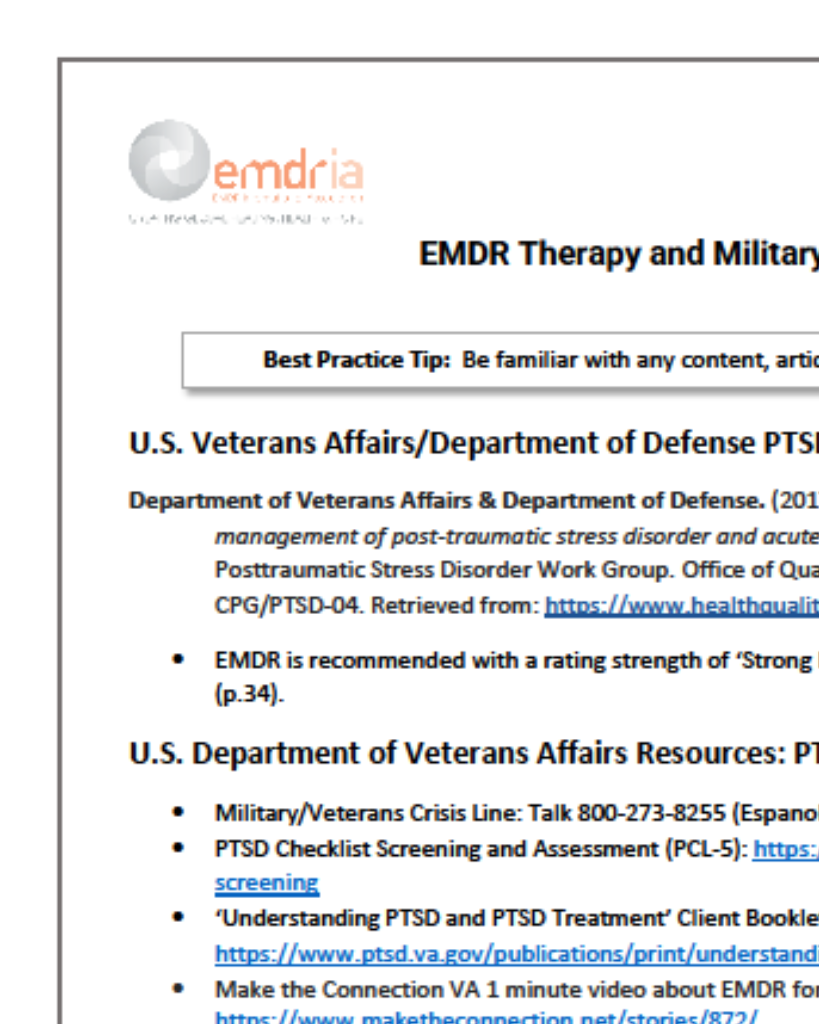
EMDR Therapy and Military Resource List

Read More

Neurobiological foundations of EMDR therapy (Springer, 2019)

Read More

Guidelines for Virtual EMDR Therapy: A Report of the Virtual Training and Therapy Task Group

Read More

Find an EMDR Therapist®

EMDRIA™ has more than 18,000 members trained to provide EMDR Therapy. Find a therapist near you.

Find an EMDR Therapist®
sun-flare-min
logo-emdria-grayscale-min

7000 N Mo Pac Expy
Ste 200
Austin, TX 78731-3013

Email info@emdria.org

Phone 512-451-5200

EMDRIA Facebook EMDRIA Twitter EMDRIA LinkedIn EMDRIA YouTube EMDRIA Online Community
  • About EMDR Therapy
  • EMDR Training and Education
  • EMDRIA™ Membership
  • Publications & Resources
  • EMDRIA Online Community
  • EMDRIA Foundation
  • Privacy Policy
  • Copyright Policy
  • Accessibility Statement
  • Sitemap
gold-circle-2022

© 1995-2026 EMDR International Association™. All rights reserved.

Website by Yoko Co

  • This field is for validation purposes and should be left unchanged.
  • This field is hidden when viewing the form
  • This field is hidden when viewing the form
  • This field is hidden when viewing the form
  • This field is hidden when viewing the form
  • This field is hidden when viewing the form
  • Please be aware that email is not a secure means of communication and spam filters may prevent your email from reaching the therapist. We recommend you follow up with a phone call. Sending an email using this page does not guarantee that the recipient will receive, read, or respond to your email.

    If this is an emergency do not use this form. Call 911 or your nearest hospital.

We use cookies to ensure the best website experience. See our privacy policy to learn more.