Skip to content
EMDR International Association
  • About EMDR Therapy
    • Learn more about EMDR
      Therapy

      Find an EMDR Therapist®

      What is EMDR Therapy

      AIP Model

      AIP Model

      Experiencing EMDR Therapy

      Experiencing EMDR Therapy

      EMDR in Treatment Guidelines

      EMDR in Treatment Guidelines

      Recent Research

      Recent Research

      Uses for EMDR

      Addiction

      Addiction

      Anxiety

      Anxiety

      Childhood Trauma

      Childhood Trauma

      Depression

      Depression

      PTSD

      PTSD

  • About EMDR Therapy
    • What is EMDR therapy?
      • AIP Model
      • Experiencing EMDR Therapy
      • EMDR in Treatment Guidelines
      • Recent Research
    • Uses in EMDR
      • Addiction
      • Anxiety
      • Childhood Trauma
      • Depression
      • PTSD
    • Find an EMDR Therapist®
  • Training & Events
    • EMDRIA™ Training and
      Events

      EMDRIA™ Conference
      EMDRIA™ Virtual Summit

      EMDR Basic Training

      Eligibility Requirements

      Eligibility Requirements

      5 Steps to EMDR Training

      5 Steps to EMDR Training

      EMDR Basic Training FAQs

      EMDR Basic Training FAQs

      Training vs Certification

      Training vs Certification

      Find EMDR Basic Training

      Find EMDR Basic Training

      EMDR Education Calendar

      Consultant / Trainer Events

      EMDRIA OnDemand Education

  • Training & Events
    • EMDR Basic Training
      • Eligibility Requirements
      • 5 Steps to EMDR Training
      • EMDR Basic Training FAQs
      • Training vs Certification
      • Find an EMDR Basic Training
    • EMDR Education Calendar
    • Consultant / Trainer Events
    • EMDRIA OnDemand Education
    • EMDRIA Conference
    • EMDRIA Summit
    • EMDRIA Digital Badges
    • Consultant / Trainer Events
    • Apply: Certified Therapist
    • Apply: Approved Consultant
    • Apply: Approved Trainer
  • Credentialing
    • Puzzle

      Credentialing

      Apply: Certified Therapist
      Apply: Approved Consultant
      Apply: Approved Trainer

      EMDRIA Certified Therapist™

      Membership vs Certification

      Membership vs Certification

      Certification FAQs

      Certification FAQs

      Certified Therapist Renewal

      Certified Therapist Renewal

      EMDRIA Approved Consultant™

      Updating Consultant Standards

      Updating Consultant Standards

      CIT Declaration Form

      CIT Declaration Form

      Consultant-in-Training FAQs

      Consultant-in-Training FAQs

      Approved Consultant Renewal

      Approved Consultant Renewal

      EMDRIA Approved Trainer™

      EMDR Basic Training Standards

      EMDR Basic Training Standards

      Training Policies & Requirements

      Training Policies & Requirements

      EMDRIA Credit Providers

      Program Application & Guidelines

      Program Application & Guidelines

      EMDRIA Credit FAQs

      EMDRIA Credit FAQs

      EMDRIA Digital Badges

      Consultant / Trainer Events

  • Credentialing
    • EMDRIA Certified Therapist™
      • Membership vs Certification
      • Certified FAQs
      • Certified Therapist Renewal
    • EMDRIA Approved Consultant™
      • Updating Consultant Standards
      • CIT Declaration Form
      • Consultant in Training FAQs
      • Approved Consultant Renewal
    • EMDRIA Approved Trainer™
      • EMDR Basic Training Standards
      • Training Policies & Requirements
    • EMDRIA Credit Providers
      • Program Application & Guidelines
      • EMDRIA Credit FAQs
  • Publications & Resources
    • Publications & Resources

      Search the EMDRIA Library
      Subscribe to our Blog

      Journal of EMDR Practice & Research®

      Go With That Magazine®

      Focal Point Blog

      Let's Talk EMDR Podcast

      EMDRIA Library

      Glossary of EMDR Terms

      Glossary of EMDR Terms

      Online EMDR Therapy Resources

      Online EMDR Therapy Resources

      Antiracism Resources

      Antiracism Resources

      Toolkits & Practice Resources

      Toolkits & Practice Resources

      Español: Recursos en Español

      Español: Recursos en Español

  • Publications & Resources
    • Journal of EMDR Practice & Research®
    • Go With That Magazine®
    • Focal Point Blog
    • Let’s Talk EMDR Podcast
    • EMDRIA Library
      • Glossary of EMDR Terms
      • Online EMDR Therapy Resources
      • Antiracism Resources
      • Toolkits & Practice Resources
      • Español: Recursos en Español
    • Search the EMDRIA Library
    • Subscribe to Focal Point Blog
  • Membership
    • Users_Group

      Membership

      Member Hub
      EMDRIA Member Connect

      Join EMDRIA

      Benefits of Membership

      Benefits of Membership

      Membership vs Certification

      Membership vs Certification

      Agency Group Membership

      Agency Group Membership

      International Affiliates

      International Affiliates

      Members Only

      Account Overview

      Account Overview

      Directory Profile Information

      Directory Profile Information

      Renew Membership

      Renew Membership

      Retired Membership

      Retired Membership

  • Membership
    • Join EMDRIA™
      • Benefits of Membership
      • Membership vs Certification
      • Agency Group Membership
      • International Affiliates
    • Members Only
      • Account Overview
      • Directory Profile Information
      • Renew Membership
      • Retired Membership
    • Member Hub
    • EMDRIA Member Connect
  • About EMDRIA™
    • Circle_Help

      About EMDRIA™

      EMDRIA Foundation

      About Us

      EMDRIA 30th Anniversary

      EMDRIA 30th Anniversary

      Policies & Code of Conduct

      Policies & Code of Conduct

      EMDRIA Awards & Winners

      EMDRIA Awards & Winners

      EMDRIA FAQs

      EMDRIA FAQs

      Meet the Board of Directors

      Board News and Updates

      Board News and Updates

      Contact Media Relations

      Contact EMDRIA

  • About EMDRIA™
    • About EMDRIA™
      • EMDRIA’s 30th Anniversary
      • Policies & Code of Conduct
      • EMDRIA Awards & Winners
      • EMDRIA FAQs
    • Meet the Board of Directors
      • Board News and Updates
    • Contact Media Relations
    • Contact EMDRIA
    • EMDRIA Foundation
FacebookTwitterLinkedinInstagramWordpress
  • Join EMDRIA™
  • Contact
  • Find an EMDR Therapist®
EMDR International Association
Log In
  • About EMDR Therapy
    • Learn more about EMDR
      Therapy

      Find an EMDR Therapist®

      What is EMDR Therapy

      AIP Model

      AIP Model

      Experiencing EMDR Therapy

      Experiencing EMDR Therapy

      EMDR in Treatment Guidelines

      EMDR in Treatment Guidelines

      Recent Research

      Recent Research

      Uses for EMDR

      Addiction

      Addiction

      Anxiety

      Anxiety

      Childhood Trauma

      Childhood Trauma

      Depression

      Depression

      PTSD

      PTSD

  • About EMDR Therapy
    • What is EMDR therapy?
      • AIP Model
      • Experiencing EMDR Therapy
      • EMDR in Treatment Guidelines
      • Recent Research
    • Uses in EMDR
      • Addiction
      • Anxiety
      • Childhood Trauma
      • Depression
      • PTSD
    • Find an EMDR Therapist®
  • Training & Events
    • EMDRIA™ Training and
      Events

      EMDRIA™ Conference
      EMDRIA™ Virtual Summit

      EMDR Basic Training

      Eligibility Requirements

      Eligibility Requirements

      5 Steps to EMDR Training

      5 Steps to EMDR Training

      EMDR Basic Training FAQs

      EMDR Basic Training FAQs

      Training vs Certification

      Training vs Certification

      Find EMDR Basic Training

      Find EMDR Basic Training

      EMDR Education Calendar

      Consultant / Trainer Events

      EMDRIA OnDemand Education

  • Training & Events
    • EMDR Basic Training
      • Eligibility Requirements
      • 5 Steps to EMDR Training
      • EMDR Basic Training FAQs
      • Training vs Certification
      • Find an EMDR Basic Training
    • EMDR Education Calendar
    • Consultant / Trainer Events
    • EMDRIA OnDemand Education
    • EMDRIA Conference
    • EMDRIA Summit
    • EMDRIA Digital Badges
    • Consultant / Trainer Events
    • Apply: Certified Therapist
    • Apply: Approved Consultant
    • Apply: Approved Trainer
  • Credentialing
    • Puzzle

      Credentialing

      Apply: Certified Therapist
      Apply: Approved Consultant
      Apply: Approved Trainer

      EMDRIA Certified Therapist™

      Membership vs Certification

      Membership vs Certification

      Certification FAQs

      Certification FAQs

      Certified Therapist Renewal

      Certified Therapist Renewal

      EMDRIA Approved Consultant™

      Updating Consultant Standards

      Updating Consultant Standards

      CIT Declaration Form

      CIT Declaration Form

      Consultant-in-Training FAQs

      Consultant-in-Training FAQs

      Approved Consultant Renewal

      Approved Consultant Renewal

      EMDRIA Approved Trainer™

      EMDR Basic Training Standards

      EMDR Basic Training Standards

      Training Policies & Requirements

      Training Policies & Requirements

      EMDRIA Credit Providers

      Program Application & Guidelines

      Program Application & Guidelines

      EMDRIA Credit FAQs

      EMDRIA Credit FAQs

      EMDRIA Digital Badges

      Consultant / Trainer Events

  • Credentialing
    • EMDRIA Certified Therapist™
      • Membership vs Certification
      • Certified FAQs
      • Certified Therapist Renewal
    • EMDRIA Approved Consultant™
      • Updating Consultant Standards
      • CIT Declaration Form
      • Consultant in Training FAQs
      • Approved Consultant Renewal
    • EMDRIA Approved Trainer™
      • EMDR Basic Training Standards
      • Training Policies & Requirements
    • EMDRIA Credit Providers
      • Program Application & Guidelines
      • EMDRIA Credit FAQs
  • Publications & Resources
    • Publications & Resources

      Search the EMDRIA Library
      Subscribe to our Blog

      Journal of EMDR Practice & Research®

      Go With That Magazine®

      Focal Point Blog

      Let's Talk EMDR Podcast

      EMDRIA Library

      Glossary of EMDR Terms

      Glossary of EMDR Terms

      Online EMDR Therapy Resources

      Online EMDR Therapy Resources

      Antiracism Resources

      Antiracism Resources

      Toolkits & Practice Resources

      Toolkits & Practice Resources

      Español: Recursos en Español

      Español: Recursos en Español

  • Publications & Resources
    • Journal of EMDR Practice & Research®
    • Go With That Magazine®
    • Focal Point Blog
    • Let’s Talk EMDR Podcast
    • EMDRIA Library
      • Glossary of EMDR Terms
      • Online EMDR Therapy Resources
      • Antiracism Resources
      • Toolkits & Practice Resources
      • Español: Recursos en Español
    • Search the EMDRIA Library
    • Subscribe to Focal Point Blog
  • Membership
    • Users_Group

      Membership

      Member Hub
      EMDRIA Member Connect

      Join EMDRIA

      Benefits of Membership

      Benefits of Membership

      Membership vs Certification

      Membership vs Certification

      Agency Group Membership

      Agency Group Membership

      International Affiliates

      International Affiliates

      Members Only

      Account Overview

      Account Overview

      Directory Profile Information

      Directory Profile Information

      Renew Membership

      Renew Membership

      Retired Membership

      Retired Membership

  • Membership
    • Join EMDRIA™
      • Benefits of Membership
      • Membership vs Certification
      • Agency Group Membership
      • International Affiliates
    • Members Only
      • Account Overview
      • Directory Profile Information
      • Renew Membership
      • Retired Membership
    • Member Hub
    • EMDRIA Member Connect
  • About EMDRIA™
    • Circle_Help

      About EMDRIA™

      EMDRIA Foundation

      About Us

      EMDRIA 30th Anniversary

      EMDRIA 30th Anniversary

      Policies & Code of Conduct

      Policies & Code of Conduct

      EMDRIA Awards & Winners

      EMDRIA Awards & Winners

      EMDRIA FAQs

      EMDRIA FAQs

      Meet the Board of Directors

      Board News and Updates

      Board News and Updates

      Contact Media Relations

      Contact EMDRIA

  • About EMDRIA™
    • About EMDRIA™
      • EMDRIA’s 30th Anniversary
      • Policies & Code of Conduct
      • EMDRIA Awards & Winners
      • EMDRIA FAQs
    • Meet the Board of Directors
      • Board News and Updates
    • Contact Media Relations
    • Contact EMDRIA
    • EMDRIA Foundation
Home / Resources / PTSD / The effectiveness of EMDR (Eye Movement Desensitization and Reprocessing) protocol in reducing intrusive PTSD symptoms in combat veterans (Psychiatry, Neurology and Medical Psychology)

Share on social media

The effectiveness of EMDR (Eye Movement Desensitization and Reprocessing) protocol in reducing intrusive PTSD symptoms in combat veterans (Psychiatry, Neurology and Medical Psychology)

The effectiveness of EMDR (Eye Movement Desensitization and Reprocessing) protocol in reducing intrusive PTSD symptoms in combat veterans

Ефективність протоколу EMDR (Eye Movement Desensitization and Reprocessing) у зниженні інтрузивних симптомів ПТСР у ветеранів бойових дій

This literature review summarizes current evidence on the effectiveness of EMDR in reducing intrusive symptoms of PTSD in combat veterans and outlines practical guidelines for evaluating treatment outcomes.

Мета роботи– узагальнити сучасні дані щодо ефективності EMDR у зниженні інтрузивних симптомів ПТСР у ветеранів бойових дій та окреслити практичні орієнтири оцінювання результатів лікування.


Article Abstract

“Background: Intrusive symptoms of posttraumatic stress disorder (PTSD) in combat veterans (intrusive memories, flashbacks, nightmares, pronounced psychophysiological reactivity to reminders) are among the most debilitating manifestations associated with decreased functioning, increased risk of comorbid depression, anxiety, and sleep disorders. EMDR (Eye Movement Desensitization and Reprocessing) therapy is a trauma-focused psychotherapy that combines brief replay of traumatic material with bilateral stimulation aimed at processing traumatic memories and reducing their emotional intensity. EMDR is recommended in clinical guidelines as an effective method of treating PTSD, including the «Strong for» recommendation in the VA/DoD guideline (2023), which is especially relevant for the military and veteran population.

Purpose: to summarize current evidence on the effectiveness of EMDR in reducing intrusive symptoms of PTSD in combat veterans and to outline practical guidelines for evaluating treatment outcomes.
Materials and Methods: A narrative review of the evidence was conducted with a focus on first-line trauma-focused psychotherapies, EMDR in military/veteran samples, and measurement of intrusions using validated scales. The psychometric structure of the IES-R (Impact of Event Scale-Revised) was taken into account for the interpretation of intrusive symptoms, which includes the Intrusion subscale along with Avoidance and Hyperarousal and demonstrates sufficient internal consistency of the subscales.
Results: The evidence base for psychological therapies for PTSD, including EMDR, confirms a clinically significant effect. A systematic review and meta-analysis of randomized trials (114 RCTs, n=8171) reported «robust evidence» for a clinically important effect of EMDR and trauma-focused CBT as first-line treatments. In a Cochrane review of psychological therapies for chronic PTSD, EMDR was more effective than waiting for help in reducing clinician-rated PTSD severity (SMD approximately −1.17; 95% CI −2.04 to −0.30), although the quality of evidence for individual comparisons was rated as low/ very low, requiring caution in interpretation. In veteran-oriented data, a study in which IES-R symptoms (a scale that includes an intrusive component) were significantly reduced in both intensive daily EMDR and weekly sessions: mean IES-R scores decreased from approximately 52–53 to 16–17 after treatment with maintenance of effect at 1-year follow-up; all participants were below the IES-R threshold used by the authors as a marker of PTSD.
Conclusions: EMDR is an evidence-based trauma-focused psychotherapy recommended by authoritative guidelines for the treatment of PTSD, and available data (particularly in veteran samples) suggest a significant reduction in overall severity of traumatic distress, including intrusive manifestations. For clinical practice, it is advisable to systematically measure intrusions before/after treatment and at follow-up using the IES-R Intrusion or the PCL-5 reexperiencing clusters, with concurrent assessment of sleep and functioning.”
—Description from publisher

РЕЗЮМЕ

“Актуальність. Інтрузивні симптоми посттравматичного стресового розладу (ПТСР) у ветеранів бойових дій (навʼязливі спогади, флешбеки, нічні кошмари, виражена психофізіологічна реактивність на нагадування) належать до найбільш виснажливих проявів, асоційованих зі зниженням функціонування, підвищенням ризику коморбідної депресії, тривоги та порушень сну. Терапія EMDR (Eye Movement Desensitization and Reprocessing) є травмофокусованою психотерапією, що поєднує короткочасне відтворення травматичного матеріалу з двобічною стимуляцією, спрямованою на переробку травматичних спогадів і зменшення їх емоційної інтенсивності. EMDR рекомендована в клінічних настановах як ефективний метод лікування ПТСР, включно з рекомендацією «Strong for» у настанові VA/DoD (2023), що особливо релевантно для популяції військовослужбовців і ветеранів.

Мета роботи – узагальнити сучасні дані щодо ефективності EMDR у зниженні інтрузивних симптомів ПТСР у ветеранів бойових дій та окреслити практичні орієнтири оцінювання результатів лікування.

Матеріали та методи. Проведено наративний огляд доказів із фокусом на травмофокусовані психотерапії першої лінії, EMDR у військових/ветеранських вибірках, вимірювання інтрузій за валідизованими шкалами. Для інтерпретації інтрузивної симптоматики враховано психометричну структуру IES-R (Impact of Event Scale-Revised), яка містить підшкалу Intrusion поряд із Avoidance і Hyperarousal та демонструє достатню внутрішню узгодженість підшкал.

Результати. Доказова база психологічних терапій для ПТСР, включно з EMDR, підтверджує клінічно значущий ефект. Систематичний огляд і метааналіз рандомізованих досліджень (114 РКД, n=8171) повідомляє наявність «robust evidence» для клінічно важливого ефекту EMDR та CBT із травмофокусом як методів першої лінії. У Кокранівському огляді психологічних терапій для хронічного ПТСР EMDR була ефективнішою за очікування допомоги щодо зменшення тяжкості ПТСР за оцінкою клініциста (SMD близько − 1,17; 95% ДІ −2,04…−0,30), хоча якість доказів для окремих порівнянь оцінювалася як низька/дуже низька, що потребує обережної інтерпретації. У ветеран-орієнтованих даних показовим є дослідження, де симптоми за IES-R (шкала, що включає інтрузивний компонент) істотно зменшилися як у форматі інтенсивного щоденного EMDR, так і у форматі щотижневих сесій: середні значення IES-R знижувалися приблизно з 52–53 до 16–17 після лікування з утриманням ефекту на однорічному спостереженні; всі учасники опинилися нижче порогового значення IES-R, яке використовувалося авторами як маркер ПТСР.

Висновки. EMDR є доказовою травмофокусованою психотерапією, рекомендованою авторитетними настановами для лікування ПТСР, а наявні дані (зокрема у ветеранських вибірках) свідчать про суттєве зниження загальної вираженості травматичного дистресу, що включає інтрузивні прояви. Для клінічної практики доцільним є системне вимірювання інтрузій до/після лікування, а також під час фолоу-апу з використанням IES-R Intrusion або кластерів повторного переживання у PCL-5, із паралельною оцінкою сну та функціонування.”


Article Access/Доступ до статті

Open Access

Feorenko, Y. A., & Stasyuk, V. V. (2026). The effectiveness of EMDR (Eye Movement Desensitization and Reprocessing) protocol in reducing intrusive PTSD symptoms in combat veterans. Psychiatry, Neurology and Medical Psychology, 13(1(33)), 185-198. https://doi.org/10.26565/2312-5675-2026-33-12

Федоренко, Ю., & Стасюк, В. (2026). Ефективність протоколу EMDR (Eye Movement Desensitization and Reprocessing) у зниженні інтрузивних симптомів ПТСР у ветеранів бойових дій. Психіатрія, неврологія та медична психологія, 13(1(33), 185-198. https://doi.org/10.26565/2312-5675-2026-33-12

View the Resource(opens in new tab)
Basic InfoCollapse

Date
February 27, 2026

Creator(s)
Fedorenko Yuliia Andriivna, V. V. Stasyuk

Topics
PTSD

Client Population
Military/Veterans

More InfoCollapse

Extent
14 pages

Rights
© Fedorenko Yu.A., Stasyuk V.V., 2026, Ця робота ліцензується відповідно до Creative Commons Attribution 4.0 International License.

APA Citation
Feorenko, Y. A., & Stasyuk, V. V. (2026). The effectiveness of EMDR (Eye Movement Desensitization and Reprocessing) protocol in reducing intrusive PTSD symptoms in combat veterans. Psychiatry, Neurology and Medical Psychology, 13(1(33)), 185-198. https://doi.org/10.26565/2312-5675-2026-33-12 Федоренко, Ю., & Стасюк, В. (2026). Ефективність протоколу EMDR (Eye Movement Desensitization and Reprocessing) у зниженні інтрузивних симптомів ПТСР у ветеранів бойових дій. Психіатрія, неврологія та медична психологія, 13(1(33), 185-198. https://doi.org/10.26565/2312-5675-2026-33-12

Audience
EMDR Therapists

Language
English, Ukrainian

Content Type
Article, Peer-Reviewed

Access Type
External Resource, Open Access
Related Resources

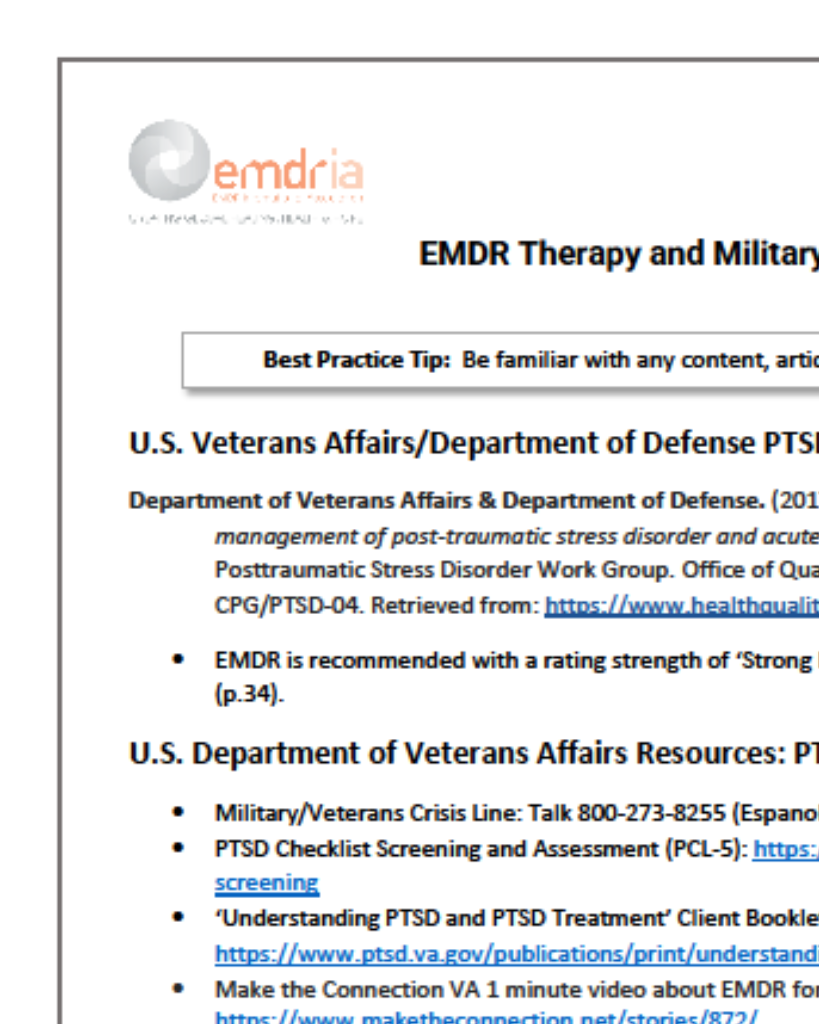
EMDR Therapy and Military Resource List

Read More

PTSD symptoms change in response to a brief intensive trauma-focused treatment programme in non-veterans and veterans with war-related PTSD (European Journal of Psychotraumatology)

Read More

EMDR Early Intervention Resources

Read More

Find an EMDR Therapist®

EMDRIA™ has more than 18,000 members trained to provide EMDR Therapy. Find a therapist near you.

Find an EMDR Therapist®
d2088683554149097441c3e1f6c13679941fbfdf (1)
EMDRIA

7000 N Mo Pac Expy
Ste 200
Austin, TX 78731-3013

info@emdria.org

512-451-5200

EMDRIA Facebook (opens in new tab) EMDRIA Twitter (opens in new tab) (opens in new tab) EMDRIA LinkedIn (opens in new tab) EMDRIA YouTube (opens in new tab) EMDRIA Online Community (opens in new tab)
  • About EMDR Therapy
  • EMDR Training and Education
  • EMDRIA™ Membership
  • Publications & Resources
  • EMDRIA Member Connect
  • EMDRIA Foundation
  • Privacy Policy
  • Copyright Policy
  • Accessibility Statement
  • Sitemap

© 1995-2026 EMDR International Association™. All rights reserved.

Website by Flipside Group

  • This field is for validation purposes and should be left unchanged.
  • This field is hidden when viewing the form
  • This field is hidden when viewing the form
  • This field is hidden when viewing the form
  • This field is hidden when viewing the form
  • This field is hidden when viewing the form
  • Disclaimer: This form is intended for initial contact with a therapist. Your message is submitted through the EMDRIA website and then sent to the therapist by email. Because email is not a secure method of communication, please consider limiting the amount of detailed personal, health, or confidential information you include in your initial message. Once you've established contact, you and the therapist can determine the most appropriate and secure way to communicate. Please be aware that email delivery cannot be guaranteed, and therapists manage their own inquiries and response times. Sending a message through this form does not guarantee that the therapist will receive, read, or respond to your inquiry. If a phone number is listed on the therapist's profile, you may wish to follow up by phone if you do not receive a response. If you are experiencing an emergency or are in immediate danger, do not use this form. Call 911 or go to your nearest emergency department.
We use cookies to ensure the best website experience. See our privacy policy to learn more.