EMDR and Complex Trauma Go With That Magazine® Issue
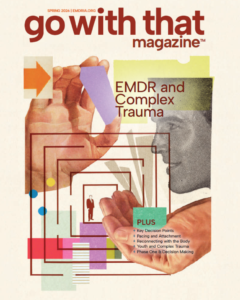 Clients with complex trauma often present with layered clinical needs that require thoughtful case conceptualization and phase-oriented treatment planning. This Go With That Magazine® issue explores key considerations for applying EMDR therapy with this population, highlighting individualized pacing, case conceptualization, and phase-specific interventions that support affect regulation, resource development, and preparation for trauma reprocessing. It also addresses common clinical challenges and examines the role of pacing and titration in maintaining therapeutic effectiveness. Throughout, the issue underscores the importance of a flexible, attuned, and trauma-informed approach to EMDR therapy with clients experiencing complex trauma.
Mark Brayne’s article is highlighted here. EMDRIA members can access all other articles and issues at the Go With That Magazine® homepage.
Complex Trauma: EMDR Pacing and Attachment as Organizing Lens
“Eye Movement Desensitization and Reprocessing (EMDR) therapy stands or falls on pacing and timing. Dr. Francine Shapiro’s original contribution was not only the discovery that bilateral stimulation facilitates adaptive information processing (AIP), but the recognition that processing must occur within a workable range of nervous system activation (Shapiro, 2018). When trauma is discrete and occurs later in life, that range is often relatively stable. With more complex presentations rooted in developmental experience, the system’s capacity is much less predictable. Activation can escalate into overwhelm or, equally, collapse into compliance, intellectualization, looping, or emotional shutdown. The client may remain in therapy; yet adaptive processing continues to stutter and stall.
This article examines how, especially, but not only, in developmental and complex presentations, EMDR therapy can be paced more effectively when case conceptualization, target selection, activation, and session structure are viewed and managed through an attachment-informed lens. The standard eight-phase protocol remains intact. What shifts is the clinician’s orientation to what is being treated. When attachment-organized material is accurately identified, pacing becomes less about holding back and more about knowing where to go.
Even with intense, identifiable trauma, symptoms typically constellate more around attachment-informed survival strategies than they do around isolated events. If EMDR therapy proceeds as though the disturbance is primarily event-based, interventions may remain at the network’s surface. When clinicians recognize and directly target attachment organization, processing is more likely to engage and safely hold the specific memory node (Shapiro, 2018), which is driving present distress.
This position aligns with broader psychotherapy research, emphasizing the centrality of attachment and relational awareness. Wallin (2007) argues that clinicians must attend to how attachment patterns shape both symptom formation and the therapeutic relationship itself. In the framework described here, however, attachment awareness is not primarily focused on explicitly restructuring a client’s attachment style within the therapeutic relationship but rather on case conceptualization and target selection (Bowlby, 1969/1982; 1988).
From Event-centered to Attachment-organized EMDR
EMDR therapy training has traditionally emphasized the disturbing event: the accident, the assault, the car crash, the explicit moment of terror or overwhelm. In many cases, this focus remains appropriate and effective. What is, however, often at least as important is not the event in isolation but how this individual nervous system learned in its formative years to organize and metabolize experience. The clinical question shifts from “What happened?” to “How, where, when, with (or without) whom, did this client learn to respond to what happened?” Targeting moves from the moment of rupture to the quality, or absence, of repair.
This distinction is reflected in the International Classification of Diseases, 11th Revision (ICD-11, World Health Organization, 2018), which differentiates post-traumatic stress disorder (PTSD) from complex PTSD (C-PTSD). In addition to the core PTSD symptoms of re-experiencing, avoidance, and persistent threat, C-PTSD includes disturbances in the self-organization domains of affect dysregulation, negative self-concept, and relational disturbance.
In EMDR therapy, which prioritizes attachment awareness, survival responses can be conceptualized beyond the familiar Flight–Fight– Freeze triad to include Flop, Friend, and Fawn, echoing established descriptions in trauma research of the defensive or “survival cascade” (Schauer & Elbert, 2010; Kozlowska et al., 2015). Manifesting as mobilized defensive states, inhibition under perceived danger, dorsal vagal shutdown (Porges, 2011), proximity seeking under threat (Taylor et al., 2000), or appeasement and compliance behaviors (Walker, 2013), these autonomic shifts can be understood as attachment based attempts to restore safety through connection and attachment (Brayne, 2024). The urge to ‘Friend’ might be understood as proactive attachment-seeking to engage the other and restore safety, whereas ‘Fawn’ involves appeasement through self-suppression. As another’s needs are prioritized, both lead to a loss of agency, to compulsive caretaking, excessive emotional responsibility, and trauma-bonded relational dynamics (Dutton & Painter, 1993).
The rules of early survival grammar go on to drive adult symptoms, such as chronic anxiety, irritability, indecision, emotional distance, or depressive withdrawal. Recognizing these patterns allows clinicians to use relationally attuned targeting, interweaving, and pacing decisions to update a client’s foundational survival logic, rather than focusing primarily on symptom reduction. … [Keep reading by clicking below]
This issue also includes the following articles:
-
Key Decision Points in Working More Effectively with Clients with Complex Trauma in EMDR Therapy by Thomas Zimmerman, Ms.Ed., LPCC
-
Reconnecting with the Body: EMDR and Complex Trauma by Natalia Seijo
-
The Star Theoretical Model & Its Application to EMDR Treatment of Youth with Complex Trauma by Frances S. Waters, LMSW, DCSW, LMFT, Annie Monaco, LCSW, RPT-S, and Ann Beckley-Forest, LCSW, RPT-S
-
Phase One as Clinical Foundation: Clarifying Processes and Decision-Making in EMDR Therapy with Complex Trauma by Jill Hosey, MSW, RSW, LICSW
Back to Focal Point Blog Homepage
Additional Resources
If you are a therapist interested in the EMDR training:
- Learn more about EMDR therapy at the EMDRIA™ Library
- Learn more about EMDR Training
- Search for an EMDR Training Provider
- Check out our EMDR Training FAQ
If you are EMDR trained:
- Check out the EMDRIA™ Let’s Talk EMDR Podcast
- Check out the EMDRIA™ Focal Point Blog
- Learn more about EMDRIA™ membership
- Search for EMDR Continuing Education opportunities
If you are an EMDRIA™ Member:
Related Articles