Skip to content
EMDR International Association
  • About EMDR Therapy
    • Learn more about EMDR
      Therapy

      Find an EMDR Therapist®

      What is EMDR Therapy

      AIP Model

      AIP Model

      Experiencing EMDR Therapy

      Experiencing EMDR Therapy

      EMDR in Treatment Guidelines

      EMDR in Treatment Guidelines

      Recent Research

      Recent Research

      Uses for EMDR

      Addiction

      Addiction

      Anxiety

      Anxiety

      Childhood Trauma

      Childhood Trauma

      Depression

      Depression

      PTSD

      PTSD

  • About EMDR Therapy
    • What is EMDR therapy?
      • AIP Model
      • Experiencing EMDR Therapy
      • EMDR in Treatment Guidelines
      • Recent Research
    • Uses in EMDR
      • Addiction
      • Anxiety
      • Childhood Trauma
      • Depression
      • PTSD
    • Find an EMDR Therapist®
  • Training & Events
    • EMDRIA™ Training and
      Events

      EMDRIA™ Conference
      EMDRIA™ Virtual Summit

      EMDR Basic Training

      Eligibility Requirements

      Eligibility Requirements

      5 Steps to EMDR Training

      5 Steps to EMDR Training

      EMDR Basic Training FAQs

      EMDR Basic Training FAQs

      Training vs Certification

      Training vs Certification

      Find EMDR Basic Training

      Find EMDR Basic Training

      EMDR Education Calendar

      Consultant / Trainer Events

      EMDRIA OnDemand Education

  • Training & Events
    • EMDR Basic Training
      • Eligibility Requirements
      • 5 Steps to EMDR Training
      • EMDR Basic Training FAQs
      • Training vs Certification
      • Find an EMDR Basic Training
    • EMDR Education Calendar
    • Consultant / Trainer Events
    • EMDRIA OnDemand Education
    • EMDRIA Conference
    • EMDRIA Summit
    • EMDRIA Digital Badges
    • Consultant / Trainer Events
    • Apply: Certified Therapist
    • Apply: Approved Consultant
    • Apply: Approved Trainer
  • Credentialing
    • Puzzle

      Credentialing

      Apply: Certified Therapist
      Apply: Approved Consultant
      Apply: Approved Trainer

      EMDRIA Certified Therapist™

      Membership vs Certification

      Membership vs Certification

      Certification FAQs

      Certification FAQs

      Certified Therapist Renewal

      Certified Therapist Renewal

      EMDRIA Approved Consultant™

      Updating Consultant Standards

      Updating Consultant Standards

      CIT Declaration Form

      CIT Declaration Form

      Consultant-in-Training FAQs

      Consultant-in-Training FAQs

      Approved Consultant Renewal

      Approved Consultant Renewal

      EMDRIA Approved Trainer™

      EMDR Basic Training Standards

      EMDR Basic Training Standards

      Training Policies & Requirements

      Training Policies & Requirements

      EMDRIA Credit Providers

      Program Application & Guidelines

      Program Application & Guidelines

      EMDRIA Credit FAQs

      EMDRIA Credit FAQs

      EMDRIA Digital Badges

      Consultant / Trainer Events

  • Credentialing
    • EMDRIA Certified Therapist™
      • Membership vs Certification
      • Certified FAQs
      • Certified Therapist Renewal
    • EMDRIA Approved Consultant™
      • Updating Consultant Standards
      • CIT Declaration Form
      • Consultant in Training FAQs
      • Approved Consultant Renewal
    • EMDRIA Approved Trainer™
      • EMDR Basic Training Standards
      • Training Policies & Requirements
    • EMDRIA Credit Providers
      • Program Application & Guidelines
      • EMDRIA Credit FAQs
  • Publications & Resources
    • Publications & Resources

      Search the EMDRIA Library
      Subscribe to our Blog

      Journal of EMDR Practice & Research®

      Go With That Magazine®

      Focal Point Blog

      Let's Talk EMDR Podcast

      EMDRIA Library

      Glossary of EMDR Terms

      Glossary of EMDR Terms

      Online EMDR Therapy Resources

      Online EMDR Therapy Resources

      Antiracism Resources

      Antiracism Resources

      Toolkits & Practice Resources

      Toolkits & Practice Resources

      Español: Recursos en Español

      Español: Recursos en Español

  • Publications & Resources
    • Journal of EMDR Practice & Research®
    • Go With That Magazine®
    • Focal Point Blog
    • Let’s Talk EMDR Podcast
    • EMDRIA Library
      • Glossary of EMDR Terms
      • Online EMDR Therapy Resources
      • Antiracism Resources
      • Toolkits & Practice Resources
      • Español: Recursos en Español
    • Search the EMDRIA Library
    • Subscribe to Focal Point Blog
  • Membership
    • Users_Group

      Membership

      Member Hub
      EMDRIA Member Connect

      Join EMDRIA

      Benefits of Membership

      Benefits of Membership

      Membership vs Certification

      Membership vs Certification

      Agency Group Membership

      Agency Group Membership

      International Affiliates

      International Affiliates

      Members Only

      Account Overview

      Account Overview

      Directory Profile Information

      Directory Profile Information

      Renew Membership

      Renew Membership

      Retired Membership

      Retired Membership

  • Membership
    • Join EMDRIA™
      • Benefits of Membership
      • Membership vs Certification
      • Agency Group Membership
      • International Affiliates
    • Members Only
      • Account Overview
      • Directory Profile Information
      • Renew Membership
      • Retired Membership
    • Member Hub
    • EMDRIA Member Connect
  • About EMDRIA™
    • Circle_Help

      About EMDRIA™

      EMDRIA Foundation

      About Us

      EMDRIA 30th Anniversary

      EMDRIA 30th Anniversary

      Policies & Code of Conduct

      Policies & Code of Conduct

      EMDRIA Awards & Winners

      EMDRIA Awards & Winners

      EMDRIA FAQs

      EMDRIA FAQs

      Meet the Board of Directors

      Board News and Updates

      Board News and Updates

      Contact Media Relations

      Contact EMDRIA

  • About EMDRIA™
    • About EMDRIA™
      • EMDRIA’s 30th Anniversary
      • Policies & Code of Conduct
      • EMDRIA Awards & Winners
      • EMDRIA FAQs
    • Meet the Board of Directors
      • Board News and Updates
    • Contact Media Relations
    • Contact EMDRIA
    • EMDRIA Foundation
FacebookTwitterLinkedinInstagramWordpress
  • Join EMDRIA™
  • Contact
  • Find an EMDR Therapist®
EMDR International Association
Log In
  • About EMDR Therapy
    • Learn more about EMDR
      Therapy

      Find an EMDR Therapist®

      What is EMDR Therapy

      AIP Model

      AIP Model

      Experiencing EMDR Therapy

      Experiencing EMDR Therapy

      EMDR in Treatment Guidelines

      EMDR in Treatment Guidelines

      Recent Research

      Recent Research

      Uses for EMDR

      Addiction

      Addiction

      Anxiety

      Anxiety

      Childhood Trauma

      Childhood Trauma

      Depression

      Depression

      PTSD

      PTSD

  • About EMDR Therapy
    • What is EMDR therapy?
      • AIP Model
      • Experiencing EMDR Therapy
      • EMDR in Treatment Guidelines
      • Recent Research
    • Uses in EMDR
      • Addiction
      • Anxiety
      • Childhood Trauma
      • Depression
      • PTSD
    • Find an EMDR Therapist®
  • Training & Events
    • EMDRIA™ Training and
      Events

      EMDRIA™ Conference
      EMDRIA™ Virtual Summit

      EMDR Basic Training

      Eligibility Requirements

      Eligibility Requirements

      5 Steps to EMDR Training

      5 Steps to EMDR Training

      EMDR Basic Training FAQs

      EMDR Basic Training FAQs

      Training vs Certification

      Training vs Certification

      Find EMDR Basic Training

      Find EMDR Basic Training

      EMDR Education Calendar

      Consultant / Trainer Events

      EMDRIA OnDemand Education

  • Training & Events
    • EMDR Basic Training
      • Eligibility Requirements
      • 5 Steps to EMDR Training
      • EMDR Basic Training FAQs
      • Training vs Certification
      • Find an EMDR Basic Training
    • EMDR Education Calendar
    • Consultant / Trainer Events
    • EMDRIA OnDemand Education
    • EMDRIA Conference
    • EMDRIA Summit
    • EMDRIA Digital Badges
    • Consultant / Trainer Events
    • Apply: Certified Therapist
    • Apply: Approved Consultant
    • Apply: Approved Trainer
  • Credentialing
    • Puzzle

      Credentialing

      Apply: Certified Therapist
      Apply: Approved Consultant
      Apply: Approved Trainer

      EMDRIA Certified Therapist™

      Membership vs Certification

      Membership vs Certification

      Certification FAQs

      Certification FAQs

      Certified Therapist Renewal

      Certified Therapist Renewal

      EMDRIA Approved Consultant™

      Updating Consultant Standards

      Updating Consultant Standards

      CIT Declaration Form

      CIT Declaration Form

      Consultant-in-Training FAQs

      Consultant-in-Training FAQs

      Approved Consultant Renewal

      Approved Consultant Renewal

      EMDRIA Approved Trainer™

      EMDR Basic Training Standards

      EMDR Basic Training Standards

      Training Policies & Requirements

      Training Policies & Requirements

      EMDRIA Credit Providers

      Program Application & Guidelines

      Program Application & Guidelines

      EMDRIA Credit FAQs

      EMDRIA Credit FAQs

      EMDRIA Digital Badges

      Consultant / Trainer Events

  • Credentialing
    • EMDRIA Certified Therapist™
      • Membership vs Certification
      • Certified FAQs
      • Certified Therapist Renewal
    • EMDRIA Approved Consultant™
      • Updating Consultant Standards
      • CIT Declaration Form
      • Consultant in Training FAQs
      • Approved Consultant Renewal
    • EMDRIA Approved Trainer™
      • EMDR Basic Training Standards
      • Training Policies & Requirements
    • EMDRIA Credit Providers
      • Program Application & Guidelines
      • EMDRIA Credit FAQs
  • Publications & Resources
    • Publications & Resources

      Search the EMDRIA Library
      Subscribe to our Blog

      Journal of EMDR Practice & Research®

      Go With That Magazine®

      Focal Point Blog

      Let's Talk EMDR Podcast

      EMDRIA Library

      Glossary of EMDR Terms

      Glossary of EMDR Terms

      Online EMDR Therapy Resources

      Online EMDR Therapy Resources

      Antiracism Resources

      Antiracism Resources

      Toolkits & Practice Resources

      Toolkits & Practice Resources

      Español: Recursos en Español

      Español: Recursos en Español

  • Publications & Resources
    • Journal of EMDR Practice & Research®
    • Go With That Magazine®
    • Focal Point Blog
    • Let’s Talk EMDR Podcast
    • EMDRIA Library
      • Glossary of EMDR Terms
      • Online EMDR Therapy Resources
      • Antiracism Resources
      • Toolkits & Practice Resources
      • Español: Recursos en Español
    • Search the EMDRIA Library
    • Subscribe to Focal Point Blog
  • Membership
    • Users_Group

      Membership

      Member Hub
      EMDRIA Member Connect

      Join EMDRIA

      Benefits of Membership

      Benefits of Membership

      Membership vs Certification

      Membership vs Certification

      Agency Group Membership

      Agency Group Membership

      International Affiliates

      International Affiliates

      Members Only

      Account Overview

      Account Overview

      Directory Profile Information

      Directory Profile Information

      Renew Membership

      Renew Membership

      Retired Membership

      Retired Membership

  • Membership
    • Join EMDRIA™
      • Benefits of Membership
      • Membership vs Certification
      • Agency Group Membership
      • International Affiliates
    • Members Only
      • Account Overview
      • Directory Profile Information
      • Renew Membership
      • Retired Membership
    • Member Hub
    • EMDRIA Member Connect
  • About EMDRIA™
    • Circle_Help

      About EMDRIA™

      EMDRIA Foundation

      About Us

      EMDRIA 30th Anniversary

      EMDRIA 30th Anniversary

      Policies & Code of Conduct

      Policies & Code of Conduct

      EMDRIA Awards & Winners

      EMDRIA Awards & Winners

      EMDRIA FAQs

      EMDRIA FAQs

      Meet the Board of Directors

      Board News and Updates

      Board News and Updates

      Contact Media Relations

      Contact EMDRIA

  • About EMDRIA™
    • About EMDRIA™
      • EMDRIA’s 30th Anniversary
      • Policies & Code of Conduct
      • EMDRIA Awards & Winners
      • EMDRIA FAQs
    • Meet the Board of Directors
      • Board News and Updates
    • Contact Media Relations
    • Contact EMDRIA
    • EMDRIA Foundation
Home / Resources / Blurring emotional memories using eye movements: Individual differences and speed of eye movements (European Journal of Psychotraumatology)

Share on social media

Blurring emotional memories using eye movements: Individual differences and speed of eye movements (European Journal of Psychotraumatology)

Blurring emotional memories using eye movements: Individual differences and speed of eye movements

This study found that dual-task interventions (eye movements) reduce memory vividness and emotionality more than no task, with greater effects from higher cognitive load, but tailoring eye movement speed to an individual’s working memory capacity does not improve outcomes.


Article Abstract

“Background: In eye movement desensitization and reprocessing (EMDR), patients make eye movements (EM) while recalling traumatic memories. Making EM taxes working memory (WM), which leaves less resources available for imagery of the memory. This reduces memory vividness and emotionality during future recalls. WM theory predicts that individuals with small working memory capacities (WMCs) benefit more from low levels of taxing (i.e., slow EM) whereas individuals with large WMC benefit more from high levels of taxing (i.e., fast EM).

Objective: We experimentally examined and tested four prespecified hypotheses regarding the role of WMC and EM speed in reducing emotionality and vividness ratings: 1) EM—regardless of WMC and EM speed—are more effective compared to no dual task, 2) increasing EM speed only affects the decrease in memory ratings irrespective of WMC, 3) low-WMC individuals—compared to high-WMC individuals—benefit more from making either type of EM, 4) the EM intervention is most effective when—as predicted by WM theory—EM are adjusted to WMC.

Method: Undergraduates with low (n=31) or high (n=35) WMC recalled three emotional memories and rated vividness and emotionality before and after each condition (recall only, recall + slow EM, and recall + fast EM).

Results: Contrary to the theory, the data do not support the hypothesis that EM speed should be adjusted to WMC (hypothesis 4). However, the data show that a dual task in general is more effective in reducing memory ratings than no dual task (hypothesis 1), and that a more cognitively demanding dual task increases the intervention’s effectiveness (hypothesis 2).

Conclusions: Although adjusting EM speed to an individual’s WMC seems a straightforward clinical implication, the data do not show any indication that such a titration is helpful.”

—Description from publisher

Article Access

Open Access

van Schie, K., van Veen, S. C., Engelhard, I. M., Klugkist, I., & van den Hout. (2016). Blurring emotional memories using eye movements: Individual differences and speed of eye movements. European Journal of Psychotraumatology, 7: 29476. https://doi.org/10.3402/ejpt.v7.29476

View the Resource
Basic Info Collapse

Date
July 4, 2016

Creator(s)
Kevin van Schie, Suzanne C. van Veen, Iris M. Engelhard

Contributor(s)
Irene Klugkist, Marcel A. van den Hout

Practice & Methods
BLS, Mechanisms of Action

More Info Collapse

Extent
9 pages

Publisher
Taylor & Francis

Rights
Copyright 2016 Kevin van Schie et al. This is an Open Access article distributed under the terms of the Creative Commons Attribution 4.0 International License, allowing third parties to copy and redistribute the material in any medium or format, and to remix, transform, and build upon the material, for any purpose, even commercially, under the condition that appropriate credit is given, that a link to the license is provided, and that you indicate if changes were made. You may do so in any reasonable manner, but not in any way that suggests the licensor endorses you or your use.

APA Citation
van Schie, K., van Veen, S. C., Engelhard, I. M., Klugkist, I., & van den Hout. (2016). Blurring emotional memories using eye movements: Individual differences and speed of eye movements. European Journal of Psychotraumatology, 7: 29476. https://doi.org/10.3402/ejpt.v7.29476

Audience
EMDR Therapists, Other Mental Health Professionals

Language
English

Content Type
Article, Peer-Reviewed

Access Type
External Resource, Open Access

Related Resources
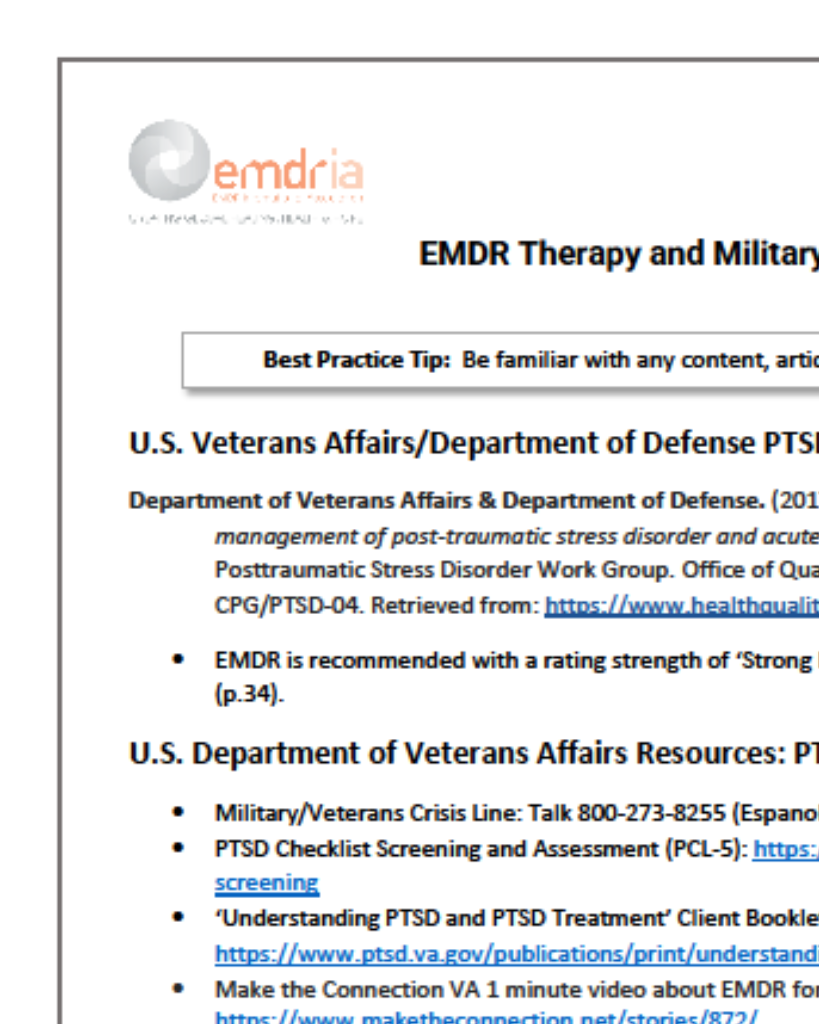
EMDR Therapy and Military Resource List

Read More

Blurring of emotional and non-emotional memories by taxing working memory during recall (Cognition and Emotion)

Read More

A meta-analysis of the contribution of eye movements in processing emotional memories (Journal of Behavior Therapy and Experimental Psychiatry)

Read More

Find an EMDR Therapist®

EMDRIA™ has more than 18,000 members trained to provide EMDR Therapy. Find a therapist near you.

Find an EMDR Therapist®
d2088683554149097441c3e1f6c13679941fbfdf (1)
EMDRIA

7000 N Mo Pac Expy
Ste 200
Austin, TX 78731-3013

info@emdria.org

512-451-5200

EMDRIA Facebook EMDRIA Twitter EMDRIA LinkedIn EMDRIA YouTube EMDRIA Online Community
  • About EMDR Therapy
  • EMDR Training and Education
  • EMDRIA™ Membership
  • Publications & Resources
  • EMDRIA Member Connect
  • EMDRIA Foundation
  • Privacy Policy
  • Copyright Policy
  • Accessibility Statement
  • Sitemap

© 1995-2026 EMDR International Association™. All rights reserved.

Website by Flipside Group

  • This field is for validation purposes and should be left unchanged.
  • This field is hidden when viewing the form
  • This field is hidden when viewing the form
  • This field is hidden when viewing the form
  • This field is hidden when viewing the form
  • This field is hidden when viewing the form
  • Please be aware that email is not a secure means of communication and spam filters may prevent your email from reaching the therapist. We recommend you follow up with a phone call. Sending an email using this page does not guarantee that the recipient will receive, read, or respond to your email.

    If this is an emergency do not use this form. Call 911 or your nearest hospital.

We use cookies to ensure the best website experience. See our privacy policy to learn more.