A Regulation-Focused Model for Phase 2 EMDR: Qigong, Bilateral Artmaking, and Equine Engagement
Guest Blog Post by Dr. Elizabeth Warson, Ph.D., LPC and Sifu Kurtis Tilley, LMFT
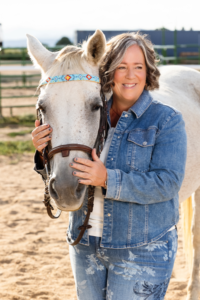
Dr. Elizabeth Warson © Photography by Desiree
Before traumatic material can be approached safely, the nervous system must first learn something essential: how it can remain present. In Eye Movement Desensitization and Reprocessing (EMDR) therapy, this learning takes place in Phase 2—Preparation. While Phase 2 is sometimes described as a preliminary step, experienced clinicians understand it as a foundational and ongoing process. It is where safety is established, regulation is practiced, anAll Postsd the body begins to trust that sensation and emotion can be experienced without being overwhelmed.
Equine and Expressive Arts Inspired Qigong (E.Qi) can be understood as a regulation-based practice that aligns closely with the aims of Phase 2 EMDR work. E.Qi is not a therapy model and does not involve trauma memory processing. Instead, it supports the development of the very capacities Phase 2 is designed to cultivate: nervous system regulation, bilateral integration, dual attention, embodied awareness, and confidence in one’s ability to return to safety (Tilley & Warson, 2024). E.Qi can be understood as a holistic, horse centered experiential practice that integrates Qigong movement, equine–assisted insight, and expressive arts to support embodied self–awareness and healing.
Regulation as an embodied learning process
At its core, E.Qi is a practice of learning regulation through experience. Rather than relying on cognitive strategies or imagined resources, E.Qi invites the body into slow, rhythmic movement, relational attunement, and creative expression. Regulation is not something participants are asked to perform correctly; it is something they practice, lose, and recover in manageable ways (Tilley & Warson, 2024). This mirrors the nervous system learning that Phase 2 EMDR work seeks to establish (Warson & Warson, 2024).
Qigong as the somatic foundation

Sifu Kurtis Tilley © Photography by Desiree
Qigong provides the somatic foundation of E.Qi. Through coordinated breath, posture, and movement, participants experience what it feels like to ground, settle, and experience the sensation of motion in relation to stillness (Goldbeck et al., 2021). Movements emphasize bringing awareness to the weight distribution through the feet (rooting), legs and knees (sinking), and movement through the hips, spine and arms (spiraling). This is progressive learning that turns static and stepwise postures into smooth transitions through patterns known to support autonomic regulation, physical strength, balance and flexibility. More importantly, regulation is not defined as stillness, but as a representation of continued practice that demonstrates learned skills over time. The movements and the familiarity with stillness become so natural it is as if the participants can regulate without regulating. Participants move into activation and back out again, learning that arousal is not dangerous and that settling is possible.
This distinction is particularly relevant for trauma-informed work. Many individuals entering EMDR have nervous systems that equate bodily sensation with threat. Stillness may feel unsafe, and verbal grounding strategies may feel abstract or inaccessible. E.Qi offers an alternative pathway. Safety is not imagined or explained; it is felt through repetition, rhythm, and choice. Over time, participants develop an embodied familiarity with regulation that does not depend on cognitive effort (Tilley & Warson, 2024).
Bilateral focus and integration without trauma activation
One of the most direct connections between E.Qi and Phase 2 EMDR practice lies in its consistent bilateral focus. In EMDR, bilateral stimulation supports integration and dual attention. During Phase 2, bilateral input is often introduced gently to help the nervous system become accustomed to integration without activating traumatic memory networks (Warson & Warson, 2024). E.Qi incorporates bilateral experience continuously and organically. Contralateral movements, spiraling forms, alternating weight shifts, and rhythmic sequences engage both sides of the body and brain. This bilateral engagement occurs without trauma recall, allowing the nervous system to practice integration while remaining anchored in the present moment. Over time, this can reduce sensitivity to bilateral input and build tolerance for the dual-attention demands of later EMDR reprocessing.
For some individuals—particularly those with complex trauma or dissociative patterns—even gentle bilateral stimulation in a clinical context can feel activating. E.Qi offers a gradual, embodied introduction to bilateral integration through movement and sensation rather than focused attention on distress (Tilley & Warson, 2024). In this way, it supports readiness without pressure.
Case illustration: Embodied regulation with traumatic brain injury and complex PTSD
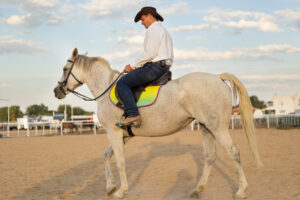
A long-term client living with traumatic brain injury and complex PTSD found regulation through mounted E.Qi practices. Rather than following structured or prescribed sequences, she responded most strongly to organic, embodied movement that felt natural within her body. Working in relationship with the horse allowed her to experience rhythm, balance, and co-regulation in a way that felt intuitive rather than effortful. Over time, she began translating these sensations into large-scale bilateral drawing, allowing movement experienced through riding to extend into creative expression. This process helped reinforce her sense of integration between body awareness, creativity, and emotional regulation (Tilley & Warson, in press).
Cultivating dual attention through embodied awareness
Dual attention is another central capacity cultivated in both E.Qi and Phase 2 EMDR work. In EMDR therapy, clients must be able to notice internal experience while staying oriented to the present. This ability cannot be taught conceptually; it must be learned somatically (Warson & Warson, 2023). E.Qi develops dual attention through embodied experience (Tilley & Warson, in press) Participants are invited to track breath, muscle tone, balance, and emotional shifts while simultaneously attending to movement patterns, spatial orientation, or relational cues. Because attention remains grounded in sensation and movement rather than memory, participants learn that internal awareness does not automatically pull them into the past. This learning is subtle but powerful. It builds confidence in staying present with sensation—one of the clearest indicators of Phase 2 readiness (Warson et al., 2024).
Bilateral artmaking as a regulation and integration practice
© Photography by Desiree
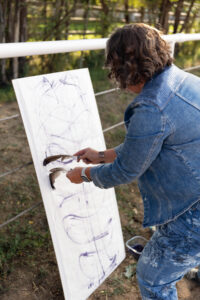
Bilateral artmaking is a central expressive component of E.Qi that directly supports the aims of Phase 2 EMDR preparation (Warson & Warson, 2023). Like Qigong, it does not involve trauma recall or memory processing. Instead, it offers a regulated, present-moment way to engage bilateral integration, dual attention, and embodied choice. Through simultaneous or alternating use of both hands—such as mirrored drawing, rhythmic mark-making, or crossing the midline—participants engage bilateral neural pathways without activating traumatic memory networks. Attention remains on sensation, movement, and rhythm rather than meaning or narrative. This mirrors the gentle introduction of bilateral stimulation in Phase 2 EMDR, where the goal is developing capacity and familiarity rather than activation.
Bilateral artmaking is inherently self-modulating (Warson & Warson, 2024). Participants control speed, pressure, range of motion, and duration, allowing regulation to emerge through choice rather than instruction. These micro-decisions reinforce agency and counter the dysregulated states often associated with trauma histories. The art process itself functions as a regulator, supporting engagement without overwhelm. More importantly, bilateral artmaking promotes integration without interpretation. Images are not processed for symbolic meaning, reducing the risk of premature cognitive or emotional activation. This makes the practice especially accessible for individuals with complex trauma, attachment disruption, or dissociative patterns, for whom verbal reflection may feel destabilizing.
As with Qigong, participants move into mild activation through novelty and engagement and then back into settling (Goldbeck et al., 2021). Over time, the nervous system learns that activation is survivable and regulation is recoverable. Within E.Qi, bilateral artmaking serves as a bridge between movement, sensation, and relational presence, strengthening the foundational capacities required for later EMDR reprocessing (Tilley & Warson, in press).
Horses as external regulators and relational anchors
© Photography by Desiree
The presence of horses within E.Qi adds an important relational dimension to this regulation-based approach. While E.Qi does not function as equine-assisted psychotherapy, horses serve as powerful external regulators within the practice (Tilley & Warson, 2024). Their sensitivity to human autonomic states provides immediate, nonverbal feedback that helps participants recognize shifts in their own internal regulation. Changes in breath, movement, and attention are often reflected in the horse’s responses, offering a relational mirror that requires no interpretation or verbal explanation.
From an EMDR Phase 2 perspective, horses function much like external anchors for safety and orientation (Warson & Tumlin, 2024; Warson, 2025). Their steady presence supports present-moment awareness, while their responsiveness invites participants to notice the connection between internal state and external relationship. Regulation becomes something that is felt in vivo rather than something that must be cognitively achieved. This is particularly meaningful for individuals whose trauma histories have disrupted early attachment or made interpersonal regulation feel unsafe or unpredictable.
Enhancing Phase 2 enhances client readiness
Phase 2 EMDR work is not simply about preparation for trauma processing; it is about restoring trust in the nervous system’s ability to remain present. E.Qi offers a regulation-focused pathway that supports this learning through embodied movement, bilateral integration, creative expression, and relational attunement with horses (Tilley & Warson, 2024). Through Qigong, bilateral artmaking, and equine presence—without trauma activation—participants strengthen the core capacities Phase 2 is designed to cultivate: nervous system regulation, dual attention, agency, and confidence in returning to safety. In this way, E.Qi does not replace EMDR preparation; it deepens it by grounding readiness for healing in lived experiences of movement, relationship, and felt safety.
Dr. Elizabeth Warson is an EMDR Consultant and practitioner specializing in regulation-focused, equine-assisted, and expressive arts–informed EMDR preparation. Founder of Healing Pathways LLC, she integrates EMDR, bilateral artmaking, and horses. She teaches internationally, publishes on trauma-informed practice, and co-authored E.Qi: Equine & Expressive Arts Inspired Qigong.
Sifu Kurtis Tilley is a certified Chinese martial arts instructor and Licensed Massage Therapist based in Colorado. He integrates qigong, bodywork, and equine massage to support regulation and resilience. Currently pursuing a biology degree at the University of Northern Colorado, his work bridges traditional movement practices with somatic and scientific perspectives.
References
Goldbeck, F., Xie, Y. L., Hautzinger, M., Fallgatter, A. J., Sudeck, G., & Ehlis, A. C. (2021). Relaxation or regulation: The acute effect of mind-body exercise on heart rate variability and subjective state in experienced Qi Gong practitioners. Evidence-Based Complementary and Alternative Medicine, 6673190. https://doi.org/10.1155/2021/6673190
Tilley, K. & Warson, E. (2024). E.Qi: Equine & expressive arts inspired Qigong. Teahouse Publishing.
Tilley, K. & Warson, E. (in press, 2026). E.Qi.2: Equine & expressive arts inspired Qigong. Teahouse Publishing.
Warson, E. (2025). Healing in motion: Insights from equine-assisted EMDR with a neurodivergent youth. EMDRIA. https://www.emdria.org/blog/healing-in-motion-insights-from-equine-assisted-emdr-with-a-neurodivergent-youth
Warson, E., Cowx, S., Curelo, J., Spier, E., & Sutrick, A. (2024, June). Arts-informed EMDR: A continuum of resourcing practices from bilateral artmaking to visual journaling. Go With That Magazine, 29(2), 22-35. https://www.emdria.org/magazine/arts-informed-emdr-a-continuum-of-resourcing-practices-from-bilateral-artmaking-to-visual-journaling/
Warson, E. & Tumlin, K. (2024). Sunkawakan WoLakota: Horse BalanceTCOM Conversations. https://tcomconversations.org/sunkawakan-wolakota-horse-balance/
Warson, E. & Warson, J. (2023). Bilateral movement and artmaking: Hemispheric integration across the midline (Mouvement bilatéral et création artistique : intégration hémisphérique sur la ligne médiane). Canadian Journal of Art Therapy, 36(2), 105-113. https://doi.org/10.1080/26907240.2023.2218727
Warson, E. & Warson, J. (2024). Mind meets heart: Random conversations on the brain & creativity. Healing Pathways, LLC Publishing.
Back to Focal Point Blog Homepage
Additional Resources
If you are a therapist interested in the EMDR training:
- Learn more about EMDR therapy at the EMDRIA Library
- Learn more about EMDR Training
- Search for an EMDR Training Provider
- Check out our EMDR Training FAQ
If you are EMDR trained:
- Check out the EMDRIA Let’s Talk EMDR Podcast
- Check out the EMDRIA Focal Point Blog
- Learn more about EMDRIA membership
- Search for EMDR Continuing Education opportunities
If you are an EMDRIA™ Member:
- Learn more about EMDR Consultation
- Find clinical practice articles in the EMDRIA Go With That Magazine®
- Search for articles in Journal of EMDR Practice and Research in the EMDRIA Library
Related Articles