

Reducing acute stress in a 16-year old using trauma-focused cognitive behaviour therapy and eye movement desensitization and reprocessing (Developmental Neurorehabilitation)
To assess the effects of trauma-focused cognitive behaviour therapy (TF-CBT) and EMDR for the treatment of acute stress in an adolescent.
Psychological treatment of women with psychological complaints after pre-eclampsia (Journal of Psychosomatic Obstetrics & Gynecology)
Study to describe interventions for women with pre-eclampsia, such as psycho-education, supportive techniques, autonomy techniques, and EMDR.
Eye Movement Desensitization and Reprocessing (EMDR) Scripted Protocols: Basics and Special Situations (Springer, 2009)
This book serves as a one-stop resource where therapists can access a wide range of word-for-word scripted protocols for EMDR practice.
Helping child flood victims using group EMDR intervention in Argentina: Treatment outcome and gender differences (International Journal of Stress Management)
Children with disaster-related trauma during a flood in Argentina were treated with the EMDR-Integrative Group Treatment Protocol.
소아기 특정 공포증의 EMDR 치료 증례 (Anxiety and Mood)
This report summarizes the case of a child with a specific phobia (i.e. nighttime fear) which was successfully treated with EMDR.
Rape treatment outcome research: Empirical findings and state of the literature (Clinical Psychology Review)
This article reviews empirical support for treatments targeting women sexually assaulted during adolescence or adulthood.
The brain’s orienting response: An event-related functional magnetic resonance imaging investigation (Human Brain Mapping)
This study suggests that the brain’s response to novel sounds not only orients attention but also extracts their meaning to help guide appropriate actions.

EMDR Solutions II: For depression, eating disorders, performance, and more (Norton, 2009)
This book by Robin Shapiro, MSW, LICSW with contributions by Celia Grand, LCSW, BCD and others, presents step-by-step instructions for implementing EMDR approaches to treat a range of issues, specifically depression, eating disorders, performance, medically-based trauma, and more.
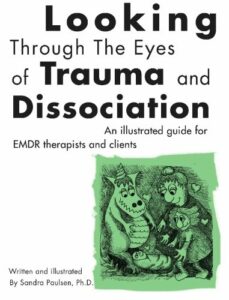
Looking through the eyes of trauma and dissociation: An illustrated guide for EMDR therapists and clients (Booksurge, 2009)
Book of original cartoons to explain the treatment of traumatic dissociation, use of ego state therapy, and EMDR for clients and therapists.
On the neural basis of EMDR therapy: Insights from qEEG studies (Traumatology)
The authors present evidence based on quantitative electroencephalogram studies that the neural basis for the EMDR effect is depotentiation of fear memory synapses in the amygdala during an evoked brain state similar to that of slow wave sleep.
Effective psychotherapies for posttraumatic stress disorder: A review and critique (CNS Spectrums)
This report reviews and critiques the psychotherapy literature for the treatment of PTSD and systematically presents data.
Scientific resistance to research, training and utilization of eye movement desensitization and reprocessing (EMDR) therapy in treating post-war disorders (Social Science & Medicine)
The implications of sustained resistance to EMDR for combat veterans and other trauma sufferers are discussed.
