

Possible neural mechanisms of psychotherapy for trauma-related symptoms: cerebral responses to the neuropsychological treatment of post-traumatic stress disorder model individuals (Scientific Reports)
Study presents findings that suggest psychotherapy for traumatic symptoms involves brain regions related to memory representation and emotion.
Early psychological preventive intervention for workplace violence: A randomized controlled explorative and comparative study between EMDR-Recent Event and Critical Incident Stress Debriefing (Issues in Mental Health Nursing)
This RCT investigated the efficacy of an early psychological intervention called EMDR-RE compared to Critical Incident Stress Debriefing.

EMDR integrated group treatment protocol for secondary traumatic stress/vicarious trauma in first responders (Northcentral University, 2016)
This study examined whether the proposed treatment, EMDR integrated group treatment protocol (EMDR-IGTP), was effective in decreasing PTSD symptoms associated with vicarious stress and increasing post-traumatic growth (PTG).
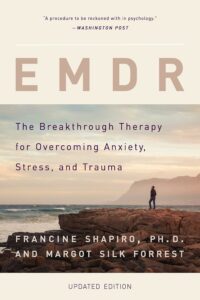
EMDR The Breakthrough Therapy for Overcoming Anxiety, Stress, and Trauma (Basic, 2016)
This book explains how painful life experiences are physically stored in our brains and how the breakthrough eye movement therapy EMDR can bring relief.
Are addiction-related memories malleable by working memory competition? Transient effects on memory vividness and nicotine craving in a randomized lab experiment (Journal of Behavior Therapy and Experimental Psychiatry)
Study concludes that eye movements provide a valuable way of coping with the acute effects of craving during smoking cessation attempts.
The relative efficacy of bona fide psychotherapies for post-traumatic stress disorder: a meta-analytical evaluation of randomized controlled trials (BMC Psychiatry)
Trauma focused treatments, prolonged exposure and exposure therapies were slightly more efficacious than other therapies in PTSD treatment.
Blurring emotional memories using eye movements: Individual differences and speed of eye movements (European Journal of Psychotraumatology)
This study found that dual-task interventions (eye movements) reduce memory vividness and emotionality more than no task, with greater effects from higher cognitive load, but tailoring eye movement speed to an individual’s working memory capacity does not improve outcomes.
Self-esteem treatment in anxiety: A randomized controlled crossover trial of eye movement desensitization and reprocessing (EMDR) versus competitive memory training (COMET) in patients with anxiety disorders (Behaviour Research and Therapy)
Study comparing EMDR vs. Competitive Memory Training (COMET) for low self-esteem in patients with anxiety disorders.
The efficacy of eye movement desensitization and reprocessing for posttraumatic stress disorder and depression among Syrian refugees: Results of a randomized controlled trial (Psychological Medicine)
EMDR may be effective in reducing PTSD and depression symptoms among Syrian refugees with PTSD located in a refugee camp.
Prolonged exposure and EMDR for PTSD v. a PTSD waiting list condition: Effects on symptoms of psychosis, depression and social functioning in patients with chronic psychotic disorders (Psychological Medicine)
In patients with chronic psychotic disorders prolonged exposure (PE) and EMDR not only reduced PTSD symptoms, but also paranoid thoughts.
Letter to the Editor: Treating post-traumatic stress disorder by resource activation in Cambodia (World Psychiatry)
An RCT for the treatment of PTSD in Cambodia, with one group utilizing resourcing strategies based on EMDR resource development and installation (RDI) and the other group a waitlist.
Amygdala volumetric change following psychotherapy for posttraumatic stress disorder (The Journal of Neuropsychiatry and Clinical Neurosciences)
Impact of EMDR and prolonged exposure on the volumes of the amygdala and hippocampus in 20 patients with PTSD assessed via MRI.
