EMDR Consultation Go With That Magazine® Issue
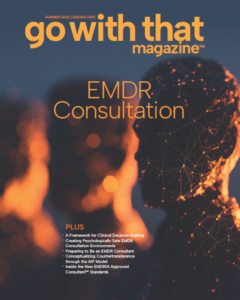 This article introduces the updated EMDRIA Approved Consultant™ Standards and the collaborative process used to develop them. It outlines the consultant’s roles as educator, motivator, and evaluator; distinguishes consultation from supervision; and explains how the standards support ethical, reflective, culturally responsive, and developmentally focused consultation.
EMDRIA members can access all other articles and issues at the Go With That Magazine® homepage.
Raising the Bar: Inside the New EMDRIA Approved Consultant™ Standards
“Consultation has always been at the heart of Eye Movement Desensitization and Reprocessing (EMDR) therapy. It is where clinicians move beyond manuals and training and begin to integrate EMDR into the complexity of real clinical work. Consultation is where the therapist’s confidence grows, questions sharpen and professional identity takes shape. Consultants are not only educators, motivators and evaluators; they are stewards of clinical quality and professional development in the field.
Yet while consultation has long been central to EMDR practice, expectations for what consultation should look like—especially at the advanced levels have often been learned informally rather than articulated clearly.
Most EMDR consultants did not learn how to consult from a guidebook. They learned through their experiences of doing, observing, adapting and discovering, often through trial and error. As the EMDR community grows, so does the need for shared language and clearer expectations around consulting.
This article will describe the updating of the EMDRIA Approved Consultant™ Standards, the general process, and how they embody our emphasis on a developmental approach (being better tomorrow than we are today) and the pillars who identify our community: pursuing excellence, building community, opening pathways and expanding understandings.
EMDRIA™ developed the updated Approved Consultant™ Standards with intentional inclusion of the EMDR community creating a practical framework that reflects both the responsibility and the relational nature of consultation. Rather than redefining consultation, these standards name and structure what skilled consultants are already doing. The standards clarify the purpose and scope of EMDR consultation outlining expectations for both consultants and consultee. They emphasize reflective and deliberative practice, ethical responsibility and trauma-informed relationships that foster safety, growth and professional identity.” … [Keep reading by clicking below.]
This issue also includes the following articles:
- Case Conceptualization in EMDR Therapy: A Framework for Clinical Decision-Making in Complex Trauma and Dissociative Disorders by Dolores Mosquera, INTRA-TP Spain
- Space for Joy, Visibility, and Connection: Creating Psychologically Safe EMDR Consultation Environments by Joshualin Dean, MS, LMHC, NCC
- How Coaching High School Students Prepared Me to Be an EMDR Consultant by Jamie Marich, Ph.D., LPCC-S, REAT
- Conceptualizing Countertransference through the AIP Model: Bringing Relational Depth to EMDR Consultation by Jessica Downs, LCSW, Cassie Krajewski, LCSW and Laurel Thornton, LPC
- Counselor’s Corner
- Community Voices
Back to Focal Point Blog Homepage
Additional Resources
If you are a therapist interested in the EMDR training:
- Learn more about EMDR therapy at the EMDRIA™ Library
- Learn more about EMDR Training
- Search for an EMDR Training Provider
- Check out our EMDR Training FAQ
If you are EMDR trained:
- Check out the EMDRIA™ Focal Point Blog
- Learn more about EMDRIA™ membership
- Search for EMDR Continuing Education opportunities
If you are an EMDRIA™ Member:
Related Articles