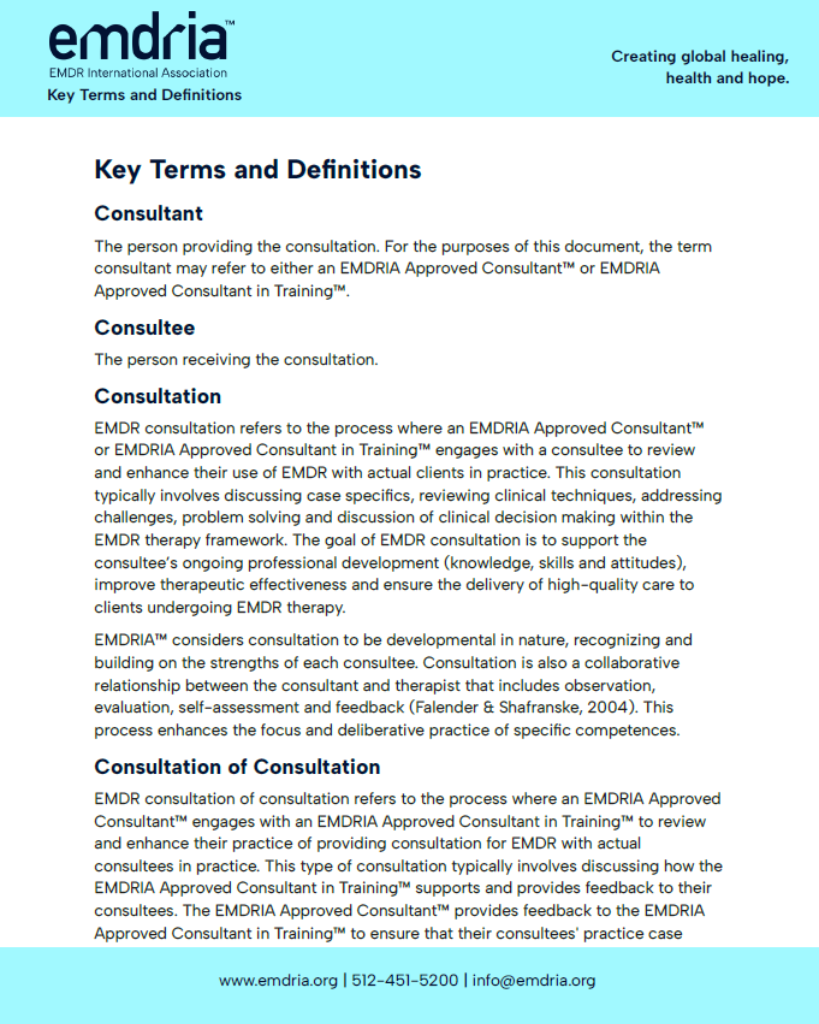
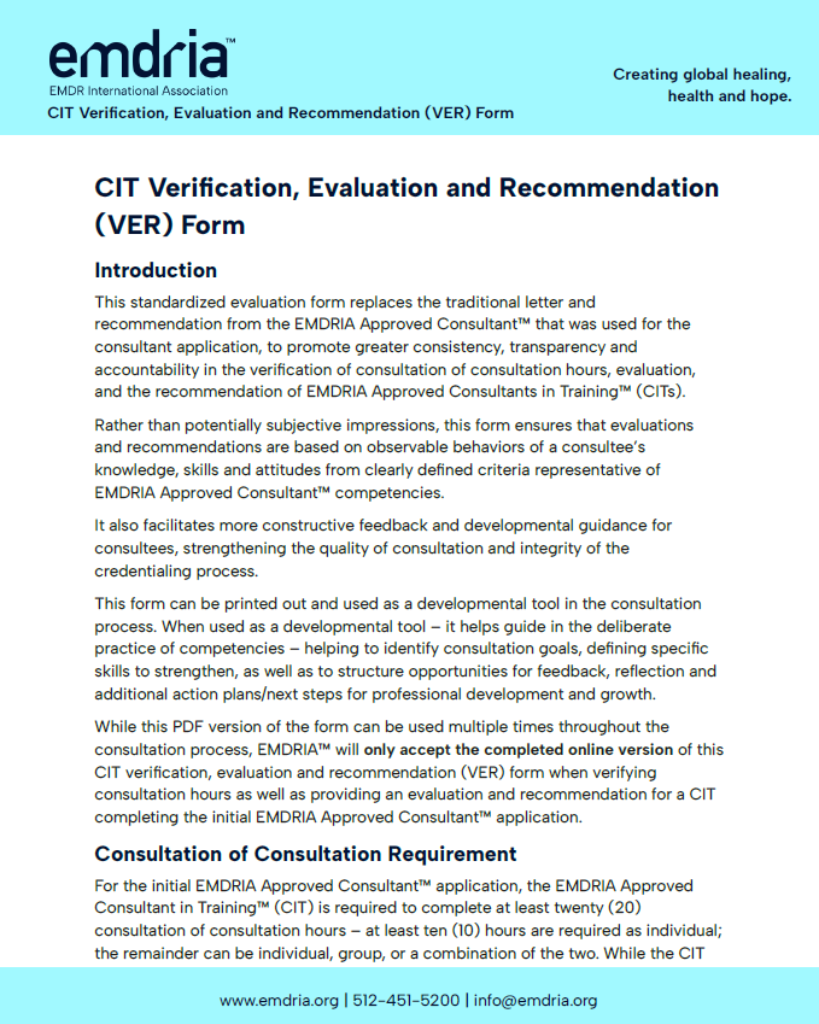
Core Competencies for EMDRIA Approved Consultants™
This packet outlines the core competencies for EMDRIA Approved Consultants™, detailing the knowledge, skills, attitudes, and ethical foundations required to support effective, developmentally informed EMDR consultation.
This packet includes the following PDFs:
- Adapting EMDR Therapy Knowledge
- Attitudes – Interpersonal and Intrapersonal
- Consultation Skills
- Cultural Humility and Ethics, IDEA
- EMDR Therapy Skills
- Foundational EMDR Therapy Knowledge
- General Therapeutic Knowledge
- General Therapeutic Skills
- Teaching Skills
- Therapeutic Consultation Alliance
Transcript
Adapting EMDR Therapy Knowledge
Last updated: 01/27/2026
This competency reflects the ability to apply a strong theoretical understanding of the AIP model to guide thoughtful adaptations of EMDR therapy. Adaptations are made with intention and clarity, preserving the integrity of the EMDR approach.
[Graphic highlighting the “adapting EMDR therapy knowledge” branch of the EMDRIA Approved Consultant™ Competencies. Surrounding the graphic are the words “Therapeutic/Consultation Alliance” and “Cultural Humility and Ethics/IDEA”]
Clinical Experience
A consultant has extensive knowledge of different applications of EMDR therapy. A consultant applies understanding gained from working with diverse populations and complex clinical presentations, and draws from real-world experiences to offer relevant insights, guide case conceptualization, and support effective clinical decision-making.
This expertise enables the consultant to support consultees in enhancing their confidence and increasing their effectiveness when working with diverse populations and complex cases.
Adaptation and Integration of EMDR Therapy
A consultant utilizes a depth of EMDR knowledge and clinical expertise to determine when, why, and how to adapt EMDR without compromising the integrity of the model. This involves integration of EMDR with other evidence-based modalities when clinically appropriate and includes rationale for integration. Consultants must embody both technical mastery and clinical discernment in the use of adaptation of EMDR therapy. Consultants should guide consultees to remain grounded in the EMDR model while adapting thoughtfully and ethically to real-world complexities and diverse client needs.
This expertise enables the consultant to support consultees to adapt and integrate EMDR as appropriate for clients’ needs and situations.
[Document 2]
Attitudes – Interpersonal and Intrapersonal
Last updated: 02/18/2026
Intrapersonal and interpersonal attitudes and dispositions reflect enduring patterns of beliefs, emotions, and behaviors that shape how individuals relate to themselves and others (Hogg & Vaughan, 2005). These dispositions influence actions, values, and motivation in clinical practice. They evolve over time through feedback, reflective self-awareness, deliberate and focused practice, and intentional personal growth.
[Graphic highlighting the “Attitudes” branch of the EMDRIA Approved Consultant™ Competencies. Surrounding the graphic are the words “Therapeutic/Consultation Alliance” and “Cultural Humility and Ethics/IDEA”]
Self-Awareness
A consultant has the ability to know their own limitations and competencies, manage their personal reactions, biases, and cultural awareness.
Supportive Dispositions
A consultant demonstrates a variety of supportive dispositions such as integrity toward EMDR treatment, and use of affirming, accepting, and understanding attitudes towards consultees.
Positive Influence and Model
A consultant models positive behaviors such as professionalism, vulnerability, and self-care.
Willingness to Learn
A consultant is aware of the latest research, trends, and updates in the field of EMDR therapy to provide evidence-based guidance and incorporate new findings into practice. Consultants seek to attain and maintain competence in EMDR consultation through formal education and training as well as using EMDRIA resources (including those found in the EMDRIA™ Library). Consultants also develop constructive relationships with other consultants by seeking opportunities for feedback toward self-improvement.
[Document 3]
Consultation Skills
Last updated: 02/18/2026
This competency encompasses the cognitive understanding and applied skills required for effective consultation, demonstrated through modeling, teaching, and responsive support that address the diverse needs of consultees across varying levels of practice, experience, and training.
[Graphic highlighting the “Consultation Skills” branch of the EMDRIA Approved Consultant™ Competencies. Surrounding the graphic are the words “Therapeutic/Consultation Alliance” and “Cultural Humility and Ethics/IDEA”]
Demonstrates Ethical and Professional Standards
A consultant adheres to the ethical guidelines and professional standards of their profession and within their scope of practice.
- By identifying and addressing any issues of transference and/or countertransference, consultants manage consultation relationships professionally and ethically.
Maintains Professional Boundaries
A consultant maintains professional boundaries with their consultees and recognizes that consultation is focused on enhancing clinical skills, and it is not psychotherapy. A consultant does not provide consultation for a spouse, partner, family members and/or relatives. A consultant does not provide therapy to current consultees.
- By focusing on the professional development of the consultee, when necessary, consultants may want to encourage consultees to engage in their own personal therapy as appropriate; however, this occurs outside the context of consultation and with a different therapist who is not the consultant.
Provides Developmentally Attuned Support
A consultant assesses the individual skills and experience levels of their consultees and, remains cognizant that learning and mastering EMDR can feel overwhelming. The consultant normalizes these challenges, providing empathetic support during emotionally difficult or uncertain clinical moments.
- By helping consultees manage self-doubt and emotional responses with sensitivity, consultants can support the consultee in developing their proficiency in EMDR therapy with confidence and resilience. Additionally, consultants support consultees in practicing new skills in a deliberate and focused way.
Applies Familiarity and Consistency with EMDRIA™ Standards and EMDR Research
A consultant adheres to EMDRIA™ standards and stays abreast of resources and current EMDR research.
- By staying informed of updates to standards and resources, consultants effectively guide consultees through the certification process, supporting compliance with required standards, and upholding the integrity and credibility of EMDR training and practice.
Facilitates Effective Group Consultations – if applicable
A consultant effectively facilitates group consultations by establishing a clear structure that promotes group safety, cohesion, and respectful discussion.
- By skillfully guiding group dynamics to encourage meaningful peer feedback and collaborative learning, consultants ensure that logistical elements—such as allocating appropriate time for each case discussion—support equitable participation and maximize the group’s educational value.
[Document 3]
Cultural Humility and Ethics/IDEA
Last updated: 02/18/2026
Cultural Humility and Ethics
Cultural humility and ethics are essential in the EMDR consultation process. Consultants model the same sensitivity clinicians are called to bring to their clients. Humility means acknowledging that learning is ongoing and that no one person holds all the answers. This mindset not only strengthens the consultation relationship but also supports ethical, culturally responsive EMDR practice that better supports and serves diverse clients.
[Graphic highlighting the EMDRIA Approved Consultant™ Competencies. Surrounding the graphic are the words “Therapeutic/Consultation Alliance” and “Cultural Humility and Ethics/IDEA”]
Inclusion, Diversity, Equity, and Access (IDEA)
Inclusion, Diversity, Equity, and Access (IDEA) is a guiding framework at EMDRIA™ and for EMDR Consultation. It reminds consultants to create learning environments where all voices are welcomed, respected, and represented. By broaching IDEA in consultation, consultants intentionally acknowledge the impact of cultural background, lived experience, and systemic barriers on both clients and clinicians and recognize that such conversations deepen trust and foster mutual learning and greater cultural attunement.
This framework ensures that EMDR skills are developed with cultural humility, that consultees feel safe to bring their full identities into the process, and that the practice of EMDR therapy remains accessible and equitable for the diverse communities it serves. IDEA as a framework requires a consultant who constantly engages in self-assessment and actively engages in learning to keep their own biases in check to support consultees from different backgrounds—with curiosity and understanding.
[Document 5]
EMDR Therapy Skills
Last updated: 02/18/2026
This competency encompasses the consultant’s ability to support the development and refinement of EMDR therapy skills in consultees. It involves guiding consultees in the accurate implementation of EMDR procedures, maintaining fidelity to the standard protocol while allowing for clinically appropriate adaptations, and promoting confidence, precision, and ethical judgment in the application of EMDR interventions.
[Graphic highlighting the “EMDR Therapy Skills” branch of the EMDRIA Approved Consultant™ Competencies. Surrounding the graphic are the words “Therapeutic/Consultation Alliance” and “Cultural Humility and Ethics/IDEA”]
Applies Foundational EMDR Therapy Knowledge
A consultant guides consultees in applying foundational EMDR therapy knowledge as outlined in this document. This includes integrating the AIP model, the Eight Phases of
EMDR therapy, and the Three-Pronged Approach into case conceptualization and treatment planning.
- By demonstrating the application of foundational EMDR therapy knowledge, the consultant models the use of EMDR as a guiding clinical framework, promotes cultural humility throughout the consultation process, and supports consultees in effectively integrating EMDR principles into their clinical practice.
Adapts EMDR Therapy Knowledge
A consultant guides consultees in applying adaptations for EMDR therapy as outlined in this document. This includes helping consultees recognize when and how to modify EMDR treatment. Through this process, the consultant models flexibility, ethical decision-making, and client-centered responsiveness while reinforcing EMDR as the guiding clinical framework.
- By demonstrating the ability to adapt EMDR therapy, the consultant models flexibility and clinical judgment in applying EMDR principles to diverse client needs and settings.
[Document 6]
Foundational EMDR Therapy Knowledge
Last updated: 02/18/2026
This competency involves the capacity to use a theoretical understanding of the AIP model and application of EMDR therapy to assess, conceptualize, plan, and implement treatment in a consistent and effective manner.
[Graphic highlighting the “Foundational EMDR Therapy Knowledge” branch of the EMDRIA Approved Consultant™ Competencies. Surrounding the graphic are the words “Therapeutic/Consultation Alliance” and “Cultural Humility and Ethics/IDEA”]
AIP Model
A consultant demonstrates a thorough understanding of the AIP model and its implications for case conceptualization and treatment planning with a client-centered approach that considers setting of practice.
- This expertise enables the consultant to support consultees in using the AIP therapy model in their clinical practice.
8-Phases Overall
A consultant demonstrates a thorough knowledge of the 8 phases of EMDR therapy. This includes clearly explaining and applying each phase with clinical flexibility and adherence to EMDR treatment.
- This expertise enables the consultant to support consultees in explaining and applying each phase clearly, organizing and prioritizing targets, managing client stuck points skillfully, and applying the 8 phases framework in a client-centered way.
3-Pronged Approach
A consultant demonstrates a thorough knowledge of the Three-Pronged Approach and understands its integration into case conceptualization, treatment planning, and clinical decision making.
- This expertise enables the consultant to support consultees in engaging in a comprehensive reprocessing of maladaptive experiences across time domains— past trauma, present triggers, and future possible traumatic situations. Clinicians should use the Three-Pronged Approach with flexibility to adapt to each client’s needs.
Knowledge and Application of Case Conceptualization and Treatment Planning
A consultant demonstrates a thorough knowledge of case conceptualization, including identifying and addressing potential blocks in the therapeutic process.
- This expertise enables the consultant to support consultees in the development of treatment plans that are client-centered and that use the AIP model and the phases of EMDR therapy. Detailed examination of client cases to gain insights, address therapeutic challenges, and refine treatment strategies is required to develop this competence.
Cultural Humility and Ethics
A consultant demonstrates a thorough knowledge in culturally responsive care and individualized approaches to EMDR therapy, considering diverse consultee and client backgrounds, identities, and trauma experiences to integrate this knowledge into case conceptualization and treatment planning that includes cultural humility and an awareness of personal biases.
- This expertise enables the consultant to support consultees in recognizing how culture, context, and individual differences inform therapeutic needs and responses.
EMDR as a Guiding Framework
A consultant demonstrates a thorough knowledge of EMDR not just as a technique, but a clinical therapeutic approach that informs how clinicians conceptualize cases, how they relate to their clients, and how they support healing.
- This expertise enables the consultant to support consultees in maintaining integrity to the model across diverse settings and clinicians.
How to Address Common Missteps
A consultant demonstrates a thorough knowledge of how to identify, address, and support the correction of common missteps that can compromise EMDR treatment, client safety, and therapeutic effectiveness. This requires both clinical knowledge and educational attunement through reflective and structured guidance.
- This expertise enables the consultant to support consultees in recognizing and acknowledging missteps in clinical practice and brainstorming ideas on how to address similar situations in the future.
[Document 7]
General Therapeutic Knowledge
Last updated: 02/18/2026
This competency involves the capacity to use a theoretical understanding and application to assess, conceptualize, plan, and implement a course of therapy in a consistent and effective manner.
[Graphic highlighting the “General Therapeutic Knowledge” branch of the EMDRIA Approved Consultant™ Competencies. Surrounding the graphic are the words “Therapeutic/Consultation Alliance” and “Cultural Humility and Ethics/IDEA”]
Mental Health Problems
A consultant possesses a solid working knowledge and understanding of a wide range of mental health problems, including those in the current version of the Diagnostic and Statistical Manual of Mental Disorders (DSM) and/or the International Classifications of Diseases (ICD). If a consultant does not have sufficient experience to address specific mental health concerns, they are expected to acknowledge these limitations transparently and refer the consultee to an appropriate expert or qualified professional.
- This expertise enables the consultant to support consultees in accurate case conceptualization, appropriate treatment planning, and the safe application of therapy tailored to the complexities of each client’s diagnosis and presentation.
Trauma and Trauma-Informed Principles
A consultant demonstrates comprehensive knowledge and understanding of trauma and trauma-informed principles, emphasizing safety, choices, empowerment, collaboration, and cultural consideration in the therapeutic process. Trauma-informed care is a framework that recognizes the impact of trauma and emphasizes safety, stabilization, trust, and avoidance of re-traumatization. It guides how services are delivered, supports readiness for treatment, but does not necessarily involve direct processing of traumatic memories. Trauma-focused treatment, such as EMDR therapy, directly targets traumatic experiences using structured, evidence-based protocols. Grounded in the Adaptive Information Processing (AIP) model, trauma-focused EMDR involves the reprocessing of maladaptively linked memories. In short, trauma-informed care creates the conditions for safety and engagement; trauma-focused EMDR therapy treats the trauma itself.
- This expertise enables the consultant to support consultees in recognizing the widespread impact of trauma, its neurobiological effects, and the importance of pacing, stabilization, and client readiness for trauma reprocessing.
- This expertise enables the consultant to support consultees delivering therapy with sensitivity to trauma histories, cultural contexts, and individual differences to promote healing in a respectful and supportive environment.
Dissociation
A consultant possesses a thorough understanding of dissociation including various diagnostic and screening tools.
- This expertise enables the consultant to support consultees in assessing dissociative symptoms within the context of trauma and help them implement appropriate pacing, stabilization, and grounding strategies to ensure client’s emotional and physical safety.
- This expertise enables the consultant to support consultees in recognizing when specialized interventions or referrals are needed to effectively address complex dissociative presentations.
[Document 8]
General Therapeutic Skills
Last updated: 02/18/2026
This competency reflects the consultant’s ability to support a consultee in the application of general therapeutic principles.
[Graphic highlighting the “General Therapeutic Skills” branch of the EMDRIA Approved Consultant™ Competencies. Surrounding the graphic are the words “Therapeutic/Consultation Alliance” and “Cultural Humility and Ethics/IDEA”]
Foster and Maintain a Good Therapeutic Alliance
A consultant models and cultivates the ability to foster and maintain a strong therapeutic alliance with their clients and consultees, emphasizing empathy, trust, and attunement.
- By demonstrating respectful, supportive, and collaborative interactions, the consultant helps consultees understand the critical role of the therapeutic alliance in EMDR therapy and encourages them to build similar connections with their clients for effective and safe treatment outcomes.
Use and Interpret Screening and/or Assessment Tools
A consultant demonstrates proficiency in administering and interpreting therapeutic screening and/or assessment tools including trauma-related assessments.
- By guiding consultees in selecting appropriate screening and/or assessments tools, the consultant supports accurate interpretation of results within the EMDR framework, ensuring that the information enhances clinical decision-making and helps tailor interventions to the client’s unique needs.
Understand and Respond to Dysregulated, Dissociated, and/or Suicidal Clients
A consultant is skilled in guiding consultees to recognize and effectively respond to clients in distress, ensuring safety and stabilization throughout the therapeutic process.
- By emphasizing the importance of assessing emotional states, managing crises, and using grounding techniques to support regulation, consultants help consultees maintain therapeutic containment.
Collaborate with Clients
A consultant encourages and models the ability to collaboratively engage clients in exploring and choosing treatment options, fostering a client-centered, trauma-informed approach that honors their preferences, values, and readiness.
- By facilitating open dialogue about treatment options, the consultant helps consultees engage in similar conversations with their clients.
Assess and Manage Risk
A consultant demonstrates expertise in guiding consultees to assess and manage risk effectively, including identifying indicators of safety concerns such as suicidality, self-harm, or aggression and provides the consultee with appropriate ways to support clients with those presentations.
- By emphasizing ongoing risk assessment throughout treatment, the consultant supports consultees in the development of clear safety plans, and crisis interventions as needed.
Manage Therapeutic Terminations
A consultant guides consultees in navigating therapeutic terminations ethically and with care, supporting client closure, integration, and emotional readiness.
- By emphasizing the importance of reviewing treatment progress, addressing unresolved issues, and collaboratively planning for aftercare or referral when needed, the consultant supports consultees in fostering a smooth and respectful transition that honors self-determination and leaves the door open to return for consultation if appropriate.
[Document 9]
Teaching Skills
Last updated: 02/18/2026
This competency reflects cognitive aspects demonstrated in a physical capacity to perform a teaching activity/task with a successful outcome (Hoge et al., 2005). It includes an understanding of information and its application through effective teaching and transfer of knowledge techniques to support diverse needs of consultees through practice, experience, and training.
[Graphic highlighting the “Teaching Skills” branch of the EMDRIA Approved Consultant™ Competencies. Surrounding the graphic are the words “Therapeutic/Consultation Alliance” and “Cultural Humility and Ethics/IDEA”]
Creates a Positive Learning Environment
A consultant fosters a safe, inclusive, and affirming learning environment where consultees feel supported to take risks, make mistakes, and develop new skills.
- By emphasizing the creation of space for growth, consultants are promoting psychological safety, encouraging open dialogue, as well as recognizing and valuing the existing knowledge and lived experiences of each consultee. When consultants create an environment where consultees feel comfortable expressing themselves and taking risks without fear of negative consequences, this further supports consultees in fully engaging and building confidence in the consultation process.
Adapts Teaching Skills for Diverse, Adult Learner Needs
A consultant adapts their teaching approaches to meet the individual and group needs of consultees, incorporating principles of cultural responsiveness and humility along with IDEA.
- By using a variety of interactive learning methods and multimodal resources—such as questioning techniques, Socratic dialogue, visual aids, handouts, role play, explanation of protocols, and media tools (e.g., podcasts, videos, scripts), etc.— consultants promote engagement to further deepen and apply what is learned.
Fosters a Reflective Learning Process
A consultant helps consultees explore the rationale behind their clinical decisions, rather than focusing on what they did “wrong.”
- By using metaphors, analogies, and real-world case examples, consultants strive to make complex concepts accessible to support practical application.
- By practicing active listening and Socratic questioning techniques, consultants guide consultees toward their own insights, encouraging critical thinking and skill development rather than providing directive answers.
Promotes Skill Development
A consultant allows for both time and learning space for each consultee to think through a variety of different clinical options with guidance. A consultant recognizes the knowledge and skills that a consultee brings from other therapeutic approaches and other professional and personal experiences.
- By including the use of role-plays, case simulations, videos, and real-time observation within consultation sessions, consultants support the integration of EMDR protocols into diverse clinical contexts.
- By providing developmentally appropriate feedback and is delivered in a way that is constructive, non-shaming, and growth-oriented, consultants support consultees in building their own confidence, competence, and clinical judgment.
Evaluates Application of EMDR Therapy
A consultant frequently evaluates consultee competence using EMDRIA™ competencies and adherence to the established EMDR standards. Consultants review and assess a range of work products—including case documentation, session recordings (video/audio), transcripts, role plays, vivo observations, and verbal summaries—to provide precise, constructive feedback
- By guiding consultees through challenges (e.g. clinical impasses, clinical choice points, or inaccuracies) in applying standard EMDR therapy, consultants support thorough and consistent evaluation for consultee growth.
Encourages Two-Way Learning
A consultant values collaboration and establishes means to exchange knowledge, perspectives, and growth, so learning flows in both directions in a consultation relationship between consultee and consultant.
- By being open to both giving and receiving feedback, consultants model engaging in a life-long learning process.
[Document 10]
Therapeutic/Consultation Alliance
Last updated: 02/18/2026
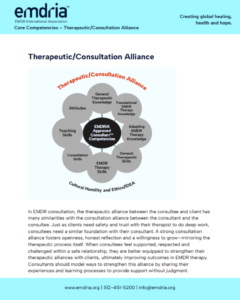
[Graphic highlighting the EMDRIA Approved Consultant™ Competencies. Surrounding the graphic are the words “Therapeutic/Consultation Alliance” and “Cultural Humility and Ethics/IDEA”]
In EMDR consultation, the therapeutic alliance between the consultee and client has many similarities with the consultation alliance between the consultant and the consultee. Just as clients need safety and trust with their therapist to do deep work, consultees need a similar foundation with their consultant. A strong consultation alliance fosters openness, honest reflection, and a willingness to grow—mirroring the therapeutic process itself. When consultees feel supported, respected, and challenged within a safe relationship, they are better equipped to strengthen their therapeutic alliances with clients, ultimately improving outcomes in EMDR therapy. Consultants should model ways to strengthen this alliance by sharing their experiences and learning processes to provide support without judgment.
Date
February 18, 2026
Creator(s)
EMDR International Association
Extent
23 pages
Publisher
EMDR International Association
Rights
Copyright © 2026 EMDR International Association
APA Citation
EMDR International Association. (2026, February 18). Core Competencies for EMDRIA Approved Consultants™ [Packet Handout].
Audience
Consultants/Consultees
Language
English
Content Type
Handout
Original Source
Consultation Toolkit, EMDRIA Toolkits/Practice Resources
Access Type
Open Access