Key Changes to EMDRIA Approved Consultant™ Standards
This document outlines key updates to EMDRIA Approved Consultant™ standards, educational programming, evaluation frameworks, supported resources, and revised application requirements.
This PDF includes 4 separate documents:
- Educational Programming
- Evaluation Framework
- Supported Resources
- Updated Application Requirements
Transcript
Educational Programming
Last updated: 02/18/2026
Overview
EMDRIA™ has enhanced the current educational programming to support EMDRIA Approved Consultants™ in deepening their clinical expertise and strengthening their capacity as educators, motivators, and evaluators in the EMDR therapy process. This includes developing required courses for the initial and renewal applications.
This programming provides a framework for developing a consultant’s knowledge, skills, and attitudes by fostering reflective practice, and enhancing the ability to assess and support consultee’s growth.
Grounded in EMDRIA’s Approved Consultant™ standards and adult learning principles, these educational opportunities ensure that consultation remains a reflective, ethical, practical, and culturally responsive process – to support the next generation of EMDR therapists in upholding EMDRIA’s™ mission to sustain professional excellence and foster healing through the continued growth of EMDR practitioners.
Offerings
EMDRIA is committed to supporting consultants to adopt the core competencies outlined in the standards document. The current offerings are:
- EMDRIA Approved Consultant™ Online Community
- EMDRIA Approved Consultant™ Day – virtual and in-person
Through targeted learning opportunities, consultants receive practical guidance, case-based learning, opportunities for interaction with other consultants, and reflective application of skills. The new additions are:
- Foundations of EMDR Consultation course – required for the initial consultant application
- Core Competencies in EMDR Consultation course – required for the initial consultant application
- Courses for the renewal consultant application – more information about these courses coming later
This programming ensures that consultants not only learn about the competencies but actively integrate them into their consultation practice, fostering consistency, excellence, and continued professional growth across the EMDR community.
The educational programming for EMDRIA Approved Consultants™ models a continuum of life-long learning that includes instruction, information, reflection, and practice.
Instruction
- Provides information
- Provides guidance
- Provides structure and direction
Information
- Provides contextual knowledge by a variety of consultants
- Includes research literature, concepts, and specialized protocols
Practice
- Allows for practice and adaptation
- Provides opportunities for ownership, creativity, and feedback
Reflection
- Includes engagement and feedback
- Encourages questions and connections
[Document 2]
Evaluation Framework
Last updated: 02/18/2026
Overview
Evaluation is an integral component of the consultation process, providing both structure and accountability for the consultee’s professional growth. Consultants are responsible for assessing a consultee’s readiness to receive the EMDRIA Approved Consultant™ credential.
Evaluation should be based on observable competencies, reflective practice, and ethical standards rather than subjective impressions. When providing recommendations, consultants are expected to offer clear, constructive feedback that highlights strengths, identifies areas for continued development, and supports the consultee’s commitment to clinical excellence. This process ensures that recommendations made to EMDRIA™ reflect integrity, fairness, and adherence to established professional standards.
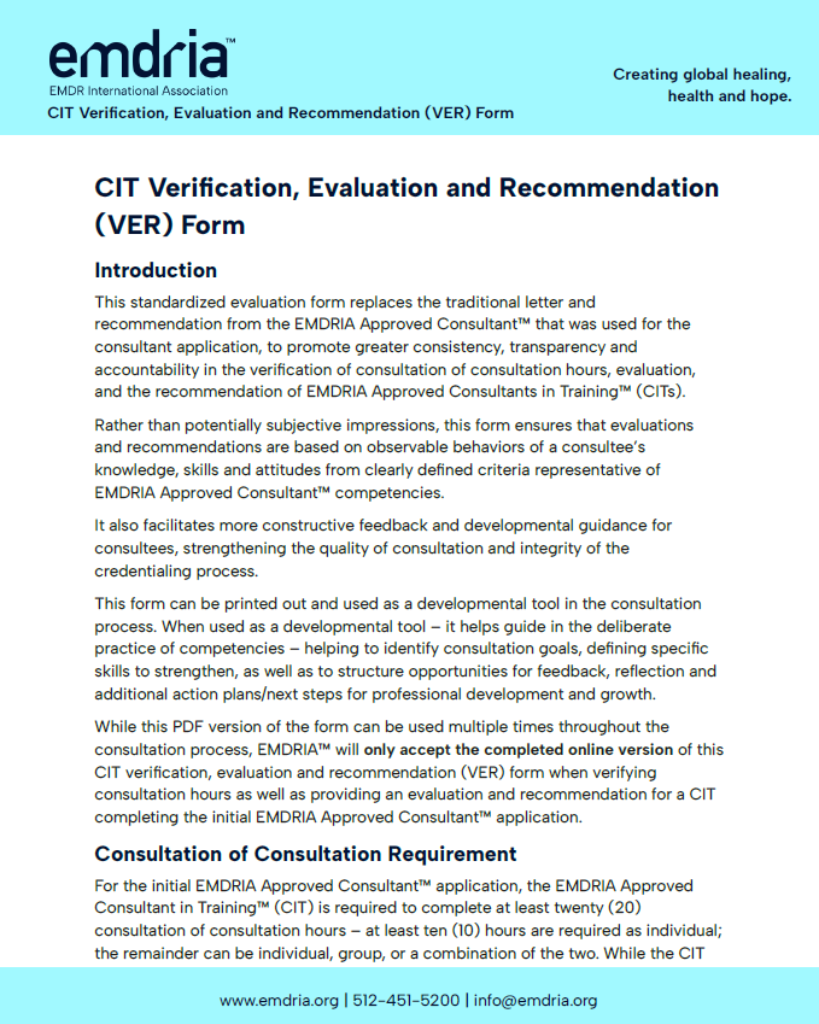
EMDRIA™ has created an online form (CIT Verification, Evaluation, and Recommendation Form) to replace the traditional letter and recommendation from the EMDRIA Approved Consultant™ to promote greater consistency, transparency, and accountability in the evaluation of EMDRIA Approved Consultants in Training (CITs). While narrative letters often vary in detail and emphasis, a structured form provides a standardized way to verify hours of consultation and assess competencies across knowledge, skills, and attitudes. This form ensures that recommendations are based on observable behaviors and clearly defined criteria based on the standards rather than subjective impressions. In addition, the form facilitates more constructive feedback and developmental guidance for consultees, strengthening the quality of the knowledge, skills, and attitudes associated with consultation, as well as in the integrity of the credentialing process.
Ways to Use the Form as an Evaluation Tool
1. Summary Tool
To document consultation hours as well as documenting progress, summarizing improvement, and evaluating readiness for the EMDRIA Approved Consultant™ credential. While the form may be used multiple times throughout the consultation process to support development, it is required that the consultant submit the completed online evaluation form to EMDRIA™ when providing a final recommendation for credentialing. More information on using the form as a summary tool can be found below.
2. Developmental Tool
To guide the deliberate and focused practice of competencies – helping identify consultation goals, define specific skills to strengthen, and structure opportunities for feedback, reflection, and growth. The form is not required by EMDRIA™ if it is used in this way. The form (or a similar resource such as the EMDRIA’s Consultant Self-Assessment) may also be used as part of on-going self-reflection by the EMDRIA Approved Consultant in Training™ or Consultant™. More information on using the form as a developmental tool can be found below.
Summary Tool
Consultation of Consultation Requirement
An EMDRIA Approved Consultant in Training™ (CIT) is required to complete at least twenty (20) consultation of consultation hours – at least ten (10) hours are required as individual, the remainder can be individual, group, or a combination of the two. While the CIT can work with multiple consultants, EMDRIA™ will only accept consultation of consultation hours and recommendations from up to three (3) consultants.
Evaluation Form Requirements
Regardless of recommendation, each consultant that the CIT obtains consultation of consultation hours from, will need to complete the form, in its entirety, – which includes:
1. Verification of Consultation of Consultation Hours – The consultant will include the total number of consultation of consultation hours (individual and/or group) and the time frame/date range these hours took place.
2. Evaluation of CIT Based on the EMDRIA Approved Consultant™ standards –EMDRIA expects that the consultee receives a ‘Proficient’ (4) rating for each criteria. If the consultee receives less than this rating, the consultant is expected to provide recommendations for areas of growth for the consultee in the specific criteria.
a. NOTE: If a consultant has not observed a specific knowledge, skill, and/or attitude during consultation, please choose “Not Observed” and provide recommendations as appropriate.
3. Recommendation of the CIT – a selection of ‘Yes’ or ‘No’ is required. When providing a recommendation, consultants are expected to offer clear, constructive feedback that highlights strengths, identify areas for continued development, and supports the consultee’s commitment to clinical excellence.
The following table outlines the rating level and the overall description for each rating.
- Beginning Level: Minimal understanding of EMDR theory, AIP, and EMDR consultation fundamentals. Consultation sessions lack structure; feedback is vague or incorrect. Limited cultural awareness, minimal self-reflection, and requires constant guidance.
- Limited Level: Emerging but inconsistent understanding. Can identify some EMDR concepts but struggle to apply them reliably. Consultation structure is inconsistent; feedback lacks depth. Cultural awareness is surface level. Requires regular direction and correction.
- Competent Level: Solid, reliable application of EMDR principles. Consultation sessions are organized and goal oriented. Provides accurate, actionable feedback. Demonstrates reflective practice, cultural humility, and strong professional boundaries. Requires only occasional guidance.
- Proficient Level: Strong, flexible, developmentally attuned consultation practice. Integrates EMDR and AIP concepts fluidly across diverse cases. Feedback is precise and tailored. Demonstrates advanced cultural responsiveness, intentional power awareness, and thoughtful reflection. Functions largely independently.
- Advanced Level: Skillfully synthesize complex clinical, cultural, and systemic factors within the EMDR framework. Grounded in a deep and nuanced understanding of the AIP model. Provides consultation that is individualized, collaborative, trauma-informed, and transformative. Demonstrates profound humility, ethical leadership, culturally responsible, and highly refined reflective practice. Deeply informed and continually growing.
Consultants should provide evaluation and feedback with cultural humility and an awareness of cross-cultural dynamics, recognizing how culture, context, and communication styles shape learning and perceptions. Feedback should be grounded in IDEA principles—ensuring fairness, respect, and responsiveness—and supported by recommended resources for effective EMDR consultation.
The evaluation form reflects the developmental and multifaceted nature of consultation, integrating clinical expertise, teaching ability, reflective practice, and ethical awareness within a framework grounded in both therapeutic alliance and cultural and ethical humility.
This framework recognizes that effective consultation extends beyond technical expertise—it involves fostering growth, reflection, and confidence in consultees while maintaining a strong ethical and cultural foundation. The evaluation form based on these competencies provides a structured and transparent way to assess a consultant in training’s developmental progress to become an EMDRIA Approved Consultant™.
Beyond credentialing, the evaluation form also provides a foundation for creating an action plan for continued professional development. By reflecting on areas of growth and identifying next steps for self-improvement, consultants and consultees alike are encouraged to remain lifelong learners—striving to be better tomorrow than they are today.
Developmental Tool
The diagram below illustrates the process flow to use the form as a Developmental tool:
- Define goals for consultation
- Decide which competency (skills, knowledge, and attitude) for focus
- Practice the competency
- Assess and evaluate with intentional reflection and feedback
- Integrate feedback
- Repeat steps three to five above until proficiency is achieved
- Identify next goal for consultation
- Repeat steps two to seven above
[Graph representing this cycle of steps]
Conclusion
The Evaluation Framework for EMDRIA Approved Consultants™ provides a structured, transparent, and developmentally informed approach to assessing consultation competence. Grounded in EMDRIA’s updated standards, this framework supports consultants in offering clear, consistent, and culturally responsive feedback while documenting a consultee’s progress over time. By integrating behavioral indicators, reflective feedback loops, and an emphasis on cultural humility and ethical practice, the framework strengthens both accountability and growth within the consultation relationship.
Its purpose is not merely to evaluate, but to guide ongoing professional development and ensure that consultants are well prepared to uphold the quality, integrity, and effectiveness of EMDR therapy across diverse communities and clinical contexts.
[Document 3]
Supported Resources
Last updated: 02/18/2026
Overview
As part of implementing the revised EMDRIA Approved Consultant™ Standards, EMDRIA has developed a comprehensive set of resources designed to support consultants and consultants in training throughout their work. These materials were created with the help of the key expectations, competencies, and guidelines outlined in the standards document, ensuring consistency, clarity, and practical application.
How the Resources Were Created
The updated consultant standards served as the foundation for developing these support materials. To ensure the resources were both helpful and practical:
- Key expectations and competencies were pulled directly from the consultant standards to identify what consultants need to know and do.
- Those expectations were translated into everyday tools – such as templates, guidance documents, and educational tools – to make the standards easier to apply in real practice.
- Feedback from the virtual focus groups helped us understand where consultants needed the most clarity and support.
- Resources were aligned with recent changes to the consultant application and evaluation process, so everything works together and reflects the updated requirements.
Types of Resources Available
- The following categories of support materials are now available:
- Guidance Documents
- Consultant Self-Assessment Materials
- Templates and Examples
- Training and Education Tools
Where to Access the Resources
All consultant supported resources are available on the EMDRIA website. Some of these resources are restricted and exclusively for EMDRIA members, so you will need to login to your EMDRIA account first.
[Document 4]
Updated Application Requirements
Last updated: 02/18/2026
Overview
In conjunction with the EMDRIA Approved Consultant™ Standards, EMDRIA has revised the initial EMDRIA Approved Consultant application requirements to better reflect the competencies expected of EMDRIA Approved Consultants™. These updates are designed to streamline the process, clarify expectation, and promote a more meaningful and structured pathway from EMDRIA Approved Consultant in Training™ to EMDRIA Approved Consultant™.
Key Changes
1. EMDR Experience Requirement
Previous requirement: The applicant must have three years of EMDR experience following the completion of an EMDRIA Approved Basic Training.
Updated requirement: The applicant must have at least one year of EMDR experience following their EMDRIA CIT declaration date.
2. Consultation Experience Requirement
- New requirement: The applicant must work with a minimum of five (5) consultees.
- New requirement: The applicant must provide at least fifteen (15) hours of consultation, in total, with their consultees.
3. Notary Requirement
- Remaining requirement: The applicant must have conducted at least three hundred (300) EMDR sessions with at least seventy-five (75) clients.
- Removed requirement: The applicant must provide documentation of the above statements and have the document notarized.
- Updated requirement: The applicant will attest to the accuracy of the above statements directly within the application.
4. Consultation of Consultation Requirement
- Updated requirement: Of the twenty (20) required hours of consultation of consultation, at least ten (10) hours must be counted as individual (one-on-one).
- New requirement: The applicant can work with multiple consultants; however, EMDRIA™ will only accept consultation of consultation hours and recommendations from up to three (3) EMDRIA Approved Consultants™.
5. Consultant Evaluation & Recommendation Requirement
- Updated requirement: The consultant recommendation process has been enhanced to include an evaluation (online form) of the applicant’s progress by each consultant.
- Updated requirement: The applicant must receive a recommendation from the consultant who provided the majority of their consultation of consultation hours.
6. Peer Recommendation Requirement
- Removed requirement: The applicant no longer needs to provide two (2) letters of recommendation from their peers.
7. Continuing Education (EMDRIA Credits) Requirement
- Remaining requirement: The applicant must complete twelve (12) EMDRIA Credits
- Updated requirement: Three (3) of the twelve (12) EMDRIA Credits must come from the completion of the two (2) required consultant courses, Foundations of EMDR Consultation and Core Competencies in EMDR Consultation.
Conclusion
These updates ensure the consultant credentialing process reflects EMDRIA’s standards of professional practice and provides clear, intentional progression toward consultant-level competency. The revisions emphasize quality consultation experience, thoughtful mentorship, and continued professional development while simplifying documentation and evaluation processes.
Date
February 18, 2026
Creator(s)
EMDR International Association
Extent
11 pages
Publisher
EMDR International Association
Rights
Copyright © 2026 EMDR International Association
APA Citation
EMDR International Association. (2026, February 18). Key Changes to EMDRIA Approved Consultant™ Standards [Packet Handout].
Audience
Consultants/Consultees
Language
English
Content Type
Handout
Original Source
Consultation Toolkit, EMDRIA Toolkits/Practice Resources
Access Type
Open Access