Skip to content
EMDR International Association
  • About EMDR Therapy
    • Learn more about EMDR
      Therapy

      Find an EMDR Therapist®

      What is EMDR Therapy

      AIP Model

      AIP Model

      Experiencing EMDR Therapy

      Experiencing EMDR Therapy

      EMDR in Treatment Guidelines

      EMDR in Treatment Guidelines

      Recent Research

      Recent Research

      Uses for EMDR

      Addiction

      Addiction

      Anxiety

      Anxiety

      Childhood Trauma

      Childhood Trauma

      Depression

      Depression

      PTSD

      PTSD

  • About EMDR Therapy
    • What is EMDR therapy?
      • Adaptive Information Processing (AIP) Model
      • EMDR Therapy & Addiction
      • EMDR Therapy & Anxiety
      • EMDR Therapy & Childhood Trauma
      • EMDR Therapy & Depression
      • EMDR Therapy & PTSD
    • Experiencing EMDR Therapy
    • EMDR Therapy in Treatment Guidelines
    • Recent Research on EMDR Therapy
    • Find an EMDR Therapist®
  • Training & Events
    • EMDRIAâ„¢ Training and
      Events

      EMDRIAâ„¢ Conference
      EMDRIAâ„¢ Virtual Summit

      EMDR Basic Training

      Eligibility Requirements

      Eligibility Requirements

      5 Steps to EMDR Training

      5 Steps to EMDR Training

      EMDR Basic Training FAQs

      EMDR Basic Training FAQs

      Training vs Certification

      Training vs Certification

      Find EMDR Basic Training

      Find EMDR Basic Training

      EMDR Education Calendar

      Consultant / Trainer Events

      EMDRIA OnDemand Education

  • Training & Events
    • EMDR Basic Training
      • Eligibility Requirements for EMDR Basic Training
      • 5 Steps to Take an EMDRIAâ„¢ Approved EMDR Basic Training
      • EMDR Basic Training FAQs
      • Training vs Certification
      • Find an EMDR Basic Training
    • EMDR Education Calendar
    • Continuing Education
      • OnDemand Education
    • EMDRIA Conference
    • EMDRIA Summit
      • Summit Speaker Resources
    • EMDRIAâ„¢ Digital Badges
    • EMDRIA Certified Therapistâ„¢ Application
      • How to Market Yourself as an EMDRIA Certified Therapistâ„¢
      • EMDRIA Certified Therapistâ„¢ FAQs
      • Membership vs Certification
      • EMDRIA Certified Therapistâ„¢ Renewal
    • EMDRIA Approved Consultantâ„¢ Application
      • Updating EMDRIA Approved Consultantâ„¢ Standards
      • CIT Declaration Form
      • EMDRIA Approved Consultant in Trainingâ„¢ FAQs
      • Consultation Packet
      • EMDRIA Approved Consultantâ„¢ Renewal
      • Consultant Day Events
    • EMDRIA Credit Provider & Program Applications
    • EMDRIA Approved Trainerâ„¢ Application
    • EMDR Basic Training Policies & Requirements
    • Standards for EMDR Basic Training
    • Trainer Day Events
  • Credentialing
    • Puzzle

      Credentialing

      Apply: Certified Therapist
      Apply: Approved Consultant
      Apply: Approved Trainer

      EMDRIA Certified Therapistâ„¢

      Membership vs Certification

      Membership vs Certification

      Certification FAQs

      Certification FAQs

      Certified Therapist Renewal

      Certified Therapist Renewal

      EMDRIA Approved Consultantâ„¢

      Updating Consultant Standards

      Updating Consultant Standards

      CIT Declaration Form

      CIT Declaration Form

      Consultant-in-Training FAQs

      Consultant-in-Training FAQs

      Approved Consultant Renewal

      Approved Consultant Renewal

      EMDRIA Approved Trainerâ„¢

      EMDR Basic Training Standards

      EMDR Basic Training Standards

      Training Policies & Requirements

      Training Policies & Requirements

      EMDRIA Credit Providers

      Program Application & Guidelines

      Program Application & Guidelines

      EMDRIA Credit FAQs

      EMDRIA Credit FAQs

      EMDRIA Digital Badges

      Consultant / Trainer Events

  • Publications & Resources
    • Publications & Resources

      Search the EMDRIA Library
      Subscribe to our Blog

      Journal of EMDR Practice & Research®

      Go With That Magazine®

      Focal Point Blog

      Let's Talk EMDR Podcast

      EMDRIA Library

      Glossary of EMDR Terms

      Glossary of EMDR Terms

      Online EMDR Therapy Resources

      Online EMDR Therapy Resources

      Antiracism Resources

      Antiracism Resources

      Toolkits & Practice Resources

      Toolkits & Practice Resources

      Español: Recursos en Español

      Español: Recursos en Español

  • Publications & Resources
    • EMDRIA Library
    • Glossary of EMDR Terms
    • Antiracism Resources
    • Online EMDR Therapy Resources
    • Focal Point Blog
      • Subscribe to Focal Point Blog
    • Go With That Magazine®
    • Journal of EMDR Practice & Research®
    • Let’s Talk EMDR Podcast
    • Toolkits & Practice Resources
      • 8 Phases Toolkit
      • Building Your EMDR Practice Toolkit
      • Client Brochures
      • Addictions Toolkit
      • Depression Toolkit
      • EMDRIA Children’s Toolkit
      • Chronic Pain Toolkit
      • Military Toolkit
      • EMDR Consultation Toolkit
    • Kits y Recursos Prácticos
      • Folletos de Terapia EMDR
      • Kit de las 8 Fases
      • Kit de la Depresión
      • Kit del Dolor Crónico
      • Kit de los Niños y Niñas
  • Membership
    • Users_Group

      Membership

      Member Hub
      EMDRIA Online Community

      Join EMDRIA

      Benefits of Membership

      Benefits of Membership

      Membership vs Certification

      Membership vs Certification

      Agency Group Membership

      Agency Group Membership

      International Affiliates

      International Affiliates

      Members Only

      Account Overview

      Account Overview

      Directory Profile Information

      Directory Profile Information

      Renew Membership

      Renew Membership

      Retired Membership

      Retired Membership

  • Membership
    • Join EMDRIAâ„¢
      • Retired Membership
      • Agency Group Membership
      • International Affiliate Organizations
    • Member Hub
    • Renew EMDRIAâ„¢ Membership
    • Membership Benefits
    • EMDRIAâ„¢ Member Account Overview
    • Directory Profile Information
    • Membership vs Certification
  • About EMDRIAâ„¢
    • Circle_Help

      About EMDRIAâ„¢

      EMDRIA Foundation

      About Us

      EMDRIA 30th Anniversary

      EMDRIA 30th Anniversary

      Policies & Code of Conduct

      Policies & Code of Conduct

      EMDRIA Awards & Winners

      EMDRIA Awards & Winners

      EMDRIA FAQs

      EMDRIA FAQs

      Meet the Board of Directors

      Board News and Updates

      Board News and Updates

      Call for BoD Nominations

      Call for BoD Nominations

      Contact Media Relations

      Contact EMDRIA

  • About EMDRIAâ„¢
    • EMDRIA’s 30th Anniversary
    • EMDRIAâ„¢ FAQs
    • Contact EMDRIAâ„¢
    • Contact Media Relations
    • Meet the Board of Directors
    • Board News and Updates
      • Annual Membership Meeting
    • EMDR International Associationâ„¢ Policies
    • EMDRIAâ„¢ Awards & Winners
    • EMDRIA Foundation
FacebookTwitterLinkedinInstagramWordpress
  • Join EMDRIAâ„¢
  • Contact
  • Find an EMDR Therapist®
EMDR International Association
Log In
  • About EMDR Therapy
    • Learn more about EMDR
      Therapy

      Find an EMDR Therapist®

      What is EMDR Therapy

      AIP Model

      AIP Model

      Experiencing EMDR Therapy

      Experiencing EMDR Therapy

      EMDR in Treatment Guidelines

      EMDR in Treatment Guidelines

      Recent Research

      Recent Research

      Uses for EMDR

      Addiction

      Addiction

      Anxiety

      Anxiety

      Childhood Trauma

      Childhood Trauma

      Depression

      Depression

      PTSD

      PTSD

  • About EMDR Therapy
    • What is EMDR therapy?
      • Adaptive Information Processing (AIP) Model
      • EMDR Therapy & Addiction
      • EMDR Therapy & Anxiety
      • EMDR Therapy & Childhood Trauma
      • EMDR Therapy & Depression
      • EMDR Therapy & PTSD
    • Experiencing EMDR Therapy
    • EMDR Therapy in Treatment Guidelines
    • Recent Research on EMDR Therapy
    • Find an EMDR Therapist®
  • Training & Events
    • EMDRIAâ„¢ Training and
      Events

      EMDRIAâ„¢ Conference
      EMDRIAâ„¢ Virtual Summit

      EMDR Basic Training

      Eligibility Requirements

      Eligibility Requirements

      5 Steps to EMDR Training

      5 Steps to EMDR Training

      EMDR Basic Training FAQs

      EMDR Basic Training FAQs

      Training vs Certification

      Training vs Certification

      Find EMDR Basic Training

      Find EMDR Basic Training

      EMDR Education Calendar

      Consultant / Trainer Events

      EMDRIA OnDemand Education

  • Training & Events
    • EMDR Basic Training
      • Eligibility Requirements for EMDR Basic Training
      • 5 Steps to Take an EMDRIAâ„¢ Approved EMDR Basic Training
      • EMDR Basic Training FAQs
      • Training vs Certification
      • Find an EMDR Basic Training
    • EMDR Education Calendar
    • Continuing Education
      • OnDemand Education
    • EMDRIA Conference
    • EMDRIA Summit
      • Summit Speaker Resources
    • EMDRIAâ„¢ Digital Badges
    • EMDRIA Certified Therapistâ„¢ Application
      • How to Market Yourself as an EMDRIA Certified Therapistâ„¢
      • EMDRIA Certified Therapistâ„¢ FAQs
      • Membership vs Certification
      • EMDRIA Certified Therapistâ„¢ Renewal
    • EMDRIA Approved Consultantâ„¢ Application
      • Updating EMDRIA Approved Consultantâ„¢ Standards
      • CIT Declaration Form
      • EMDRIA Approved Consultant in Trainingâ„¢ FAQs
      • Consultation Packet
      • EMDRIA Approved Consultantâ„¢ Renewal
      • Consultant Day Events
    • EMDRIA Credit Provider & Program Applications
    • EMDRIA Approved Trainerâ„¢ Application
    • EMDR Basic Training Policies & Requirements
    • Standards for EMDR Basic Training
    • Trainer Day Events
  • Credentialing
    • Puzzle

      Credentialing

      Apply: Certified Therapist
      Apply: Approved Consultant
      Apply: Approved Trainer

      EMDRIA Certified Therapistâ„¢

      Membership vs Certification

      Membership vs Certification

      Certification FAQs

      Certification FAQs

      Certified Therapist Renewal

      Certified Therapist Renewal

      EMDRIA Approved Consultantâ„¢

      Updating Consultant Standards

      Updating Consultant Standards

      CIT Declaration Form

      CIT Declaration Form

      Consultant-in-Training FAQs

      Consultant-in-Training FAQs

      Approved Consultant Renewal

      Approved Consultant Renewal

      EMDRIA Approved Trainerâ„¢

      EMDR Basic Training Standards

      EMDR Basic Training Standards

      Training Policies & Requirements

      Training Policies & Requirements

      EMDRIA Credit Providers

      Program Application & Guidelines

      Program Application & Guidelines

      EMDRIA Credit FAQs

      EMDRIA Credit FAQs

      EMDRIA Digital Badges

      Consultant / Trainer Events

  • Publications & Resources
    • Publications & Resources

      Search the EMDRIA Library
      Subscribe to our Blog

      Journal of EMDR Practice & Research®

      Go With That Magazine®

      Focal Point Blog

      Let's Talk EMDR Podcast

      EMDRIA Library

      Glossary of EMDR Terms

      Glossary of EMDR Terms

      Online EMDR Therapy Resources

      Online EMDR Therapy Resources

      Antiracism Resources

      Antiracism Resources

      Toolkits & Practice Resources

      Toolkits & Practice Resources

      Español: Recursos en Español

      Español: Recursos en Español

  • Publications & Resources
    • EMDRIA Library
    • Glossary of EMDR Terms
    • Antiracism Resources
    • Online EMDR Therapy Resources
    • Focal Point Blog
      • Subscribe to Focal Point Blog
    • Go With That Magazine®
    • Journal of EMDR Practice & Research®
    • Let’s Talk EMDR Podcast
    • Toolkits & Practice Resources
      • 8 Phases Toolkit
      • Building Your EMDR Practice Toolkit
      • Client Brochures
      • Addictions Toolkit
      • Depression Toolkit
      • EMDRIA Children’s Toolkit
      • Chronic Pain Toolkit
      • Military Toolkit
      • EMDR Consultation Toolkit
    • Kits y Recursos Prácticos
      • Folletos de Terapia EMDR
      • Kit de las 8 Fases
      • Kit de la Depresión
      • Kit del Dolor Crónico
      • Kit de los Niños y Niñas
  • Membership
    • Users_Group

      Membership

      Member Hub
      EMDRIA Online Community

      Join EMDRIA

      Benefits of Membership

      Benefits of Membership

      Membership vs Certification

      Membership vs Certification

      Agency Group Membership

      Agency Group Membership

      International Affiliates

      International Affiliates

      Members Only

      Account Overview

      Account Overview

      Directory Profile Information

      Directory Profile Information

      Renew Membership

      Renew Membership

      Retired Membership

      Retired Membership

  • Membership
    • Join EMDRIAâ„¢
      • Retired Membership
      • Agency Group Membership
      • International Affiliate Organizations
    • Member Hub
    • Renew EMDRIAâ„¢ Membership
    • Membership Benefits
    • EMDRIAâ„¢ Member Account Overview
    • Directory Profile Information
    • Membership vs Certification
  • About EMDRIAâ„¢
    • Circle_Help

      About EMDRIAâ„¢

      EMDRIA Foundation

      About Us

      EMDRIA 30th Anniversary

      EMDRIA 30th Anniversary

      Policies & Code of Conduct

      Policies & Code of Conduct

      EMDRIA Awards & Winners

      EMDRIA Awards & Winners

      EMDRIA FAQs

      EMDRIA FAQs

      Meet the Board of Directors

      Board News and Updates

      Board News and Updates

      Call for BoD Nominations

      Call for BoD Nominations

      Contact Media Relations

      Contact EMDRIA

  • About EMDRIAâ„¢
    • EMDRIA’s 30th Anniversary
    • EMDRIAâ„¢ FAQs
    • Contact EMDRIAâ„¢
    • Contact Media Relations
    • Meet the Board of Directors
    • Board News and Updates
      • Annual Membership Meeting
    • EMDR International Associationâ„¢ Policies
    • EMDRIAâ„¢ Awards & Winners
    • EMDRIA Foundation
Home / Resources / PTSD / Post-traumatic stress disorder and its associated factors among internally displaced people due to conflict in Northwest Ethiopia (Frontiers in Public Health)

Share on social media

Post-traumatic stress disorder and its associated factors among internally displaced people due to conflict in Northwest Ethiopia (Frontiers in Public Health)

 Post-traumatic stress disorder and its associated factors among internally displaced people due to conflict in Northwest Ethiopia

This study aimed to determine the prevalence of PTSD among internally displaced people in Northwest Ethiopia and recommends EMDR therapy alongside other treatment options.


Article Abstract

“Background: Post-traumatic stress disorder (PTSD) is a mental health condition that develops after being exposed to trauma, such as experiencing or witnessing life-threatening events, including war and other natural disasters. Despite the high levels of conflict, little attention has been given to post-traumatic stress disorder, particularly in low- and middle-income countries. Therefore, this study aimed to determine the prevalence of post-traumatic stress disorder and its associated factors among internally displaced people in Northwest Ethiopia.

Methods: A cross-sectional study design was employed from June to July 2022 in Northwest Ethiopia among internally displaced people. Simple random sampling was used to recruit 410 study participants. The standard tools used in this study included the Post-Traumatic Stress Disorder Checklist for DSM-5 (PLC-5), Kessler-10, and Oslo Social Support Scale to assess various variables. Binary logistic regression analysis was used to identify factors associated with post-traumatic stress disorder. Statistically significant factors were selected at a 95% confidence interval (CI) with adjusted odds ratio (AOR).

Results: The prevalence of post-traumatic stress disorder among internally displaced people was 54.3%, with a 95% CI (49.5, 59.3). Current substance use [AOR 95% CI: 2.01(1.16, 3.48)]; living arrangements, such as living alone or with non-relatives [AOR = 2.13; 95% CI (1.17, 3.86) and AOR = 2.39; 95% CI: (1.21, 4. 70), respectively]; being violated [AOR = 2.49; 95% CI: (1.26, 4.94)]; and psychological distress [AOR = 3.21; 95% CI: (4.35, 9.34)] were significantly associated with post-traumatic stress disorder.

Conclusion: The prevalence of post-traumatic stress disorder among internally displaced people was high. Therefore, stakeholders should provide immediate interventions that include further assessments using diagnostic criteria. In addition, Eye Movement Desensitization and Reprocessing psychotherapy along with selective serotonin reuptake inhibitors as psycho-pharmacological treatment are recommended. Furthermore, efforts should be made to reduce the identified risk factors to improve outcomes for individuals with post-traumatic stress disorder.“

—Description from publisher

Article Access

Open Access

Melkam, M., Medfu Takelle, G., Kibralew, G., & Nakie, G. (2025). Post-traumatic stress disorder and its associated factors among internally displaced people due to conflict in Northwest Ethiopia. Frontiers in Public Health, 13:1386566. Open access: https://doi.org/10.3389/fpubh.2025.1386566

View the Resource
Basic Info Collapse

Date
March 10, 2025

Creator(s)
Mamaru Melkam, Girmaw Medfu Takelle, Getasew Kibralew

Contributor(s)
Girum Nakie

Topics
PTSD, Tragedies

Client Population
Immigrants/Refugees, Racial/Cultural/Ethnic Groups

More Info Collapse

Extent
10 pages

Publisher
Frontiers

Rights
© 2025 Melkam, Medfu Takelle, Kibralew and Nakie. This is an open-access article distributed under the terms of the Creative Commons Attribution License (CC BY). The use, distribution or reproduction in other forums is permitted, provided the original author(s) and the copyright owner(s) are credited and that the original publication in this journal is cited, in accordance with accepted academic practice. No use, distribution or reproduction is permitted which does not comply with these terms.

APA Citation
Melkam, M., Medfu Takelle, G., Kibralew, G., & Nakie, G. (2025). Post-traumatic stress disorder and its associated factors among internally displaced people due to conflict in Northwest Ethiopia. Frontiers in Public Health, 13:1386566. Open access: https://doi.org/10.3389/fpubh.2025.1386566

Audience
EMDR Therapists, Other Mental Health Professionals

Language
English

Content Type
Article, Peer-Reviewed

Access Type
External Resource, Open Access

Related Resources
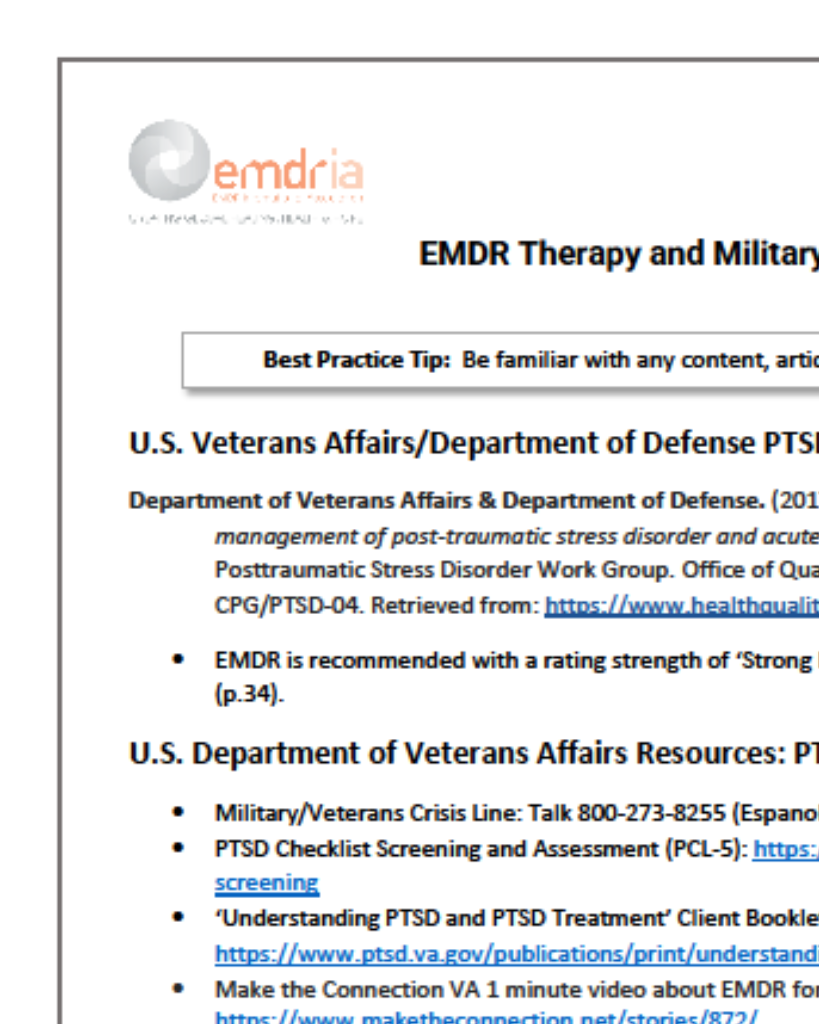
EMDR Therapy and Military Resource List

Read More

Mental health and conflict: A pilot of an online eye movement desensitization and reprocessing (EMDR) intervention for forcibly displaced Syrian women (Frontiers in Public Health)

Read More

An overview of systematic reviews on mental health promotion, prevention, and treatment of common mental disorders for refugees, asylum seekers, and internally displaced persons (Cochrane Database of Systematic Reviews)

Read More

Find an EMDR Therapist®

EMDRIAâ„¢ has more than 18,000 members trained to provide EMDR Therapy. Find a therapist near you.

Find an EMDR Therapist®
d2088683554149097441c3e1f6c13679941fbfdf (1)
EMDRIA

7000 N Mo Pac Expy
Ste 200
Austin, TX 78731-3013

info@emdria.org

512-451-5200

EMDRIA Facebook EMDRIA Twitter EMDRIA LinkedIn EMDRIA YouTube EMDRIA Online Community
  • About EMDR Therapy
  • EMDR Training and Education
  • EMDRIAâ„¢ Membership
  • Publications & Resources
  • EMDRIA Online Community
  • EMDRIA Foundation
  • Privacy Policy
  • Copyright Policy
  • Accessibility Statement
  • Sitemap

© 1995-2026 EMDR International Association™. All rights reserved.

Website by Flipside Group

  • This field is for validation purposes and should be left unchanged.
  • This field is hidden when viewing the form
  • This field is hidden when viewing the form
  • This field is hidden when viewing the form
  • This field is hidden when viewing the form
  • This field is hidden when viewing the form
  • Please be aware that email is not a secure means of communication and spam filters may prevent your email from reaching the therapist. We recommend you follow up with a phone call. Sending an email using this page does not guarantee that the recipient will receive, read, or respond to your email.

    If this is an emergency do not use this form. Call 911 or your nearest hospital.

We use cookies to ensure the best website experience. See our privacy policy to learn more.