Skip to content
EMDR International Association
  • About EMDR Therapy
    • Learn more about EMDR
      Therapy

      Find an EMDR Therapist®

      What is EMDR Therapy

      AIP Model

      AIP Model

      Experiencing EMDR Therapy

      Experiencing EMDR Therapy

      EMDR in Treatment Guidelines

      EMDR in Treatment Guidelines

      Recent Research

      Recent Research

      Uses for EMDR

      Addiction

      Addiction

      Anxiety

      Anxiety

      Childhood Trauma

      Childhood Trauma

      Depression

      Depression

      PTSD

      PTSD

  • About EMDR Therapy
    • What is EMDR therapy?
      • Adaptive Information Processing (AIP) Model
      • EMDR Therapy & Addiction
      • EMDR Therapy & Anxiety
      • EMDR Therapy & Childhood Trauma
      • EMDR Therapy & Depression
      • EMDR Therapy & PTSD
    • Experiencing EMDR Therapy
    • EMDR Therapy in Treatment Guidelines
    • Recent Research on EMDR Therapy
    • Find an EMDR Therapist®
  • Training & Events
    • EMDRIA™ Training and
      Events

      EMDRIA™ Conference
      EMDRIA™ Virtual Summit

      EMDR Basic Training

      Eligibility Requirements

      Eligibility Requirements

      5 Steps to EMDR Training

      5 Steps to EMDR Training

      EMDR Basic Training FAQs

      EMDR Basic Training FAQs

      Training vs Certification

      Training vs Certification

      Find EMDR Basic Training

      Find EMDR Basic Training

      EMDR Education Calendar

      Consultant / Trainer Events

      EMDRIA OnDemand Education

  • Training & Events
    • EMDR Basic Training
      • Eligibility Requirements for EMDR Basic Training
      • 5 Steps to Take an EMDRIA™ Approved EMDR Basic Training
      • EMDR Basic Training FAQs
      • Training vs Certification
      • Find an EMDR Basic Training
    • EMDR Education Calendar
    • Continuing Education
      • OnDemand Education
    • EMDRIA Conference
    • EMDRIA Summit
      • Summit Speaker Resources
    • EMDRIA™ Digital Badges
    • EMDRIA Certified Therapist™ Application
      • How to Market Yourself as an EMDRIA Certified Therapist™
      • EMDRIA Certified Therapist™ FAQs
      • Membership vs Certification
      • EMDRIA Certified Therapist™ Renewal
    • EMDRIA Approved Consultant™ Application
      • Updating EMDRIA Approved Consultant™ Standards
      • CIT Declaration Form
      • EMDRIA Approved Consultant in Training™ FAQs
      • EMDRIA Approved Consultant™ Renewal
      • Consultant Day Events
    • EMDRIA Credit Provider & Program Applications
    • EMDRIA Approved Trainer™ Application
    • EMDR Basic Training Policies & Requirements
    • Standards for EMDR Basic Training
    • Trainer Day Events
  • Credentialing
    • Puzzle

      Credentialing

      Apply: Certified Therapist
      Apply: Approved Consultant
      Apply: Approved Trainer

      EMDRIA Certified Therapist™

      Membership vs Certification

      Membership vs Certification

      Certification FAQs

      Certification FAQs

      Certified Therapist Renewal

      Certified Therapist Renewal

      EMDRIA Approved Consultant™

      Updating Consultant Standards

      Updating Consultant Standards

      CIT Declaration Form

      CIT Declaration Form

      Consultant-in-Training FAQs

      Consultant-in-Training FAQs

      Approved Consultant Renewal

      Approved Consultant Renewal

      EMDRIA Approved Trainer™

      EMDR Basic Training Standards

      EMDR Basic Training Standards

      Training Policies & Requirements

      Training Policies & Requirements

      EMDRIA Credit Providers

      Program Application & Guidelines

      Program Application & Guidelines

      EMDRIA Credit FAQs

      EMDRIA Credit FAQs

      EMDRIA Digital Badges

      Consultant / Trainer Events

  • Publications & Resources
    • Publications & Resources

      Search the EMDRIA Library
      Subscribe to our Blog

      Journal of EMDR Practice & Research®

      Go With That Magazine®

      Focal Point Blog

      Let's Talk EMDR Podcast

      EMDRIA Library

      Glossary of EMDR Terms

      Glossary of EMDR Terms

      Online EMDR Therapy Resources

      Online EMDR Therapy Resources

      Antiracism Resources

      Antiracism Resources

      Toolkits & Practice Resources

      Toolkits & Practice Resources

      Español: Recursos en Español

      Español: Recursos en Español

  • Publications & Resources
    • EMDRIA Library
    • Glossary of EMDR Terms
    • Antiracism Resources
    • Online EMDR Therapy Resources
    • Focal Point Blog
      • Subscribe to Focal Point Blog
    • Go With That Magazine®
    • Journal of EMDR Practice & Research®
    • Let’s Talk EMDR Podcast
    • Toolkits & Practice Resources
      • 8 Phases Toolkit
      • Building Your EMDR Practice Toolkit
      • Client Brochures
      • Addictions Toolkit
      • Depression Toolkit
      • EMDRIA Children’s Toolkit
      • Chronic Pain Toolkit
      • Military Toolkit
      • EMDR Consultation Toolkit
    • Kits y Recursos Prácticos
      • Folletos de Terapia EMDR
      • Kit de las 8 Fases
      • Kit de la Depresión
      • Kit del Dolor Crónico
      • Kit de los Niños y Niñas
  • Membership
    • Users_Group

      Membership

      Member Hub
      EMDRIA Member Connect

      Join EMDRIA

      Benefits of Membership

      Benefits of Membership

      Membership vs Certification

      Membership vs Certification

      Agency Group Membership

      Agency Group Membership

      International Affiliates

      International Affiliates

      Members Only

      Account Overview

      Account Overview

      Directory Profile Information

      Directory Profile Information

      Renew Membership

      Renew Membership

      Retired Membership

      Retired Membership

  • Membership
    • Join EMDRIA™
      • Retired Membership
      • Agency Group Membership
      • International Affiliate Organizations
    • Member Hub
    • Renew EMDRIA™ Membership
    • Membership Benefits
    • EMDRIA™ Member Account Overview
    • Directory Profile Information
    • Membership vs Certification
  • About EMDRIA™
    • Circle_Help

      About EMDRIA™

      EMDRIA Foundation

      About Us

      EMDRIA 30th Anniversary

      EMDRIA 30th Anniversary

      Policies & Code of Conduct

      Policies & Code of Conduct

      EMDRIA Awards & Winners

      EMDRIA Awards & Winners

      EMDRIA FAQs

      EMDRIA FAQs

      Meet the Board of Directors

      Board News and Updates

      Board News and Updates

      Contact Media Relations

      Contact EMDRIA

  • About EMDRIA™
    • EMDRIA’s 30th Anniversary
    • EMDRIA™ FAQs
    • Contact EMDRIA™
    • Contact Media Relations
    • Board News and Updates
      • Annual Membership Meeting
    • EMDR International Association™ Policies
    • EMDRIA™ Awards & Winners
    • EMDRIA Foundation
FacebookTwitterLinkedinInstagramWordpress
  • Join EMDRIA™
  • Contact
  • Find an EMDR Therapist®
EMDR International Association
Log In
  • About EMDR Therapy
    • Learn more about EMDR
      Therapy

      Find an EMDR Therapist®

      What is EMDR Therapy

      AIP Model

      AIP Model

      Experiencing EMDR Therapy

      Experiencing EMDR Therapy

      EMDR in Treatment Guidelines

      EMDR in Treatment Guidelines

      Recent Research

      Recent Research

      Uses for EMDR

      Addiction

      Addiction

      Anxiety

      Anxiety

      Childhood Trauma

      Childhood Trauma

      Depression

      Depression

      PTSD

      PTSD

  • About EMDR Therapy
    • What is EMDR therapy?
      • Adaptive Information Processing (AIP) Model
      • EMDR Therapy & Addiction
      • EMDR Therapy & Anxiety
      • EMDR Therapy & Childhood Trauma
      • EMDR Therapy & Depression
      • EMDR Therapy & PTSD
    • Experiencing EMDR Therapy
    • EMDR Therapy in Treatment Guidelines
    • Recent Research on EMDR Therapy
    • Find an EMDR Therapist®
  • Training & Events
    • EMDRIA™ Training and
      Events

      EMDRIA™ Conference
      EMDRIA™ Virtual Summit

      EMDR Basic Training

      Eligibility Requirements

      Eligibility Requirements

      5 Steps to EMDR Training

      5 Steps to EMDR Training

      EMDR Basic Training FAQs

      EMDR Basic Training FAQs

      Training vs Certification

      Training vs Certification

      Find EMDR Basic Training

      Find EMDR Basic Training

      EMDR Education Calendar

      Consultant / Trainer Events

      EMDRIA OnDemand Education

  • Training & Events
    • EMDR Basic Training
      • Eligibility Requirements for EMDR Basic Training
      • 5 Steps to Take an EMDRIA™ Approved EMDR Basic Training
      • EMDR Basic Training FAQs
      • Training vs Certification
      • Find an EMDR Basic Training
    • EMDR Education Calendar
    • Continuing Education
      • OnDemand Education
    • EMDRIA Conference
    • EMDRIA Summit
      • Summit Speaker Resources
    • EMDRIA™ Digital Badges
    • EMDRIA Certified Therapist™ Application
      • How to Market Yourself as an EMDRIA Certified Therapist™
      • EMDRIA Certified Therapist™ FAQs
      • Membership vs Certification
      • EMDRIA Certified Therapist™ Renewal
    • EMDRIA Approved Consultant™ Application
      • Updating EMDRIA Approved Consultant™ Standards
      • CIT Declaration Form
      • EMDRIA Approved Consultant in Training™ FAQs
      • EMDRIA Approved Consultant™ Renewal
      • Consultant Day Events
    • EMDRIA Credit Provider & Program Applications
    • EMDRIA Approved Trainer™ Application
    • EMDR Basic Training Policies & Requirements
    • Standards for EMDR Basic Training
    • Trainer Day Events
  • Credentialing
    • Puzzle

      Credentialing

      Apply: Certified Therapist
      Apply: Approved Consultant
      Apply: Approved Trainer

      EMDRIA Certified Therapist™

      Membership vs Certification

      Membership vs Certification

      Certification FAQs

      Certification FAQs

      Certified Therapist Renewal

      Certified Therapist Renewal

      EMDRIA Approved Consultant™

      Updating Consultant Standards

      Updating Consultant Standards

      CIT Declaration Form

      CIT Declaration Form

      Consultant-in-Training FAQs

      Consultant-in-Training FAQs

      Approved Consultant Renewal

      Approved Consultant Renewal

      EMDRIA Approved Trainer™

      EMDR Basic Training Standards

      EMDR Basic Training Standards

      Training Policies & Requirements

      Training Policies & Requirements

      EMDRIA Credit Providers

      Program Application & Guidelines

      Program Application & Guidelines

      EMDRIA Credit FAQs

      EMDRIA Credit FAQs

      EMDRIA Digital Badges

      Consultant / Trainer Events

  • Publications & Resources
    • Publications & Resources

      Search the EMDRIA Library
      Subscribe to our Blog

      Journal of EMDR Practice & Research®

      Go With That Magazine®

      Focal Point Blog

      Let's Talk EMDR Podcast

      EMDRIA Library

      Glossary of EMDR Terms

      Glossary of EMDR Terms

      Online EMDR Therapy Resources

      Online EMDR Therapy Resources

      Antiracism Resources

      Antiracism Resources

      Toolkits & Practice Resources

      Toolkits & Practice Resources

      Español: Recursos en Español

      Español: Recursos en Español

  • Publications & Resources
    • EMDRIA Library
    • Glossary of EMDR Terms
    • Antiracism Resources
    • Online EMDR Therapy Resources
    • Focal Point Blog
      • Subscribe to Focal Point Blog
    • Go With That Magazine®
    • Journal of EMDR Practice & Research®
    • Let’s Talk EMDR Podcast
    • Toolkits & Practice Resources
      • 8 Phases Toolkit
      • Building Your EMDR Practice Toolkit
      • Client Brochures
      • Addictions Toolkit
      • Depression Toolkit
      • EMDRIA Children’s Toolkit
      • Chronic Pain Toolkit
      • Military Toolkit
      • EMDR Consultation Toolkit
    • Kits y Recursos Prácticos
      • Folletos de Terapia EMDR
      • Kit de las 8 Fases
      • Kit de la Depresión
      • Kit del Dolor Crónico
      • Kit de los Niños y Niñas
  • Membership
    • Users_Group

      Membership

      Member Hub
      EMDRIA Member Connect

      Join EMDRIA

      Benefits of Membership

      Benefits of Membership

      Membership vs Certification

      Membership vs Certification

      Agency Group Membership

      Agency Group Membership

      International Affiliates

      International Affiliates

      Members Only

      Account Overview

      Account Overview

      Directory Profile Information

      Directory Profile Information

      Renew Membership

      Renew Membership

      Retired Membership

      Retired Membership

  • Membership
    • Join EMDRIA™
      • Retired Membership
      • Agency Group Membership
      • International Affiliate Organizations
    • Member Hub
    • Renew EMDRIA™ Membership
    • Membership Benefits
    • EMDRIA™ Member Account Overview
    • Directory Profile Information
    • Membership vs Certification
  • About EMDRIA™
    • Circle_Help

      About EMDRIA™

      EMDRIA Foundation

      About Us

      EMDRIA 30th Anniversary

      EMDRIA 30th Anniversary

      Policies & Code of Conduct

      Policies & Code of Conduct

      EMDRIA Awards & Winners

      EMDRIA Awards & Winners

      EMDRIA FAQs

      EMDRIA FAQs

      Meet the Board of Directors

      Board News and Updates

      Board News and Updates

      Contact Media Relations

      Contact EMDRIA

  • About EMDRIA™
    • EMDRIA’s 30th Anniversary
    • EMDRIA™ FAQs
    • Contact EMDRIA™
    • Contact Media Relations
    • Board News and Updates
      • Annual Membership Meeting
    • EMDR International Association™ Policies
    • EMDRIA™ Awards & Winners
    • EMDRIA Foundation
Home / Resources / PTSD / The psychophysiological response during post-traumatic stress disorder treatment with modular motion-assisted memory desensitisation and reconsolidation (3MDR) (European Journal of Psychotraumatology)

Share on social media

The psychophysiological response during post-traumatic stress disorder treatment with modular motion-assisted memory desensitisation and reconsolidation (3MDR) (European Journal of Psychotraumatology)

The psychophysiological response during post-traumatic stress disorder treatment with modular motion-assisted memory desensitisation and reconsolidation (3MDR)

The aim of this study was to explore psychophysiological responses during multi‐modular motion‐assisted memory desensitization and reconsolidation (3MDR) therapy.


Article Abstract

“Background: Psychophysiological changes are part of post-traumatic stress disorder (PTSD) symptomatology and can signal emotional engagement during psychological treatment.

Objectives: The aim of this study was to explore psychophysiological responses during multi‐modular motion‐assisted memory desensitization and reconsolidation (3MDR) therapy. Increased self-reported distress, substantially increased heart rate (HR) and breathing rate (BR) were expected at the start of therapy and predicted to improve over time. Since physical exercise demands during therapy were low, any large HR or BR responses were considered part of the psychophysiological response.

Methods: This study used pooled data collected during a randomized controlled trial of 3MDR, which demonstrated significant improvement as measured by the Clinician Administered PTSD Scale. Whilst attending therapy, HR and BR data, subjective units of distress (SUD) score and phrases to describe feelings whilst exposed to trauma-related images were collected continuously from 37 UK male military veterans with PTSD.

Results: HR and BR were significantly increased throughout all sessions (p < .01 for both). Whilst HR was raised slightly remaining on average below 100 beats/minute, BR was increased substantially with average values between 40 and 50 breaths/minute. SUD scores were very high during therapy which concurred with the many negative feelings experienced during therapy sessions. Across the course of the treatment, SUD scores (p < .01) and negative feelings were reduced (p < .001), and positive feelings have increased (p < .01) significantly, reflecting improvements in clinicians assessed PTSD symptoms. Across therapy sessions, HR (p = .888) and BR (p = .466) responses did not change.

Conclusions: The strong psychophysiological response alongside high levels of self-reported distress and negative feelings is interpreted as high emotional engagement during therapy. A novel finding was the very significant BR increase throughout recorded sessions. Future PTSD research should include BR response to therapy and explore breathing control as a treatment target.”

—Description from publisher

Article Access

Open Access 

van Deursen, R., Jones, K., Kitchiner, N., Hannigan, B., Barawi, K., & Bisson, J. I. (2021). The psychophysiological response during post-traumatic stress disorder treatment with modular motion-assisted memory desensitisation and reconsolidation (3MDR). European Journal of Psychotraumatology, 12(1), 1929027. Open access: https://doi.org/10.1080/20008198.2021.1929027 


View the Resource
Basic Info Collapse

Date
June 24, 2021

Creator(s)
Robert van Deursen, Kate Jones, Neil Kitchiner

Contributor(s)
Ben Hannigan, Kali Barawi, Jonathan I. Bisson

Topics
PTSD

Practice & Methods
Neurobiology

More Info Collapse

Extent
22 pages

Publisher
Taylor & Francis

Rights
© 2021 The Author(s). Published by Informa UK Limited, trading as Taylor & Francis Group. This is an Open Access article distributed under the terms of the Creative Commons Attribution-NonCommercial License (http://creativecommons.org/licenses/by-nc/4.0/), which permits unrestricted non-commercial use, distribution, and reproduction in any medium, provided the original work is properly cited.

APA Citation
van Deursen, R., Jones, K., Kitchiner, N., Hannigan, B., Barawi, K., & Bisson, J. I. (2021). The psychophysiological response during post-traumatic stress disorder treatment with modular motion-assisted memory desensitisation and reconsolidation (3MDR). European Journal of Psychotraumatology, 12(1), 1929027. Open access: https://doi.org/10.1080/20008198.2021.1929027 

Audience
EMDR Therapists, Other Mental Health Professionals

Language
English

Content Type
Article, Peer-Reviewed

Access Type
External Resource, Open Access

Related Resources
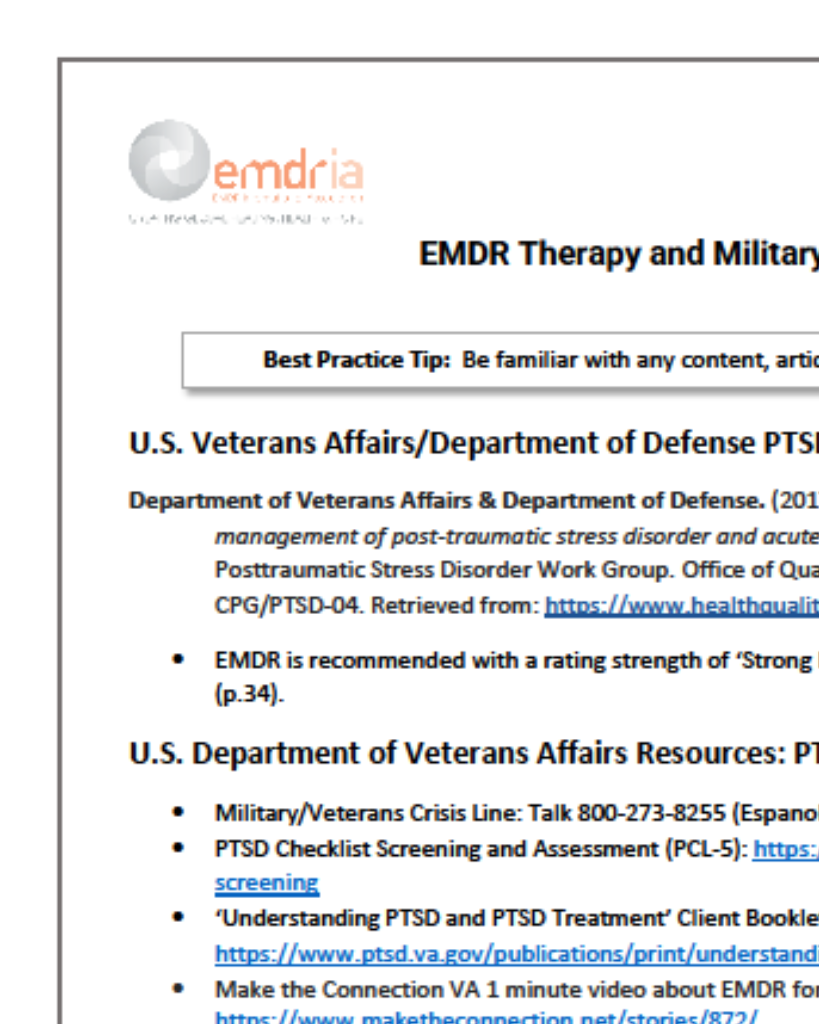
EMDR Therapy and Military Resource List

Read More

Perceived treatment processes and effects of interactive motion-assisted exposure therapy for veterans with treament-resistant posttraumatic stress disorder: A mixed methods study (European Journal of Psychotraumatology)

Read More

Decreased Emotional Dysregulation Following Multi-Modal Motion-Assisted Memory Desensitization and Reconsolidation Therapy (3MDR): Identifying Possible Driving Factors in Remediation of Treatment-Resistant PTSD (International Journal of Environmental Research and Public Health)

Read More

Find an EMDR Therapist®

EMDRIA™ has more than 18,000 members trained to provide EMDR Therapy. Find a therapist near you.

Find an EMDR Therapist®
d2088683554149097441c3e1f6c13679941fbfdf (1)
EMDRIA

7000 N Mo Pac Expy
Ste 200
Austin, TX 78731-3013

info@emdria.org

512-451-5200

EMDRIA Facebook EMDRIA Twitter EMDRIA LinkedIn EMDRIA YouTube EMDRIA Online Community
  • About EMDR Therapy
  • EMDR Training and Education
  • EMDRIA™ Membership
  • Publications & Resources
  • EMDRIA Member Connect
  • EMDRIA Foundation
  • Privacy Policy
  • Copyright Policy
  • Accessibility Statement
  • Sitemap

© 1995-2026 EMDR International Association™. All rights reserved.

Website by Flipside Group

  • This field is for validation purposes and should be left unchanged.
  • This field is hidden when viewing the form
  • This field is hidden when viewing the form
  • This field is hidden when viewing the form
  • This field is hidden when viewing the form
  • This field is hidden when viewing the form
  • Please be aware that email is not a secure means of communication and spam filters may prevent your email from reaching the therapist. We recommend you follow up with a phone call. Sending an email using this page does not guarantee that the recipient will receive, read, or respond to your email.

    If this is an emergency do not use this form. Call 911 or your nearest hospital.

We use cookies to ensure the best website experience. See our privacy policy to learn more.