The Three Roles of a Consultant
A clear, practitioner‑focused guide to the three roles of an EMDRIA Approved Consultant—Educator, Motivator, and Evaluator—and how each supports you through the EMDR credentialing journey.
Transcript
The Three Roles of a Consultant
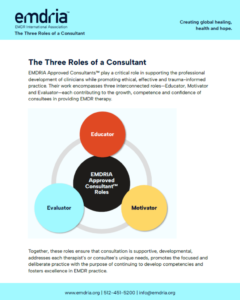
EMDRIA Approved Consultants™ play a critical role in supporting the professional development of clinicians while promoting ethical, effective and trauma-informed practice. Their work encompasses three interconnected roles—Educator, Motivator and Evaluator—each contributing to the growth, competence and confidence of consultees in providing EMDR therapy.
[Graphic with “EMDRIA Approved Consultant™ Roles” at the center and “Educator” “Evaluator” and “Motivator” surrounding it]
Together, these roles ensure that consultation is supportive, developmental, addresses each therapist’s or consultee’s unique needs, promotes the focused and deliberate practice with the purpose of continuing to develop competencies and fosters excellence in EMDR practice.
- As Educators, a consultant shares knowledge, tools and strategies to strengthen clinical or consultation skills.
- As Motivators, a consultant encourages and inspires consultees to build confidence in their clinical or consultation work.
- As Evaluators, a consultant provides accountability through constructive feedback and assesses readiness for clinical or consultation competence.
The consultant’s roles as educator, motivator and evaluator are complementary, not sequential or hierarchical, ensuring a balanced approach to learning and professional development.’
The following table outlines key tasks associated with each role, highlighting how consultants guide clinical judgment, foster skill development and encourage reflective, client-centered practice.
Educator
- Provide clarification around EMDR treatment tools, protocols, and procedures
- Explain theory and practice connections clearly
- Demonstrate techniques through modeling or role-play
- Provide information and resources as needed
- Share resources, research, and practice tools
- Recommend continuing education and further training
Motivator
- Encourage consultees to trust their clinical abilities
- Normalize challenges and setbacks as part of learning
- Recognize and affirm progress and strengths
- Inspire ongoing development and lifelong learning
- Celebrate milestones and professional achievements
- Create a supportive and safe consultation environment by modeling behaviors
Evaluator
- Assess consultee’s case presentations for the skillful and appropriate use of EMDR and other therapeutic interventions, as needed
- Review treatment plans and case conceptualization
- Provide constructive feedback on clinical decisions, highlighting strengths and areas for growth
- Assess and offer constructive feedback on ethical and trauma-informed practice with attention to cultural humility
- Determine readiness for certification with a clear evaluation framework
- Identify areas needing further training or information
Shifting Roles of the EMDR Consultant Across the Consultee’s Journey
Effective EMDR consultation requires consultants to remain attuned to:
- the unique needs of each consultee,
- each specific case being discussed and
- where the consultee is on their professional journey.
Consultants may shift fluidly between roles by:
- emphasizing evaluation when assessing competence,
- leaning into motivation to build confidence and
- providing targeted education to address gaps in knowledge, skill and/or attitudes.
This dynamic approach ensures that consultation is responsive, client-centered, consultee-centered and tailored to foster both professional growth and high-quality clinical care.
The following table highlights the emphasis of each role throughout each stage of consultation.
Stage of Consultation
Foundational Consultation (EMDR Basic Training Consultation)
- Educator: Strong emphasis – teaching goals, procedures, and protocol, case conceptualization, and foundational EMDR skills.
- Motivator: Strong emphasis – fostering safety, curiosity, and confidence in applying EMDR for the first time.
- Evaluator: Light emphasis – focusing on guiding rather than examining; providing formative feedback.
Consultation for Certification
- Educator: Moderate to strong emphasis – refining skills, integrating EMDR into complex cases, and deepening case conceptualization.
- Motivator: Moderate emphasis – supporting resilience, addressing imposter syndrome, and reinforcing professional identity.
- Evaluator: Strong emphasis – evaluating clinical competence, ethical application in a trauma-informed framework.
Consultant in Training Consultation
- Educator: Strong emphasis – teaching how to teach, model, and structure effective consultation processes.
- Motivator: Strong emphasis – encouraging development of a consultant’s identity, supporting confidence in guiding others.
- Evaluator: Strong emphasis – assessing ability to provide consultation, clinical judgment, and trauma-informed leadership.
Related Resources