Example EMDR Consultation Presentation Form
A form for consultants in training (CITs) to use to summarize a specific consultation interaction they choose to bring for discussion during the consultation of consultation process.
Transcript
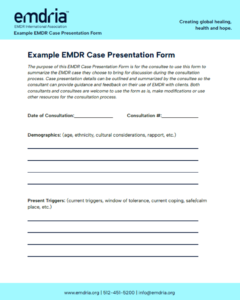
Example EMDR Consultation Presentation Form
The purpose of this EMDR Consultation Presentation Form is that the consultant in training (CIT) can use this form to summarize a specific consultation interaction they choose to bring for discussion during the consultation of consultation process. Details of the interaction can be outlined and summarized by the CIT to highlight their ability to provide feedback, guide AIP case conceptualization, and manage the consultation relationship so that the consultant can provide guidance on their instructional skills and development as an educator, motivator, and evaluator. Both consultants and CITs are welcome to use the form as is, make modifications, or use other resources to support the professional growth and mastery of consultation competencies.
CIT Name: _______________________
Session Date: _____________________
Consultant Name: ______________________
Focus of Today’s Session
CIT’s Consultation Question: What specific area of your consultation practice are you seeking feedback on today? (e.g., managing a dominant group member or a consultee who is not open to feedback, guiding AIP case conceptualization, addressing a consultee’s technical misstep, etc.) ____
Context of the Consultation Interaction
Consultee Identifier (anonymized): __
Type of Consultation (individual, group) __
Consultee’s EMDR Educational Level: (e.g., basic training trainee, certification applicant) __
Provide a short background about CIT’s work with the consultee relevant to the consultant-consultee relationship: (e.g. times of consultation, specific consultee’s strengths and areas of growth, consultee’s setting of practice) __
The Consultee’s Presentation
Consultee’s Clinical Query: Briefly summarize the clinical case(s) or question(s) the consultee brought to you. __
AIP Conceptualization: How did the consultee explain the clinical case or clinical themes (e.g. guilt/responsibility, defectiveness, safety, choices) involved in their client’s case? __
The Consultation Dialogue (The “How to Teach” Interaction)
Consultee’s Question to CIT: What was the specific question or “stuck point” the consultee asked you to help them solve? __
CIT’s Response/Intervention: Describe exactly what you said or did in response. Identify which role you were mainly utilizing in this interaction: Educator (clarifying procedural steps or information), Motivator (building confidence), or Evaluator (assessing fidelity to the EMDR model and to client’s needs). __
Theoretical Rationale: What was the “why” behind your response? How did you link your feedback back to the AIP model or to the EMDR framework (8 phases, three pronged)? __
Reflection: What do you feel you did well in your consultation recommendations? Is there anything you wish you had said or explored further that you can say later? __
Evaluation of the Consultation Process
Consultee’s Reaction: How did the consultee receive your feedback? (e.g., were they able to understand it and describe next steps in their work with their client, or did they exhibit “imposter syndrome”? Were they resistant to feedback?) __
Self-Reflection: What went well in this interaction? Where did you feel hesitant or unsure as a consultant? __
Inclusion, Diversity, Equity, and Access (IDEA): How did you intentionally broach elements of cultural humility or systemic barriers during this consultation session? __
Recommendations: What were your general recommendations for this consultee? Did you suggest specific interventions or areas of practice? __
Working Toward Consultee’s Goals: How does this interaction contribute to the consultees’ goals? __
Rationale for Structure in the Consultation Process
- Focus on Process: One helpful framework for the consultation process involves balancing macro-level conceptualization with micro-level application. In clinical sessions, the therapist maintains a perspective on the client’s overall clinical landscape and AIP case conceptualization while simultaneously focusing on making effective, in-the-moment clinical decisions. During consultation, a CIT assesses the broad clinical landscape of the consultee’s evolving skill set while providing precise, targeted feedback on the technical execution of the EMDR framework and procedural steps.
- Instructional Shift: This form ensures the CIT is not just “doing therapy” for the consultee but is instead teaching the consultee how to think through the AIP lens.
- Observable Evidence: By documenting specific questions and responses, the consultant can provide feedback based on observable consultation competencies rather than subjective impressions.
- Developmental Model: This documentation tracks the CIT’s participation in a reflective consultation practice that emphasizes intentional growth of core competencies and ability to provide feedback that is intentional and specific for the benefit of the consultee and their clients.
Related Resources