Setting Learning Goals in EMDR Consultation
Setting clear, collaborative learning goals is a cornerstone of effective EMDR consultation. This resource guides consultants in identifying consultation type, developmental stage, and learning needs, and in creating observable, measurable goals that support ongoing professional growth. Designed to be revisited throughout the consultation process, it offers practical frameworks and examples to help consultants and consultees stay focused, intentional, and aligned with EMDRIA standards.
Transcript
Setting Learning Goals in EMDR Consultation
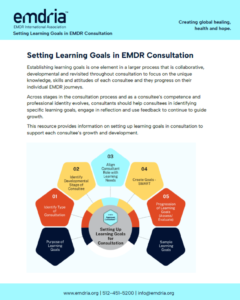
Establishing learning goals is one element in a larger process that is collaborative, developmental, and revisited throughout consultation to focus on the unique knowledge, skills, and attitudes of each consultee and they progress on their individual EMDR journeys.
Across stages in the consultation process and as a consultee’s competence and professional identity evolves, consultants should help consultees in identifying specific learning goals, engage in reflection, and use feedback to continue to guide growth.
This resource provides information on setting up learning goals in consultation to support each consultee’s growth and development.
[Graphic]
Purpose of Learning Goals for EMDR Consultation
There are several purposes in developing learning goals as part of EMDR Consultation which include the following:
- Learning goals help to guide the consultation process by clarifying expectations for both consultees and consultants.
- Learning goals help focus consultees on improvement and further development of knowledge, skills, and/or attitudes – what consultees should be able to know and do.
- Learning goals clarify what is expected of the consultee and should align with assessment and evaluation.
- Learning goals help guide consultants in terms of the particular roles to adopt–educator, motivator, and/or evaluator– to focus the relevant support to their consultees.
1. Identify the Type of Consultation
What is this Consultation for?
Each consultation type has a distinct instructional focus and expected outcomes. Identifying the specific consultation type helps to provide a foundation for specific learning goals. Learning goals should match the purpose and developmental stage of consultation, which varies across types as suggested below:
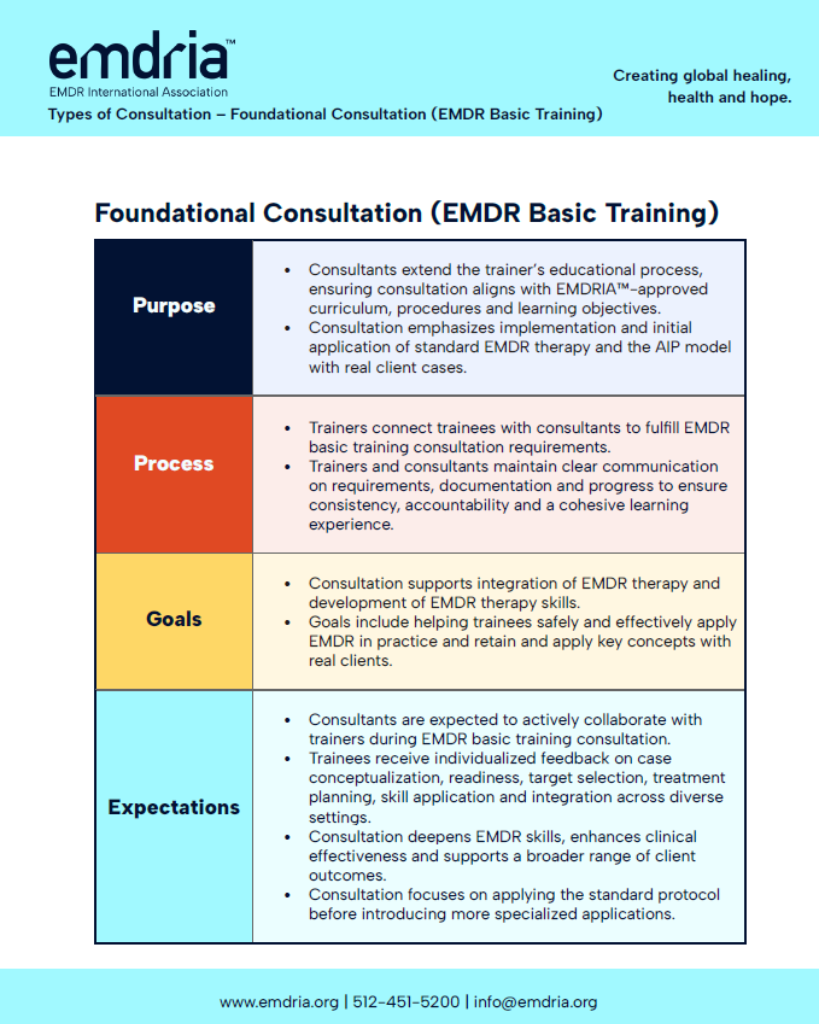
- Foundational Consultation (EMDR Basic Training Consultation) – Integrate foundational EMDR and AIP concepts and procedures into practice with actual client cases. Focus for this type of consultation is on knowledge and skill integration.
- Certification Consultation – Deepen EMDR clinical competence and decision-making with professionalism, ethical awareness, and cultural responsiveness. Focus for this type of consultation is knowing when clinical modifications are needed, and in developing clinical reasoning and flexibility.
- Consultant in Training Consultation – Develop consultation, roles (educator, motivator and evaluator), and core competencies (knowledge, skills and attitudes) to guide other EMDR clinicians.
- EMDR Case Consultation – Typically used for short-term support, the focus of this type of consultation is to strengthen clinical thinking for complex cases.
2. Identify the Developmental Stage of Consultee
Where is the Consultee in Terms of Development?
Identifying the developmental stage of each consultee involves assessing each consultee’s current understanding, skills, and emotional state to determine the appropriate level and type of support that evolves over time.
An initial interview to build rapport and through the use of techniques such as active listening and Socratic Questioning helps a consultant to explore consultee’s issues and their feelings about them.
Factors to consider when identifying the developmental stage of a consultee could include the following:
- Cognitive and Emotional Characteristics – conceptual level – how they describe their clients/consultees, ability for self-reflection, level of self-efficacy/confidence in skills and ability to solve problems
- Behavioral and Communicative Indicators – ease with individual communication style, how the consultee reacts to feedback
- Professional Experience and Competence Level – relevant to the specific type of consultation and their autonomy
3. Align Consultant Role with Learning Needs of Consultee
What is my Role as a Consultant?
When setting learning goals, consultants should also consider their own role as educator, motivator, and/or evaluator when aligning learning goals to further support the learning needs of each consultee.
For instance:
- Educator – What knowledge, skills or attitudes do I need to teach to this consultee?
- Motivator – How do I support the growth and confidence of this consultee?
- Evaluator – What knowledge, skills and/or attitudes of this consultee are being assessed or evaluated?
4. Create Learning Goals that are Both Observable and Measurable
What Should the Consultee Improve On?
The collaborative process of setting learning goals should focus on what the consultee should learn and demonstrate.
It may be helpful to create learning goals based on the SMART goal model, outlined below:
[Graphic]
S – Specific
Create 1 or 2 goals that focus on the consultee. Goals should specifically describe what the consultee will not only know but will do/demonstrate. This should match the specific type of consultation as well as the developmental level of the consultee.
Action verbs should be included in each learning goal to clearly describe what the consultee should know and be able to do. Along with general examples further below in this document, the following are verbs to consider and avoid when writing learning goals:
Verbs to Consider When Writing Learning Goals
- List, Describe, Recite, Write, Identify
- Discuss, Explain, Predict, Clarify
- Apply, Demonstrate, Prepare, Use, Integrate, Refine
- Analyze, Design, Select, Utilize, Facilitate,
- Compile, Create, Develop, Plan, Revise
- Assess, Compare, Critique, Justify
Verbs to Avoid When Writing Learning Goals
- Know, Understand, Believe
- Learn, Appreciate
- Become aware of, Become familiar with
M – Measurable
Learning goals should specifically include what the consultee will do and how it will be measured or evaluated (through various modes of observation), which may include, whenever possible, video recording or live observation to directly observe clinical skills, identify strengths and areas for growth, and provide specific, EMDR-focused feedback. When video or live observation is not permitted – such as in certain agencies, university clinics, or governmental settings – alternative behavioral samples may be used. These may include detailed case presentations, near-verbatim transcripts, structured session summaries or reflective dialogue.
Assessment should match the specific type of consultation as well as the developmental level of the consultee.
Consultants should also consider the documentation process related measurement of the learning goals to more concretely support and evaluate the consultee’s growth over time.
A – Attainable
Learning goals should be written in such a way that they are able to be accomplished within a specific time frame, including what support may be needed to successfully accomplish the goal.
R – Relevant
Learning goals should not only be tied to the learning needs of each consultee but also to the consultation type and related standards.
T – Time
Learning goals should also include a specific time frame when the goal should be completed.
5. Progression of Learning Goals
What Does the Consultee Need to Learn Now to Move Forward?
Since consultation evolves across the consultee’s growth and different types of consultation, learning goals should not be static and should be revisited throughout the consultation process as illustrated in the diagram below.
[Graphic]
Sample Learning Goals
The following indicates general examples of potential learning goals for each type of consultation – keep in mind: each learning goal should be customized for each unique consultee’s learning needs.
Foundational Consultation (Basic Training Consultation)
Consultants should clarify with the EMDRIA Approved Trainer™ what the learning goals should be, which could include statements such as the following examples:
At our next consultation session and assessed through a video recording and follow-up discussion, you should….
- Apply the 8 Phases with fidelity.
- Justify the target selection using AIP.
- Demonstrate accurate use of the standard EMDR therapy procedures introduced in basic training.
- Explain and apply AIP-informed case conceptualization for a presented case.
- Select appropriate targets and justify choices using basic training concepts.
- Develop a treatment plan consistent with training content and current clinical setting.
- Integrate feedback to strengthen EMDR skill use with diverse populations/settings.
Certification Consultation
Suggested learning goals could be:
At our next consultation session and assessed through a video recording and follow-up discussion, you should….
- Demonstrate proficiency and fidelity to the standard protocol in case work presented for consultation.
- Identify situations requiring modifications and explain how changes support safe, effective treatment.
- Apply and analyze EMDR clinical information to strengthen decision-making and EMDR practice.
- Integrate the eight phases of treatment to address clinical challenges in diverse settings.
- Refine case conceptualization and treatment planning with confidence, flexibility, and clinical integrity.
Consultant in Training Consultation
Reviewing the CIT Verification, Evaluation, and Recommendation (VER) form, suggested learning goals could be:
At our next consultation session and assessed through a video recording and follow-up discussion, you should….
- Facilitate consultation using a developmental model.
- Develop a clear consultation plan outlining goals, structure, documentation procedures, and evaluation criteria.
- Demonstrate effective consultation structure and feedback delivery in consultation work.
- Apply and analyze consultation information to strengthen consultation decision-making and adult education support for consultees.
- Integrate ethical discernment and cultural humility into consultation responses and recommendations.
- Use AIP-consistent conceptualization and treatment planning as part of consultation guidance.
EMDR Case Consultation
Set expectations collaboratively because this consultation process is not formal nor leads to a credential.
Suggested learning goals could be:
- Clarify the clinical challenge and identify decision points impacting EMDR effectiveness.
- Create case-specific intervention opinions and evaluate fit for the current presentation.
- Use feedback/recommendations to enhance EMDR proficiency for the presented case.
- Agree on practical next steps for application (that includes client safety and treatment effectiveness).
References
American Psychological Association (n.d.). Guidance for writing behavioral learning objectives. https://www.apa.org/ed/sponsor/resources/objectives.pdf
Stapleton-Corcoran, E. (2023). “Learning Objectives.” Center for the Advancement of Teaching Excellence at the University of Illinois Chicago. Retrieved March 9, 2026. from https://teaching.uic.edu/cate-teaching-guides/syllabus-course-design/learning-objectives/
Related Resources