Navigating Difficult Conversations in EMDR Consultation
Difficult conversations are an inevitable—and essential—part of EMDR consultation. This resource offers EMDR consultants a clear, compassionate framework for addressing challenges such as protocol non-adherence, resistance to feedback, and competency concerns while maintaining professionalism, curiosity, and respect. Grounded in EMDRIA™ standards, it outlines practical strategies for prevention, timely intervention, and corrective action that support both consultee development and client safety.
Transcript
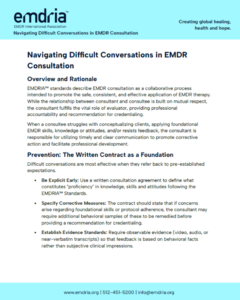
Navigating Difficult Conversations in EMDR Consultation
Overview and Rationale
EMDRIA™ standards describe EMDR consultation as a collaborative process intended to promote the safe, consistent, and effective application of EMDR therapy. While the relationship between consultant and consultee is built on mutual respect, the consultant fulfills the vital role of evaluator, providing professional accountability and recommendation for credentialing.
When a consultee struggles with conceptualizing clients, applying foundational EMDR skills, knowledge or attitudes, and/or resists feedback, the consultant is responsible for utilizing timely and clear communication to promote corrective action and facilitate professional development.
Prevention: The Written Contract as a Foundation
Difficult conversations are most effective when they refer back to pre-established expectations.
- Be Explicit Early: Use a written consultation agreement to define what constitutes “proficiency” in knowledge, skills and attitudes following the EMDRIA™ Standards.
- Specify Corrective Measures: The contract should state that if concerns arise regarding foundational skills or protocol adherence, the consultant may require additional behavioral samples of these to be remedied before providing a recommendation for credentialing.
- Establish Evidence Standards: Require observable evidence (video, audio, or near-verbatim transcripts) so that feedback is based on behavioral facts rather than subjective clinical impressions.
Managing Protocol Non-Adherence
The challenge: a consultee uses “clinical intuition” to skip steps (e.g., omitting dissociation assessment, modifying Phase 3 Assessment or providing extensive explanations that delayed reprocessing phases).
- Leaning into the Educator Role: Do not simply tell the consultee they are “wrong.” Instead, use Socratic questioning to help them explore the rationale behind the missed step.
- What was your clinical rationale for skipping the formal dissociation screen?
- How might the AIP model suggest this could impact the client’s safety during reprocessing?
- What are your thoughts about that intervention? How did it help or hinder reprocessing for the client?
- Fostering Reflective Practice: Use the “Zoom Out” approach to help the consultee see the broader clinical landscape. Help the consultee connect with the bigger picture of internal and external factors that might be impacting treatment.
- If we step back and look at the whole clinical map, how do these present triggers and symptoms connect back to the memories identified in Phase 1?
- How does the client’s desired future state inform your current target sequencing plan across the three prongs (past, present and future)?
- What is your clinical rationale for selecting this specific target right now?
- How are your own internal reactions or past clinical experiences influencing your willingness to ‘stay out of the way’ and let the client’s own processing take the lead?
- In what ways have you engaged in adaptations from the standard protocol, and what was your rationale for doing so?
- Allow yourself to be curious about what part of the process feels most uncertain.
Addressing Resistance to Feedback
The challenge: a consultee repeatedly ignores recommendations, presents with overconfidence and appears to be only interested in getting the hours for the credential.
- Normalizing the Struggle: Use the motivator role to validate that applying EMDR skills, knowledge and attitudes is a lifelong journey. Acknowledge that “imposter syndrome” can lead to defensive behaviors.
- It is very common to feel nervous when you are starting the reprocessing phases with clients at the beginning of your EMDR career. Remember that the wisdom of the client’s brain and body wants to move toward healing.
- It is very common to feel nervous when you begin as a consultant in training. Remember to maintain a curious and open attitude. Asking thoughtful questions and guiding consultees toward helpful resources are effective ways to support them in their learning and professional development.
- It usually takes several clients before therapists begin to feel more comfortable with the pacing and mechanics of EMDR therapy.
- I remember how intimidating it felt when I began using reprocessing phases with my first clients. That sense of responsibility can feel overwhelming at the beginning. Over time, though, as I saw the process unfolded and witnessed the results, that fear gradually shifted into curiosity and hope.
- To help look at this fear, let’s use the Flashforward question: what is the worst thing that could happen if you started processing with this client now?
- Constructive feedback is essential to professional growth; let’s discuss your clinical decision-making and explore the ‘why’ behind your choices rather than focusing on what went ‘wrong.’
- Identifying Parallel Processes: Reflect on whether the tension in the consultation relationship mirrors the consultee’s therapeutic relationship with their client.
- I’ve noticed some tension when we discuss this feedback. I’m wondering if this mirrors the ‘stuck’ or resistance feeling you are noticing with your client in the session?
- Consultant Self-Awareness: Ensure that your own issues (countertransference) are not contributing to the conflict. If necessary, discuss the case in your own consultation of consultation, with a colleague or in your own therapy to maintain objectivity.
- Sometimes when I notice internal tension when working with a consultee, I need to explore whether my own unprocessed past experiences (countertransference) are getting in the way of effectively assisting them.
- I’d like to model some vulnerability here and share a bit of my own learning process regarding how difficult it can be to stay out of the way of the client’s processing.
When “Corrective Measures” are Necessary
The challenge: despite feedback, the consultee does not demonstrate the required competencies for a credential.
- Providing Formative Feedback Early: Do not wait until the final hour of consultation to share concerns. Inform the consultee as soon as a lack of proficiency becomes evident.
- Developing a Remedial Action Plan: Instead of a flat “no”, create a structured developmental plan.
- At this stage of the certification process, the evaluator role is primary. I cannot recommend you yet because the work samples do not show proficiency in reprocessing phases. Let’s agree to a plan for the next three sessions: you will provide video of one reprocessing session, and we will focus specifically on your use of cognitive interweaves.
- The Power of No: If a consultee declines to implement recommendations or fails to adhere to a developmental plan to enhance their knowledge, skills and attitudes, you must thoroughly document all feedback. If you decide to withhold a recommendation for credentialing, it is essential to provide a written rationale based on observable clinical competencies and outline the specific corrective measures required for future recommendation.
Summary Tips for Success
- Stay “Consultee-Centered”: Focus on their specific needs and goals.
- Encourage Two-Way Learning: Model cultural humility by being open to the consultee’s feedback on your consultation style.
- Use Metaphors and stories: Tools like analogies and stories can soften and clarify technical feedback into accessible learning points.
Related Resources