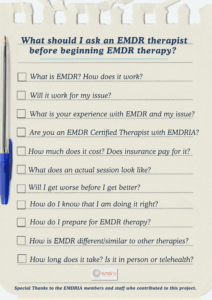
Questions to ask your EMDR therapist
Potential EMDR clients regularly ask what they should know before starting EMDR therapy. The range of answers can go in many directions, including knowledge about the process of EMDR, the eight phases, the effectiveness of EMDR, how it aids our body’s natural healing process, and how to ask about the training or credentials of the EMDR therapist. To help bring more light to this topic and provide more public awareness, we polled the EMDRIA membership. We received SO MANY great responses that we were able to create two blog posts.
- This post features EMDRIA members’ responses regarding “What should clients ask an EMDR therapist before beginning EMDR therapy?”
- Part 2 features EMDRIA members’ responses regarding “What should clients know before starting EMDR therapy?”
We grouped the most popular responses and found a few main focal questions to feature in the infographic.
Thanks to all the EMDRIA members who contributed, and view their responses below.
If you are looking for an EMDR therapist, our Find an EMDR Therapist Search is a great resource.
“What should clients ask an EMDR therapist before beginning EMDR therapy?”
Clients should ask: “When will they know they are ready to begin Phase 3? What are the signs reprocessing should slow down? What practices and strategies can they use between sessions to regulate?” *** Khatya Albano, LMFT
“1. What preparation is needed? 2. What if the things I think about are upsetting? 3. What if I want to stop? 4. What is the purpose? 5. How do we decide what to work on? 6. How long does it take? 7. How will I know when it’s finished? 8. What if I’m not good at it?/What if I have trouble doing it? 9. Are there special techniques that can make it feel safer or that can make it even more effective? 10. Are there alternatives to eye movements? 11. Can you do EMDR therapy in telehealth?“ *** Eric Aronson, PsyD
An area where new EMDR clients can get stuck is concern about their performance. Therefore, a great question is: “How do I know I am doing EMDR ‘right’?” The answer is there is not one correct way to experience EMDR. However, hearing this response directly and clearly from an EMDR clinician can provide some relief for the client. A strong EMDR clinician will nurture trust with their client and ultimately trust in the process. EMDR-trained clinicians have experienced EMDR to empathize deeply with the client’s experience.” *** Lisa Battle-Gwathney, PhD
“What can EMDR heal? How does EMDR work? What would the process look like? Is there ever a situation where EMDR wouldn’t be appropriate?” ***Janet Bayramyan, LCSW
“Why am I not doing bilateral stimulation (BLS) every session? When you say there are 8 phases to EMDR, what phases include BLS? Why is BLS not a part of all 8 phases? How long does an EMDR session last?“ *** Lydia Brown
Assuming a client is seeking a therapist, specifically, EMDR treatment, they should ask, “How did you get trained to do EMDR, and how much experience do you have in using it?“ *** Rosemary Burns, LPE-I, LPC
One of the most important questions someone should ask an EMDR therapist is: “Have you done your work, and would you tell me about that?” If a therapist has not done their work, and, it should be exhaustively, then they should not be offering EMDR. *** Suzanne Carter, LPC
“Do you (the therapist) use all of the phases of EMDR or just the eye movements?” *** Allison Champion, LMFT
Ask: “Are you certified in EMDR therapy? How much experience do you have using EMDR therapy to treat my presenting problem? Is EMDR therapy the primary modality that you use in your practice?” *** Danielle Ciccone, LPCC
“1. How long have you been an EMDR therapist? 2. Do you use the model 95 percent or more in your practice? 3. Are you certified, or do you participate in ongoing consultation? 4. Have you done your work?” Too many clients that come to my practice are flooded or believe they did EMDR, yet their work is incomplete. Many clinicians don’t obtain enough consultation after the initial training and certificate, but they advertise that they specialize in EMDR. The clients report they used tappers and talked about issues, that the clinician opened a new target each session, or the clinician is stuck and cannot fix the issue. These are significant concerns. Ask questions to ensure your clinician understands the EMDR model. *** Patricia Cornell, LMSW
“Where did you get your training? How long have you been practicing EMDR? Are you certified in EMDR? Have you kept up with advances in EMDR by taking advanced EMDR workshops (if not certified)? How do you address abreactions in the processing stage? How do you ensure a client leaves a session grounded and stabilized?” *** Camille Cunningham, LMFT
Clients should ask: “I know I want EMDR therapy, but how will I know I am ready for memory reprocessing? What will I be able to see, feel and know that lets me know I am ready for this level of therapy?” *** Anna Eckhardt, LCSW-R
“Will I have any control over my therapy?” *** Patricia Ferreiro, LPC
Client: “What is Dual Attention? And how do you know I can do it, and if I can’t, can you help me?” Therapist: “Dual Attention means being able to revisit the trauma and still being present with me, neither numb nor overwhelmed. And if you struggle, yes, I will help you. We will help you learn to orient to the present moment, and go slowly, making sure you feel attuned to and safe so that you can stay present.” *** Kathleen Fitzgerald, LPC
“What does your practice of continuing education and ongoing consultation look like to be able to continue to support your learning and work with your clients?” *** Holly Forman-Patel, LMFT, LPCC
“Have you been in therapy using EMDR before?” It’s important for your therapist to understand EMDR from a client’s perspective. Also, it is proof they believe it works. *** Latasha Gary, LCMHC
Clients should ask: “When were you trained in EMDR therapy, and what advanced training have you taken since your basic training? How comfortable are you in using the floatback in our work? Further, what do you know about trauma, and how will you prepare me for the EMDR reprocessing?“ *** Sue Genest, RCC, CCC
Beginning EMDR can feel intimidating or overwhelming. Having clear and open communication with your EMDR Therapist before you start can help decrease apprehension. Here are a few questions I recommend asking your EMDR therapist before you start therapy. “1. What are your EMDR credentials? 2. If you are Basic Trained, are you receiving consultation? 3. What issues do you most often treat when using EMDR? (Check to ensure your concern is one of the therapist’s specialty areas). 4. What outcomes do you see when working on these concerns? 5. What can I expect during an EMDR session?” *** Lauran Hahn, LMHC
“If I open this door, will I see images of the target event daily? I have done so well to keep it shoved down.” *** Andrea Hendel, LMFT
One thing clients should ask a therapist before beginning EMDR therapy is: “How can my therapist help me with tolerating the stress that can come with ‘opening up’ a memory?” Your EMDR therapist will be prepared to deliver a diverse set of EMDR-specific mindfulness and grounding strategies and will review these with you in the Phase 2 Preparation Phase. These strategies can be used to ground during processing and closeout EMDR sessions. For more information, talk to your EMDR therapist. *** Aubrey Holden
Client: “I tend to ‘zone out’ a lot. Will EMDR work for me?” If you have trouble staying present, ask your EMDR therapist to assess your ability to maintain awareness. Your therapist may do this by assessing for dissociative symptoms. EMDR is effective when you can stay in the present while accessing past trauma memories. Remember that experiencing dissociation does not mean you cannot benefit from EMDR. You will work with your therapist on strategies to bring yourself back to the present so you can move through the phases of EMDR.*** Shon Howell, LCPC
“Can EMDR work with attachment trauma?” *** Anna Kuyumcuoglu, LCAT
“Will the effects last?” *** Kristi LeBeau, LPC
“Are there any side effects to this work? Will I experience any physical symptoms as a result of this work?” I find clients aren’t aware of how somatic this work can be and that they need to do aftercare, like drinking electrolytes or lots of water after a session. *** Christine MacInnis, LMFT
“What if I can not concentrate on the eye movements?” *** Andrea Mendez, LCSW-C
“Do you offer longer sessions or intensive EMDR therapy?” So many clients benefit from a longer, dedicated period to engage in EMDR. Making solid progress through the 8 phases of EMDR in a 90 or 180-minute session, or even completing all 8 phases in an EMDR intensive, can provide a great deal of relief. It also mitigates the issue of people giving up on the process before they have completed all 8 phases. The progress I have seen people make by offering long-format EMDR has caused me to shift my entire practice to EMDR intensives. *** Charity O’Reilly, LPC
“Are you EMDR certified?” After going through the EMDR certification process several years ago, after taking the basic training, I now realize how important that is to my practice. The knowledge, learning, insight, and fidelity to the EMDR protocol I gained from becoming certified is invaluable. I can’t imagine practicing EMDR without it. I recommend that anyone seeking an EMDR therapist ensure the therapist is certified. *** Elizabeth Ossip, LCSW
“What does it mean that you are certified? How can EMDR help me?” *** Francine D Pritt, LPC
Potential clients should ask, “Is there anything I need to do to prepare?” *** Linda Reade, MA, RSW, RP
Clients should ask specifically how it works, possible outcomes, and whether their particular issue is appropriate for EMDR. *** Anne Reisman, LCSW
“What if I lose control?” A client needs to know that in EMDR, they are in charge. The client sets the pace, chooses the memory they are ready to address, and is given tools to allow them to stay in control. Trauma is often the result of having our control or autonomy taken away, and often people fear addressing their trauma because they are afraid they will lose that control again. An EMDR clinician knows how to support you while you handle a painful experience and reprocess it so that it loses its power. *** Nicole Richardson, LMFT
“How will you prepare me for EMDR Therapy? Explain the window of tolerance to me and tell me how you will help me stay in it while I reprocess. How will you ensure I am not reliving the experience too strongly while reprocessing? Will you ask how I am doing in between sessions, and how will you assist me if I am having issues?” EMDR should not typically leave one feeling like hell for days or cause destabilization. You want a therapist to work with you to implement and pace the reprocessing to minimize those issues. *** Gary Scarborough, LCSW
“1. What does the process look like? 2. Who can benefit from this approach, and who might not be suited for this approach? 3. What can I expect from this treatment? 4. Are you EMDRIA trained? 5. How often do you consult with other colleagues? 6. Can I stop EMDR treatments at any time? 7. How will we know when I can start addressing specific traumas? 8. What will we do if I start feeling overwhelmed during processing? 9. How long before I start noticing a difference? 10. Can EMDR therapy be administered virtually?” *** Romina Schnelle, LMFT
EMDR can be a life-changing process, but clients should take the necessary steps to ensure they find the right therapist fit. To begin, clients could ask the following questions: “1. Where did you receive your EMDR training, and are you EMDRIA certified? 2. How many years of EMDR experience do you have? 3. What are the risks/benefits associated with EMDR? 4. Is there anyone who is not an ideal candidate to receive EMDR treatment? 5. How long does EMDR usually take?” *** Masha Shapiro, LMHC
Clients often ask me a variety of questions, including how long I’ve been providing EMDR therapy, what are things EMDR therapy can help with, and what they should expect with reprocessing (phase 4). Other questions may offer insight into the clinician and this powerful therapy: “*What do you love about providing EMDR therapy? *Of all the therapeutic approaches, why pick EMDR therapy? *What advanced classes have you taken? *When was your last advanced class? *What is your clinical specialty? *What will you do if I “freak out”? * Do you still get regular consultations?” *** Barbara Sheehan-Zeidler, LPC
Clients should ask: “What should I expect to happen to me during the EMDR process? What will processing feel like? How will I feel after I process? How soon after processing will I notice a shift in my behavior, thoughts, feelings, etc? What do I do while I’m processing? How does processing work (within the brain, body, etc)?” *** Kristina Spurlock, LMHC
“Based on the issue(s) I’ve described, how do you imagine EMDR therapy can help? What will I feel during and after a processing session? If processing is effective, what do you imagine could change for me?” *** Lisa Stepelevich, LPC
If I had to narrow it down to one question, I would encourage clients to ask this: “What do you do to ensure your clients are comfortable throughout the process of EMDR therapy?”As an EMDR therapist who has also been an EMDR client, I can say that making the client comfortable is the most crucial task of the EMDR therapist. Making a client comfortable includes explaining the process, asking for consent and client preferences, and being aware enough to recognize if the client is having an authentic experience versus telling you what they think you want to hear. *** Rosie Szmyd, LCSW-S
One question I recommend clients ask before starting EMDR therapy is: “Do I trust my therapist?” It’s normal to be wary of the EMDR process. If any part of you does not trust your provider, you must check in with what this or these part(s) need. It might be as simple as saying it out loud to affirm this is okay. It might need more clarity on what EMDR is and the process. It might need more time to build safety and connection with the therapist. *** Stephanie Tuazon, LCSW
Here are some excellent questions clients should ask: “1. How long will this therapy take? 2. What if I don’t want to talk about some things that happened to me? 3. What if I can’t remember what happened to me? 4. Why/how does EMDR work? 5. Are there good alternatives to EMDR for trauma therapy? 6. What if I don’t feel ready to do EMDR right now? What else can I do? 7. How long has the therapist been practicing EMDR therapy? 8. Does EMDR always work? What happens if it doesn’t? 9. Has the therapist treated anyone with my specific issues? 10. How did the therapist decide EMDR would be appropriate for me?” *** Barbara Vogel, LMFT
“How long have you been doing EMDR? How often do you do it with clients? Do you do any consultation or more advanced training? How long do you estimate treatment to be, based on the diagnosis? What happens if I want to stop?” *** Rochelle Webber, LMFT
“Why is EMDR something to pursue? How does it work via virtual meetings? What are varieties of bilateral stimulation, and what works better for special populations? What are the typical order/phases of sessions? What to prepare for?” *** Rachael (Ranier) Wells, LMHC
“Will I have to relive or re-experience traumatic events during EMDR therapy?” Clients may worry about reliving or re-experiencing traumatic events vividly during EMDR sessions. However, EMDR does not involve retraumatization or require individuals to relive their traumatic experiences fully. The therapy aims to facilitate the processing of memories in a safe and controlled manner, allowing for the gradual resolution of distressing emotions and beliefs associated with the trauma. Therapists prioritize client safety, comfort, and emotional regulation throughout treatment. *** Colleen Wenner, LCMHC-S
“1. What’s your training in EMDR? Are you certified? How often do you use EMDR in your practice? Do you get consultation or supervision?” A certified therapist has put in the extra hours to learn EMDR – which should give them more clarity about how to help you. And even the most seasoned EMDR therapists need guidance and support to thrive. “2. What can I expect from EMDR?” After listening to your unique story, needs, hopes, and goals, a good EMDR therapist can identify the ways that EMDR will be able to help you realize those hopes and goals. “3. How can I prepare for EMDR?” EMDR is different from traditional talk therapy. You might feel more raw or vulnerable during and after your first few sessions. Ask your new EMDR therapist how to best prepare for this new experience.*** Amy Winters Champoux, LCSW
“How does it work? How long will it take? What does certification mean? Does it work for everyone?” *** Nancy Woods, PsyD
“What other modalities do you use to support EMDR? How will I know when I am ready to process the trauma? How long have you been trained?” *** Heather Yasolsky, LPC
Clients should ask an EMDR therapist what they should expect before beginning EMDR therapy and give a detailed description of the steps in the process. A client should ask what to expect outside of the session and when to contact the therapist outside of the session. *** Saadia Z. Yunus, LMFT
Back to Focal Point Blog Homepage
Additional Resources
If you are a therapist interested in the EMDR training, visit our EMDR Training & Education tab:
If you are EMDR trained:
- Learn more about EMDRIA membership
- Listen to the “Let’s Talk EMDR” podcast
- Search for Continuing Education opportunities
- Check out the EMDRIA blog, Focal Point
If you are an EMDRIA Member:
- Learn more about EMDR Consultation
- Find clinical practice articles in EMDRIA’s Go With That Magazine
- Search for articles in the peer-reviewed Journal of EMDR Practice and Research
Related Articles